Showing posts with label Berlin. Show all posts

Saturday, April 16, 2016

Berlin goes Gaza -- Zwischentöne

Robert Bosch Stiftung: Georg Eckert Institut - Leibniz-Institut für Internationals Schulbuchfroschung

THEMA:  Der Nahostkonflikt löst auch in Deutschland immer wieder heftige Debatten aus. In Medienberichten wird in diesem Zusammenhang vor "importierten Konflikten" gewarnt, die durch die Spannungen im Nahen Osten unter Muslimen und Juden in Deutschland ausgelöst werden könnten. Aber auch nichtmuslimische und nichtjüdische Menschen verfolgen den die Ereignisse in Israel und Palästina mit besonderer Emotionalität.

45 Min. Film: 
http://www.zwischentoene.info/themen/unterrichtseinheit/materialien/ue/berlin-goes-gaza.html#content

Projektgruppe "Salam Berlin Shalom" 2010

hentoene.info/themen/unterrichtseinheit/praesentation/ue/berlin-goes-gaza.html


Wir lernen über
Gelaal und Ahmed aus Palestinien
Joel, ein Jude in Berlin
Timur, ein Jude neulich Deutscher aus Weißrussland

Zitate aus dem Film:

Zitat 1  „Ich fühle mich als Moslem, aber auch ein bisschen als Deutscher – hat mit Moslem zwar nichts zu tun – und als Palästinenser und ich interessiere mich auch dafür.“

Zitat 2:  „Wissen Sie, das ist komisch und wenn ich jetzt zum Beispiel hier bin und dann wenn ich zum Beispiel nach Marzahn gehe und sage: „Ey, ich bin Deutscher!“ – da glaubt mir nicht ein einziger. Wenn ich jetzt rübergehe in den Libanon gehe und dort sage: „Hey Freunde, ich bin Araber!“ – da glaubt mir auch nicht einer, da sagen sie: „Ey, du bist Deutscher, du bist kein Araber.““

Zitat 3 „Deine Leute haben meinen Onkel umgebracht.“ „Wie meine Leu kein Israeli.“ „Ja, du bist doch Jude.“ „Ja, aber das das ist die gleiche Religion, aber... Das finde ich furchtbar, wie manche Leute so verallgemeinern, dass echt viele der Meinung sind, dass Jude ist auch gleich Israeli. Nein! Jude ist Jude. Israeli ist israelischer Staatsbürger.“

Zitat 4  „Ich trenne das, gerade weil ich hier lebe in Deutschland. Für mich ist der Staat Israel Israel-Staat. Und äh – es gibt auch israelische Moslems. Es gibt auch israelische Palästinenser. Es spielt ja in dem Moment keine Rolle. Ich trenne das jüdisch, israelisch, palästinensisch, Moslem, Christ.“


ARBEITSBLATT
„WAS MACHT MICH AUS?“

Das macht mich aus:
________________________________________________________________
________________________________________________________________
________________________________________________________________
Diese Ereignisse haben mich geprägt oder sind mir wichtig
(zum Beispiel aus der Geschichte, Politik, Familie):
________________________________________________________________
________________________________________________________________
________________________________________________________________
________________________________________________________________
_____________________________________________________________

Rana Göroglu, "Was geht mich Palästina an?" Eine Reise nach Jerusalem, Newsletter Jugendkultur, Religion und politische Bildung, 18/Aug, 2010. (online)  (Seite 7)
Seite 10:  ,,Menschen ohne Religion verstehen das nicht!" 

Hier von ZEIT ONLINE gibt es eine Fernsehsendung über Pakistan, die sich um Sexualität und Gesundheit handelt:


Wednesday, February 24, 2016

Musikal in Berlin:  Linie 1

Hier ein Lied davon:


Do we have musicals, plays, films, and short films which take place aboard public transportation?

Sunday, February 7, 2016

David Bowie: Helden

Viele Menschen wissen, dass David Bowie ein paar Jahren in Berlin wohnte. 

Helden (Heroes)

David Bowie

Du
Könntest Du schwimmen
Wie Delphine
Delphine es tun
Niemand gibt uns eine Chance
Doch können wir siegen
Für immer und immer
Und wir sind dann Helden
Für einen Tag
Ich
Ich bin dann König
Und Du
Du Königin
Obwohl sie
Unschlagbar scheinen
Werden wir Helden
Für einen Tag
Wir sind dann wir
An diesem Tag
Ich
Ich glaub' das zu träumen
Die Mauer
Im Rücken war kalt
Die Schüsse reißen die Luft
Doch wir küssen
Als ob nichts geschieht
Und die Scham fiel auf ihre Seite
Oh, wir können sie schlagen
Für alle Zeiten
Dann sind wir Helden
Nur diesen Tag
Dann sind wir Helden
Nur diesen Tag
Dann sind wir Helden

Über diese Zeit in Berlin . . . .

David Bowie moved to Berlin in the mid-70s in the grip of a cocaine addiction. But the city purged his demons and pushed him to new creative heights. Rory MacLean remembers their nights in his Hauptstraße flat – and one wild night out with Iggy....
It’s Christmas Day in Berlin in 1977. Seated at the table are David Bowie and the film-maker David Hemmings, along with various partners, children and add-ons like me. At a secluded restaurant in the Grunewald, the deep and dark urban forest that hugs the city’s western fringe, we eat and drink too much and Bowie gives me a copy of Fritz Lang’s biography, which one day will help me to write a book about Berlin.
In return, I gift him a retro Japanese “space jet” model made of tin. Just right for a wannabe alien. At the end of the happy evening, I follow him downstairs to the huge, ceramic lavatory where – as we stand before the urinals – we sing Buddy Holly songs together, or at least a line and a half from Little Richard’s Good Golly Miss Molly.
Mute
Current Time 0:00 Duration Time 3:26Loaded: 0% Progress: 0%
‘An extraordinary, alien, otherworldly creature’: David Bowie 1947-2016 - video tribute
When Bowie moved from Los Angeles to Berlin in late 1976, he’d been on the edge of physical and mental collapse. At first, he fell back on old habits, cruising around the divided city with flatmate Iggy Pop, drinking KöPi at Joe’s Beer House, stumbling into gutters and transvestite bars, clubbing at the Dschungel and the Unlimited. One night, Iggy sat in the passenger seat as Bowie rammed their dealer’s car again and again, for five crazed minutes. He then drove around their hotel’s underground car park, pushing 70mph, screaming above the screech of the tyres that he wanted to end it all by driving into a concrete wall. Until his car ran out of fuel and the two friends collapsed in hysterics.
To defeat his demons, Bowie needed space and stability. His estranged wife Angie no longer provided it. For much of the time, she kept their son Zowie (later Duncan Jones) away from him, in London or Switzerland. So his assistant Coco Schwab found him a modest, first floor apartment in an art nouveau building in the leafy Berlin area of Schöneberg.
Coco – the devoted, unsung heroine of Bowie’s career – had its walls painted white as a private gallery for his dark images. She ordered in blank canvases and tubes of oil paint. She read Nietzsche beside him, beneath the fluorescent portrait he painted of Japanese author Yukio Mishima. Above all, she went with him to the Brücke Museum, to gaze at the works of Kirchner, Kollwitz and Heckel. The expressionists’ rough, bold strokes and melancholic mood captured a sense of the ephemeral, as well as Bowie’s imagination.
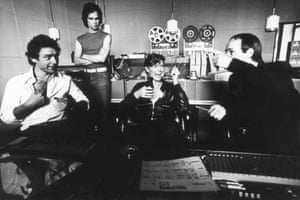
David Bowie at Hansa Tonstudio with Robert Fripp, left, and Brian Eno, right, in July 1977.
David Bowie in the studio at Hansa with Robert Fripp, left, and Brian Eno, right, in July 1977. Photograph: Christian Simonpietri/Sygma/Corbis
In the capital of reinvention, and in Coco’s care, Bowie began to edge away from cocaine psychosis, finding his way out of his life of excess, remaking himself as an ordinary man. He dressed in baggy trousers and dowdy shirts, and enjoyed the Berliners’ disinterest in him. No one bothered him on the street, unlike in star-struck LA. One night on a whim, he climbed onto a cabaret stage to perform a few Frank Sinatra songs. The local audience shrugged and asked him to step down. They had come to see a different act. Away from the limelight, he composed, painted and, for the first time in years, “felt a joy of life and a great feeling of release and healing”, as he put it.

He realised his goal was not simply to find a new way of making music, but rather to reinvent – or to come back to – himself. He no longer needed to adopt characters to sing his songs. He found the courage to throw away the props, costumes and stage sets.

By the summer of 1977, Bowie was on a creative high. With producer Tony Visconti and friend Brian Eno, he began to make a new album. Over long sessions in the studio, he ate almost nothing, sailing home to Hauptstraße with Eno at dawn, breaking a raw egg into his mouth, and sleeping a few hours before returning to the studio.
One of the first songs recorded that summer had been an instrumental track until, alone at the piano, Bowie began to sketch out some lyrics, eventually making it the title track and calling it “Heroes”. Visconti rigged up three microphones with electronic “gates”. The first mic was 20cm from Bowie, the second 6m away, the third 15m away across the vast, dark hall. The gates were set to open when Bowie sang above a certain volume, forcing him to gradually lift his voice from a whisper to a shout, using the room’s natural echo.

ADVERTISEMENT
As Visconti adjusted the levels, Bowie continued to write the lyrics, then asked to be left alone with his thoughts and the piano. Visconti slipped out and walked along Köthenerstraße to meet his lover. From the Hansa Sound Studio control room, Bowie saw them kiss, by the Wall.

Two hours later, the final lyric was recorded. “Heroes” became Berlin’s rock anthem, a droning, courageous wall of sound, fired with deep emotion, hammered by a clanging, metallic rhythm – produced in part by Visconti hitting a studio ashtray. Bowie called “Heroes”, and his three Berlin albums, his DNA. Time and again, it would be named one of pop’s greatest and most original singles.

Of course, there were moments of delicious madness both in Berlin and afterwards. At his 31st birthday party with Iggy and Eno, at the Lützower Lampe when the much-loved 60-year-old drag queen Viola was encouraged to sit on my knee and croon German love songs in my ear. Bowie went home with the only “real” girl in the place that night.
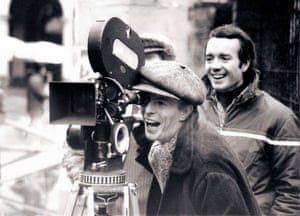
David Bowie with assistant director Rory MacLean filming Just a Gigolo in 1977.
David Bowie with assistant director Rory MacLean filming Just a Gigolo in 1977. Photograph: Emilio Lari
I had come to Berlin to work as the assistant director on Just a Gigolo, a film starring Bowie and Marlene Dietrich. As the only native English-speakers on the picture, we (Bowie, Coco, Hemmings and I) naturally gravitated toward each other. We spent many evenings together in Bowie’s Hauptstraße apartment. He would play records and demo tapes for us and others, explaining how musicians and groups come together then break up in the pursuit of creative goals, likening the process to the Die Brücke expressionists; the Beatles and John Lennon; Roxy Music and Brian Eno; Der Blaue Reiter group and Kandinsky. He introduced me to Brecht, spoke of “quadrants and quantum leaps, creation and process” – and even discussed the pitfalls of Warner Brothers’ $15m offer for a Ziggy Stardust rock musical.

“I am a generalist!” he told me one day on the set, meaning he was a Renaissance man, skilled in different fields and mediums. “Then why are you most associated with rock’n’roll?” I asked. “It is only a front,” he laughed.
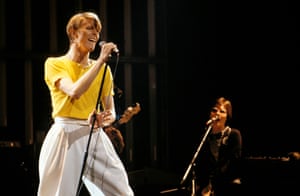
On the Isolar II tour in 1978.
 
Fast forward to Earls Court in London – the final venue of the European leg of the Isolar II tour. It’s June 1978 and 18,000 fans are whistling and wailing for the intermission to end. They clap their hands, stamp their feet and holler for Bowie to return. He has performed live for 1.5m people in 43 cities over the previous 14 weeks. Behind the stage, along a concrete corridor, their starman sits in silence, dressed in snakeskin drapecoat and huge baggy white trousers, watching Coronation Street. It’s his routine to catch an episode on video during the break: to let him get his breath, to occupy his mind but not engage it, to help him hold on to the stratospheric high from the concert’s first half.
In those few months in Berlin, Bowie made his journey from addiction to independence, from celebrity paranoia to radical, unmasked messenger who told us, all the fat-skinny people, all the nobody people, that we were beautiful, that we too could be ourselves.

Rory MacLean’s Berlin: Imagine a City is published by Weidenfeld and Nicolson

Tuesday, September 15, 2015

BE THE ONE – International German Olympics (IDO) 2016


It’s that time again! 

The International German Olympics are scheduled to take place from July 17 – 30, 2016 in Berlin.

The Goethe-Instituts in the USA and the Internationale Deutschlehrerverband (IDV) invite US high school students to participate in the two preliminary rounds and to qualify for the international final round in Berlin. The IDO is not just about competing for the title of the world’s best student of German, but also about experiencing and understanding other cultures.

Based on the motto BE THE ONE, the Goethe-Institut Chicago is searching for two “Olympic athletes“ to represent the USA in Berlin. They will prove their knowledge of the German language and culture in a competition with students from 50 different nations.

The two national preliminary rounds in the USA are based on two language levels:

- Level A2: Basic User
(2 years of German)

- Level B1/2: Independent User
(3-4 years of German)

(These classifications correspond to the levels of the Common European Framework of Reference for Languages (CEFR).

IDO Schedule of Events of the IDO:
National Preliminary Round (online, October 12 – 16, 2015)
The first preliminary round takes place online. German teachers can nominate up to four students (who speak German on an A2 or B1/B2 level, respectively) until October 5, 2015. The nominated students sign up online and will receive an access code for the Moodle page, where they will have to do a variety of exercises between October 12 and 16, 2015.

National Final Round (Chicago, December 4 and 5, 2015) 
The national final round for the 14 finalists will take place on December 4 and 5 at the Goethe-Institut Chicago. Students will complete to solve tasks in the style of an “Olympic pentathlon” that tests listening skills, reading skills, writing, creativity, and presentation. A cultural program including a visit to the Chicago Christkindlmarkt and a scavenger hunt in the German district are also planned. The two best “Olympic athletes” are chosen to represent the USA in the International German Olympics in Berlin in the summer of 2016.

International Final Round in Germany (Berlin, July 17 – 30, 2016) 

During the first week, the two “Olympic athletes” representing the USA will be trained in content and language in preparation for the competition. In the second week, they will compete in the tripartite competition: preparation of a poster, presentation, and quiz.

The prizes are scholarships for youth courses to Germany during the summer of 2017.

Teachers accompanying their students will participate in a seminar on various topics (e.g. didactics/methodology, regional studies) as well as in IDO events like the grand opening, presentations, and the awards ceremony.

The costs for travel and accommodations for the two participants as well as for one accompanying teacher are fully covered.

Timeline 

October 5, 2015
Deadline for Nominations to Participate in the National Preliminary Round USA 

October 6–11, 2015
Students are Receiving Access Codes for our Moodle Platform

October 12–16, 2015
National Preliminary Round: Online Exercises 

October 23, 2015
Notification to Schools about Participation in the National Final Round in Chicago 

December 4 and 5, 2015
National Final Round at the Goethe-Institut Chicago (14 students) 

July 17–30, 2016
International Final Round in Germany 

Conditions for Participation 
In order to participate, students must be at least 14 years old by July 17, 2016 and cannot be more than 19 years old by July 30, 2016.

For reasons of fairness, the following students will not be allowed to participate:

  1. students who have lived for more than six consecutive months in a German-speaking country,
  2. students from German schools abroad and from local private schools whose language of instruction is predominantly German,
  3. students who have already started their studies at a college or university, and
  4. native speakers.
Download SymbolNomination form (PDF)


Further information:
Anja Schmitt
Language Consultant
Mail Symbolanja.schmitt@chicago.goethe.org

Goethe-Institut Chicago
150 N Michigan Ave, Suite 200
Chicago IL 60601
Tel. +1- 312-263-0472
Fax +1- 312-263-0476

    Saturday, August 29, 2015

    10 things you should know before moving to Germany


    This autumn marks my four year Berliniversary—four years living in Germany. Oh mein Gott.
    Though I’ve lived abroad a few other times as a student and a “slow” traveler, this has been my first real experience living abroad.

    Without question, it’s been a learning experience and I’ve come away with a lot of great stories.
    Everything from the process of moving to a new country, embracing a new culture, learning a new language and a million other things.

    I never expected to live in Germany, but four years on, here I am.
    Here’s what I’ve learned along the way …

    Special thanks to Claire who has helped put together these fun illustrations.  Check out:  http://clairikine.blogspot.de/

    1. Learning German is Essential

    learn german language 620x401 
    Claire Webster

    While it might seem like a monumental task at the beginning, learning the language will make your life easier and way more fun while living in Germany. Sometimes you find yourself in a club and the guy on the dance floor next to you whispers in your ear. This is an instance when knowing German is helpful. (Trust me: this comes from personal experience!)

    Of course, the language is also important for finding jobs, getting visas, visiting all the Amts and dealing with the bureaucracy of living abroad. Even though people in bigger cities (hallo Berlin!) tend to speak English, it’s not always the case. Plus, a language that has a word like bitte which can be used for just about any situation, it’s really not that difficult to pick up essential words to know. It’ll help you get further in your expat experience.

    In every city across Germany you’ll find Volkshochschule which are local community schools which offer classes in everything from art & web design to language classes including German. Another good way is to attend language exchanges and meet-ups. The InterNations website organizes regular meet-ups in most major German cities, making it a good way to try out your language skills—plus meet other expats.

    2.  Germans Love Their Bikes (and So Should You!)

    Berlin 
    Getty Images/Sean GallupGermans are avid cyclists, and for a reason. The city infrastructure is usually built with cycling in mind, meaning bike lanes can be found almost everywhere.

    Germans are avid cyclists, and for a reason. The city infrastructure is usually built with cycling in mind, meaning bike lanes can be found almost everywhere. When moving to a new city, cycling is usually the best and the cheapest way to get to know your surroundings. Used bikes aren’t usually expensive, and several cities have bike-sharing services where you can use the public bikes for a small annual fee. Bonus: they’re emission free and will help to burn those extra calories from all the beer and sausages you stuff in your mouth.

    3.  Cash is King

    cash in Germany 
    Claire Webster

    Germans don't like debt. Businesses don't encourage debt. So do not ever assume that your card will work at any shop, restaurant or ticket machine. No matter if it’s credit or debit, German or international, much of the time it just won’t be accepted, and that's final. Many places don’t accept EC (electronic cash/debit) below a certain amount (usually 5€ or 10€).  -- Grocery stores are one of the few places I’ve found where credit cards are almost always accepted for any amount.

    4.  Electronic Music Is What You’ll Hear

    Germany is famous for its techno music scene. You might think it’s a stereotype, but I dare you to go out to a club in Berlin and not hear some form of electronic music. Even smaller clubs tend to have at least one night a week with techno, but really: it’s the bigger nightclubs that you’ll want to experience for electronic music. I don’t know why electronic music is so popular in Germany, but it is. Maybe it’s the country’s history, or the fact that so many of the world’s best techno DJs have come out of Germany (sorry, Bristol).

    Even if electronic music isn’t your thing, give it a chance. In the right club atmosphere, you’ll find yourself swept away by the beats and the crowds.

    5.  German Food is More Than Just Wurst & Bier

    Saying that, as an expat, at some point you’ll probably start to crave your favorite foods from back home. Luckily, Germany has a relatively diverse cuisine—more so than you might initially expect! Even if you can’t find your favorite international foods quite as easy, there are specialty food shops and international supermarkets (plus more than a few online services) to get what you might miss from home.

    In Germany, though, you’ll also find a lot of Italian and Turkish food options. American-style burgers are currently all the rage throughout the country, as is vegan & vegetarian food. And even when you’re craving German food in Germany, know that your options extend beyond sausages, beer and potatoes. Käsespätzle is a sort of mac & cheese perfect for the winter (or as a vegetarian option in most German restaurants) and the huge variety of meats make it easy to try new foods.

    6.  Fizzy Drinks Are Awesome

    I’m not 100% sure why, but Germans have a fixation with carbonated drinks. Water is always sparkling, unless otherwise specified. When you want to order water without the bubbles, ask for stilles Wasser (or Leitungswasser if you want it from the tap—but be warned they might not offer it to you for free!).

    I won’t lie—I didn’t like sparkling water or many fizzy drinks before moving to Germany, but now it’s a staple of most of my meals out. Germans don’t just make their water fizzy, though. It’s also in their beer. Beer in Germany is generally excellent, perhaps predictably. Even the smallest village seems to have their own brewery. And in the summer, nothing is better than a Radler (a mix of beer with lemonade) or even a Diesel (a mix of beer with cola). There are also a variety of hipster soft drinks of every stripe available. Try the German brand Fritz Kola, out of Hamburg but widely available in Germany (and even across Europe).

    7.  Everything Can Be Recycled

    recycling in germany ordnung 620x288Claire Webster

    Germans have a predilection for Ordnung, or order/discipline. And anyone who’s been to Germany will attest to the fact that everything can be organized—especially the trash. Glass bottles are separated by color. Organic waste goes in its own special bins. Paper and electronics are separated. Everything has its place. All the grocery stores have places to deposit bottles where you’ll get change back, ranging from 8 to 15 cents. In some cities, it’s quite common to leave beer bottles out on the sidewalk for the homeless and other bottle collectors to pick up.

    The longer you stay in Germany, the better you get at organizing things. It’s actually quite a comforting thing—knowing that your trash is going to be recycled. You will be a fan of green energy too, it is simply contagious: I am nuclear-free. Plus, wind turbines are an essential part of Germany’s landscape, and you will love to see them from your train or your bus while crossing the German countryside.

    8.  There’s a Place for Everything

    It’s not just your plastics and papers that can be sorted, but just about everything else in Germany has its own special place and rules. You might think the stereotype of German bureaucracy & paperwork is a myth, but it’s not. Rules are followed to the letter in Germany. There’s an Amt (office) for everything—from registering your address at the Bürgeramt to dealing with the Ordnungsamt.
    The rules go so far that even jaywalking is considered a serious offense. Trust me: try to cross an empty street when the Ampelmännchen is red. Just don’t tell people I told you to do it! (I have seen people screaming “children killer!” to someone who crosses the street with a red light, because in good German logic, children see you breaking the law and will follow your example.)

    9.  Social Media Will Always Help

    I don’t think I could’ve effectively made Germany my home without a network of friends, those people that had moved here around the same time, or those long-time locals who I was lucky enough to meet in my early days living here. Starting out in a new country, you usually don’t know many people in the beginning. I came to Berlin and knew no one.

    And while Germans can be a bit formal, it’s definitely possible to break through those tough exteriors. If you’re relatively social, using social media you should be able to connect with new people wherever you are in Germany. Facebook and meetups connect you to local events, and through them it’s easy to find out about cool things to do. I’ve also found it helpful to connect with other international people living in Germany—those that are in similar situations and probably have dealt with the same issues of bureaucracy. I couldn’t have made it here so long without a strong network of other expats. Free networking websites like InterNations make it pretty easy to connect—they’re one of the biggest expat communities worldwide and a good resource for asking questions. Sign up here for free and maybe see you at one of the many Berlin meet ups!

    10.  Get Comfortable in Your Birthday Suit

    There’s a stereotype about Germans and nudity (and a more free-spirited approach to sexuality—but that’s a different story!) and I can tell you after living in Berlin for four years, it’s definitely true. Nudity just isn’t an issue in Germany. That first summer when I went to a lake for a day of suntanning, the crowded beach was a bit of a shock: there was a lot of droop. Quite a shock for this American!

    But after that initial shock, I’ve come to realize the Germans really know what’s up. Nudity shouldn’t be an issue—when you separate clothing from sexuality, it’s actually incredibly liberating.
    * * *
    I can write lots of other stuff that you need to know before moving to Germany, from the (self-)imposed silence in public transportation to the surrealism of German television (and their weird taxes). I believe that Berlin made it easier for me to move here because the city is truly international. There are always lots of different people around. I sometimes dream of moving to a new city, a new country—somewhere like Barcelona or London, but I sincerely think I would miss Germany. Once you get in tune with the mood and the German-style, you can conquer the world (metaphorically, of course!).


    Tuesday, June 16, 2015

    BERLIN! I thought I knew you....

    Huffington Post

    9 Things You Didn't Know About Berlin

    Posted: 
    Street art on the remains of the Berlin Wall
    Graffiti art on the remains of the Berlin Wall
    As renowned for the harrowing events of World War II as for its ultra-modern reinvention as an arts and culture hub, Berlin is one of Europe's most celebrated capital cities, drawing millions of tourists each year. A city of vibrant contrasts, there's more to Berlin than meets the eye. To get you started on your journey of discovery, here are nine things you probably didn't know about Berlin.
    1. Berlin hasn't always been the capital
    Berlin only became the official capital of Germany in 1990 after the Berlin Wall fell and the country was reunified, but it also served as the capital between 1871 and 1945. Throughout the Cold War era, though, Germany was split into West and East Germany, with Bonn elected capital of the West and Berlin remaining capital of the East.
    2. The city's most popular tourist attraction no longer exists
    The notorious Berlin Wall that segregated East and West Berlin for over 30 years remains one of the city's most popular tourist attractions, despite the fact that the wall itself no longer exists. After being triumphantly torn down in 1989, only a few short stretches of the wall remain standing, most notably the 1.3-kilometer section known as the East Side Gallery and the Berlin Wall Memorial.
    3. Berlin is bigger than you think
    While the city is renowned for its iconic architecture and pioneering arts scene, Berlin's sheer size is the talking point among first-time visitors. Covering an incredible 892 square kilometers, Berlin is around nine times the size of Paris and falls second only to London as Europe's largest city by population. The city also has two main centers (thanks to its former East-West divide), 18 universities and colleges and one of Europe's tallest buildings -- the Berliner Fernsehturm, or Berlin TV Tower.
    4. Berlin has more canals than Amsterdam
    The sprawling metropolis of Berlin isn't generally thought of as a riverside city, but with over 180 kilometers of waterways within city limits, it easily outsizes the famous canal networks of Amsterdam and Venice. In fact, Berlin has more canals than any other city in the world, connected by a staggering 1,700 bridges. It's no surprise, then, that cruising the River Spree is one of the best ways to take in the sights, and the river is also dotted with beaches, bars and swimming spots throughout the summer months.
    5. Berlin has the world's largest Turkish population outside of Turkey
    If you're wondering why the döner kebab is so prevalent on the streets of Berlin, it's because the city allegedly houses the world's largest Turkish population outside of Istanbul -- many of whom moved to the city in the 1960s to take advantage of the shortage of post-war workers. Legend has it that the döner kebab (or at least a variety of it) was actually invented in Berlin, and you'll find an abundance of kebab stalls, Turkish pizza outlets and Turkish restaurants all around the city.
    6. 40% of Berlin is underground
    With underground railway networks, elaborate World War II bunkers, escape tunnels, sewers and brewery cellars, it's estimated that 40% of Berlin's structures are underground, making the city almost twice as big as it appears on the surface. Best of all, many of the underground bunkers built during WWII are now open to tour groups, including some of the secret tunnels used by the Nazi party. The vast living complexes that exist beneath the city include bedrooms, bathrooms and even a labor room for pregnant women.
    7. Berlin is a transport hub for Europe
    Berlin Central Station, which opened in 2006 with a dramatic opening ceremony, is the biggest train station in Europe and serves as a transport hub not only for Germany's extensive train network but for the rest of the continent. In addition to taking the train to national destinations like Hamburg, Cologne and Munich, you can travel directly to places like Novosibirsk in Russia or Astana in Kazakhstan. It's not only the station that ranks among the continent's largest buildings, either -- Berlin's KaDeWe (Kaufhaus des Westens) is Europe's biggest department store, covering over 60,000 square meters.
    8. Berlin's best art is on the streets
    While the world-famous Pergamon Museum and the Alte Nationalgalerie are Berlin's flagship art museums, some of the city's most iconic artworks can be found on the street; Berlin's vibrant street art forms a key part of its UNESCO City of Design status. The graffiti art adorning East Side Gallery and the "Pink Man" mural by artist BLU are among the city's most famous and striking works, but keep your eyes peeled as you'll find plenty of unexpected gems. Inspired to explore the rest of Berlin's art scene? The city also has an incredible 175 museums and galleries to satisfy all tastes.
    9. The world's largest cylindrical aquarium is in Berlin
    One of Berlin's most unique attractions is the AquaDom, a 25-meter-high glass cylinder that houses over 1,500 exotic fish -- the largest aquarium of its kind in the world, found in the city's Radisson Blu Hotel. The most spectacular attraction, though, is the hotel's elevator, which tunnels through the center, allowing visitors an incredible 360-degree panoramic view of the tropical water world.
    Contributed by Zoe Smith for Viator

    Tuesday, May 5, 2015

    Wie sieht Krieg aus?

    Here's what war looks like:

    Berlin, 1945.


    Amazing footage of the streets, including

    • few working cars
    • lots of Russian military
    • quite a few bikes
    • a building collapsing
    • a woman rescuing some fabrics from a bombed out 3rd floor dwelling
    • "Trummerfrauen" -- a bucket-brigade removing rubble
    • the famous Adlon Hotel among other ruins
    • Museum Island
    • the Straßenbahn is back (street car)
    • aerial shots at the end.  

    Footage is of remarkable quality.
    Thanks to Konstantin von zur Mühlen und Arne Körner of Chronos (Berlin TV) for editing and publishing.

    Tuesday, March 17, 2015

    Guardian Reports on Both Sides of Berlin


    Where you had no money worries
    Equal pay for equal work.
    For better or worse....the police had an eye on you ... you felt pretty safe...

    2 minutes:  You can never forget the past...


    The wall is open!


    Saturday, February 7, 2015

    Noë aus Berlin macht Ska-Musik

     Noë "Schleusenwärter"  (2010)    (Locksmith)


    "Sommer In Berlin" ist der erste Song unseres neuen Albums.  


    lyrics  Sommer In Berlin


    Der Regen fällt aufs Sonnendach
    Es hält ihn nicht auf -- Es ist dafür nicht gemacht.
    Du stehst drunter, wunderst dich
    So gründlich naß geworden bist du schon lange nicht.
    Naß stehen bleiben oder naß weitergehen     
    Ist die Frage die sich stellt
    Wenn man im Regen steht.

    CHOR:     Und du entscheidest dich
                      Für's stehenbleiben
                      Denn naß bist du eh schon,
                      Und das ist sicherlich
                      Nicht die schlechteste Entscheidung  
                      Die du heute gefällt hast --
                      Es ist Sommer in Berlin

    Der Regen fällt stundenlang
    Wenn du zum Himmel schaust wird dir ganz bang.
    Nur Verrückte springen jetzt noch freiwillig draußen rum.
    Du hättest gern was warmes zum anziehen,
    ein Paar trockene Schuh.
    Die Frage, die noch zu klären wär, auch verrückt sein
    oder weiter machen, wie bisher.

            Und du entscheidest dich
            Für's stehenbleiben
            Denn naß bist du eh schon,
            Und das ist sicherlich nicht
            Die schlechteste Entscheidung die du heute gefällt hast
            Es ist Sommer in Berlin

           Und all die andern Nassen warten auch unter ihren Dächern
           Das der Regen sich verzieht
           Und das ist sicherlich nicht die schlechteste Entscheidung
           Die sie heute gefällt haben
           Es ist Sommer in Berlin

    Das Sonnendach hängt zerfetzt
    Wasser steht dir bis zum Knie
    langsam zweifelst du an deiner Strategie
    Auch werden ab und an Passanten angetrieben
    Regenschirme treiben durch die Straßen

    Du bleibst beim stehenbleiben
    Denn naß bist du eh schon
    Und das ist sicherlich nicht
    Die schlechteste Entscheidung die du heute gefällt hast
    Es ist Sommer in Berlin
    Und all die andern Nassen warten auch unter ihren Dächern
    Das der Regen sich verzieht
    Und das ist sicherlich nicht die schlechteste Entscheidung
    Die sie heute gefällt haben
    Es ist Sommer in Berlin

    Monday, January 19, 2015

    Die Bücherverbrennung in Berlin

    10. Mai 1933:  Goebbels Feuerrede  (Fire-Chat, or Discourse)
    Das war vor 80 Jahren.  Hier ist ein Denkmal davon.


    Sunday, November 30, 2014

    New Yorker Profiles Germany's Chancellor, Angela Merkel

    THIS "PROFILE" IS LONG!   THERE ARE MANY GEMS THOUGH.  GOOD LUCK!

    A summer afternoon at the Reichstag. Soft Berlin light filters down through the great glass dome, past tourists ascending the spiral ramp, and into the main hall of parliament. Half the members’ seats are empty. At the lectern, a short, slightly hunched figure in a fuchsia jacket, black slacks, and a helmet of no-color hair is reading a speech from a binder. Angela Merkel, the Chancellor of the Federal Republic of Germany and the world’s most powerful woman, is making every effort not to be interesting.

    ...... Paragraph 1 of many!  
    Find out details of Angela's youth as an award - winning Russian speaker growing up in Brandenburg.  Learn what she thought of  rebellious West Germans in the '60's (The Baader Meinhof Gruppe) and of Americans.  Read about her initially cold relationship with Obama, which has warmed considerably -- even while he's grown far less popular.  Yes, there are clues to her private life.  There is discussion of Germany's history and politics (including fascinating details about the destruction and rebuilding of the amazing parliament building, the Reichstag).  We also learn how incredulous Germans initially were to hand their nation's government over to her.  And how she's quietly relishing the country's stability now, which has fueled her popularity, while her opponents find she's made of Teflon.
    Might she run for a 4th term? Certainly her success cannot last.  -- Right?  
     

    Tuesday, November 18, 2014

    Das geteilte Land: Die Zeit

    The German Newspaper, The Times shares statistics comparing the two former Germanys to each other in various ways.

    LOTS OF RESEARCH WENT INTO THIS MONTAGE!

    Among the statistics shared are current differences in
    • Income
    • How many boys were named "Ronny"
    • Percentage of agrarian land
    • Birth rates
    • Average age
    • Favored travel destinations
    • Flu shots per capita
    • Number of pro and semi-pro soccer teams 
    • Linguistic comparison of their word for "stapler"
    • Types of household appliances
    The mini-film shown on this site is also recommended!  Enjoy!  --rsb

    Monday, November 17, 2014

    Easy German Berlin am 9. November 2014


    Super footage!

    Don't miss:  The South Korean woman who recognized our reporter in the last seconds!

    Saturday, November 8, 2014

    9. November: Only 1 more day left in Berlin's lighted balloon celebration

    9. NOVEMBER BERLIN NACH 25 JAHREN:  CELEBRATE ALONG WITH THE PEOPLE OF BERLIN!

    Welches ist dein Lieblingsfoto?  Which of the above photos is your favorite? 

    Deutsche Welle published the photo below to accompany an article about the weekend celebration in Berlin.  The tourist board reported that there were over a million participants.  Some of the day's highlights were:
    • The opening of a new museum chronicling the lives of some of those caught up in fleeing this wall, including a two-and-a-half hour visit by Chancellor, Angela Merkel.
    • Beethoven's "Ode to Joy" (which has become the European Union's anthem)
    • The release of those 7000 white helium-filled balloons which lined much of the old wall. 
    •  Fireworks and Light Show


    Friday, November 7, 2014

    Interactive BEFORE / AFTER Photos of the Berlin Wall

    While initially you can see half of each comparison-photo, it's easy and so cool to pull the middle arrows across to view the whole photo of those you're especially interested in.

    HIER: DANKE, MORGENPOST!

    Saturday, November 1, 2014

    Wednesday, September 17, 2014

    High Hoon, a short film project from Theres Knuth

    Theres aus GAPP 2010-11 hat uns heute in der Schule besucht.  Dieser Film hat ihr geholfen in Berlin in der DEKRA Hochschule und Filmakademie studieren zu duerfen.

    Er wurde suedlich von Dueren, in Heimbach, gedreht.


    Was bedeutet der Titel?

    Was hat Theres mit dem Film zu tun?