Showing posts with label Universitaet. Show all posts

Thursday, April 7, 2016

Top 5 German Universities per Major

Yup:  StepIntoGerman has published this in Spanish!  I'm editing it here.

Administrative Careers - Economics 

 
Economía
 
  1. Uni Bayreuth
  2. Uni Mannheim
  3. Uni Augsburg
  4. Uni Bamberg
  5. Uni Düsseldorf
 

Administratión

 
administracion

  1. Uni Bayreuth
  2. EBS Universität
  3. Katholische Universität WFI / Ingolstadt
  4. Frankfurt School
  5. Europa-uni Frankfurt O.

 Engineering sciences

 
ingenieria
 
TU = Technical University

 Ambiental  Engineering

  1. Uni Bochum
  2. TU Darmstadt
  3. Uni Kassel
  4. TU München
  5. RWTH Aachen
 

 Electrónic Engineering

  1. TU Dresden
  2. Uni Hannover
  3. TU Ilmenau
  4. Uni BW München
  5. Uni Paderbon

 Civil Engineering

  1. TU Braunschweig
  2. TU Dresden
  3. Uni BW München
  4. RWTH Aachen
  5. TU Berlin

Industrial Engineering

  1. RWTH Aachen
  2. Uni Augsburg
  3. Uni Bazreuth
  4. TU Clausthal
  5. Uni Duisburg-Essen
 

Ingeniería Química Engineering

  1. TU Dortmund
  2. Karlsruher Institut für Technologie KIT
  3. Uni Erl.-Nürnberg/Erlangen
  4. TU Kaiserslautern
  5. Uni Paderborn

Ingeniería Mecánica

  1. TU Darmstadt
  2. TU Bergakademie Freiberg
  3. TU Ilmenau
  4. Karlsruher Institut für Technologie KIT
  5. RWTH Aachen

Ciencias de la Computación

ingenieria
 
  1. RWTH Aachen
  2. Uni Augsburg
  3. Jacobs Univ. Bremen
  4. TU Darmstadt
  5. Uni Heidelberg

Geography

geografia

 
  1. Uni Bonn
  2. Katholische Universität/Eichstätt
  3. Uni Frankfurt a.M.
  4. Uni Gießen
  5. Uni Göttingen

Architecture

 Arquitectura
  1. RWTH Aachen
  2. Alanus HS
  3. Uni Hannover
  4. TU München
  5. ABK Stuttgart

Social Sciences; Humanities and Languages 

 
ciencias sociales
 

History

  1. HU Berlin
  2. TU Braunschweig
  3. Uni Bremen
  4. Uni Düsseldorf
  5. Uni Gießen

 Polítical Science

  1. Uni Bamberg
  2. Jacobs Univ. Bremen
  3. Uni BW Hamburg
  4. Uni Heidelberg
  5. Uni Konstanz

Psychology

  1. Uni Bamberg
  2. Uni Bielefeld
  3. Jacobs Univ. Bremen
  4. TU Chemnitz
  5. TU Dresden

Educatión

  1. FU Berlin
  2. Uni Bielefeld
  3. Uni Bochum
  4. Uni Halle-Wittenberg
  5. Karlsruher Inst. für Technologie KIT

Law

 
leyes
  1. Uni Bayreuth
  2. Uni Düsseldorf
  3. Europa-Uni Frankfurt
  4. Uni Göttingen
  5. Uni Greifswald

Communicatión and the Media 

comunicacion
 
  1. Uni Bayreuth
  2. Uni Bochum
  3. Uni Düsseldorf
  4. Uni Duisburg-Essen
  5. Uni Konstanz

Germanístics

germanistica
  1. Uni Ausburg
  2. Katholische Universität/Eichstätt
  3. Uni Heidelberg
  4. Uni Kassel
  5. Uni Kiel

Medical Sciences

 
medicina
 
Medicine 
  1. RWTH Aachen
  2. Uni Heidelberg
  3. Uni Lübeck
  4. TU München
  5. Uni Münster

Bioengineering

  1. Uni Bayreuth
  2. Jacobs Univ. Bremen
  3. TU Dortmund
  4. Uni Erl.-Nürnberg/Erlangen
  5. Uni Hannover 

Pharmacy 

  1. Uni Frankfurt a.M.
  2. Uni Freiburg
  3. Uni Kiel
  4. Uni Marburg
  5. TU Braunschweig
Odontología
  1. Uni Greifswald
  2. Uni Halle-Wüttenberg
  3. Uni Witten/Herdecke
  4. Uni Göttingen
  5. Uni Mainz

General Medicine

  1. HS Osnabrück

  2. HS Gesundheit
  3. EvHS Darmstadt
  4. EvHS Dresden
  5. HS Esslingen

  6. These are "Hochschulen" -- not to be confused with the USA High School.  For HS in Germany the word "Oberschule" is used.

Wednesday, February 17, 2016

Why American Students Are Flocking to Germany — and Staying


BONN, Germany — How do you say "sign me up" in German?

The number of Americans studying in Germany has risen sharply, recent figures show, driven in part by the low cost of higher education compared to the United States.
More than 10,000 U.S. students are presently enrolled in the country's higher education programs, according to data from the Institute for International Education. It's an increase of almost 9 percent compared to the previous academic year, and 25 percent more than in 2008-2009.
Natasha Turner, 25, from Rochester, New York, came to Germany on an exchange program three years ago but decided to stay when she realized how "cheap it was to study here." 
 
She is now working on her master's degree in American Studies at the University of Bonn.
"For my undergraduate studies in the United States, I needed a lot of loans," she said. "After my studies in Germany I essentially finish with no loans at all."
Students in Germany pay a fee to cover university administrative costs and to support student unions. This "semester fee" rarely exceeds $250, and in many cases it also covers the cost of books and public transportation.

Minnesotan Sarah Johnson, also a University of Bonn master's student, has a total monthly expenditure of $600 in Germany — or $7,200 per year. That compares to $20-30,000 dollars in tuition fees alone she would have paid back home.

It "makes all the difference" to Johnson, 25, who does not get any financial support or scholarship and has a part-time job as a hotel receptionist. Besides having the advantage of learning a foreign language and a different culture, "the system is very easy to pay for," she said.
However, officials say the attraction is not just about the money.

"Germany and its universities have quite a good reputation in the United States," said Dorothea Rueland, Secretary General of the German Academic Exchange Service. "And we have a huge increase in courses taught in English and this obviously makes it easier for American students to channel into the German system."

More than 1,100 all-English-language classes across numerous fields have been established in recent years.

Berlin, with its three universities, is among the most popular destinations with more than 1,000 American students, followed by universities in the southern German state of Baden-Wuerttemberg, which have enjoyed official tie-ups with U.S. colleges for many years.
In the U.S., fees for tuition at public and private higher education facilities have risen significantly in recent decades.

The cost of Germany's essentially free public university education is met by the federal states and the central government. In 2015, state expenditure on higher education accounted for almost one percent of Germany's gross domestic product.
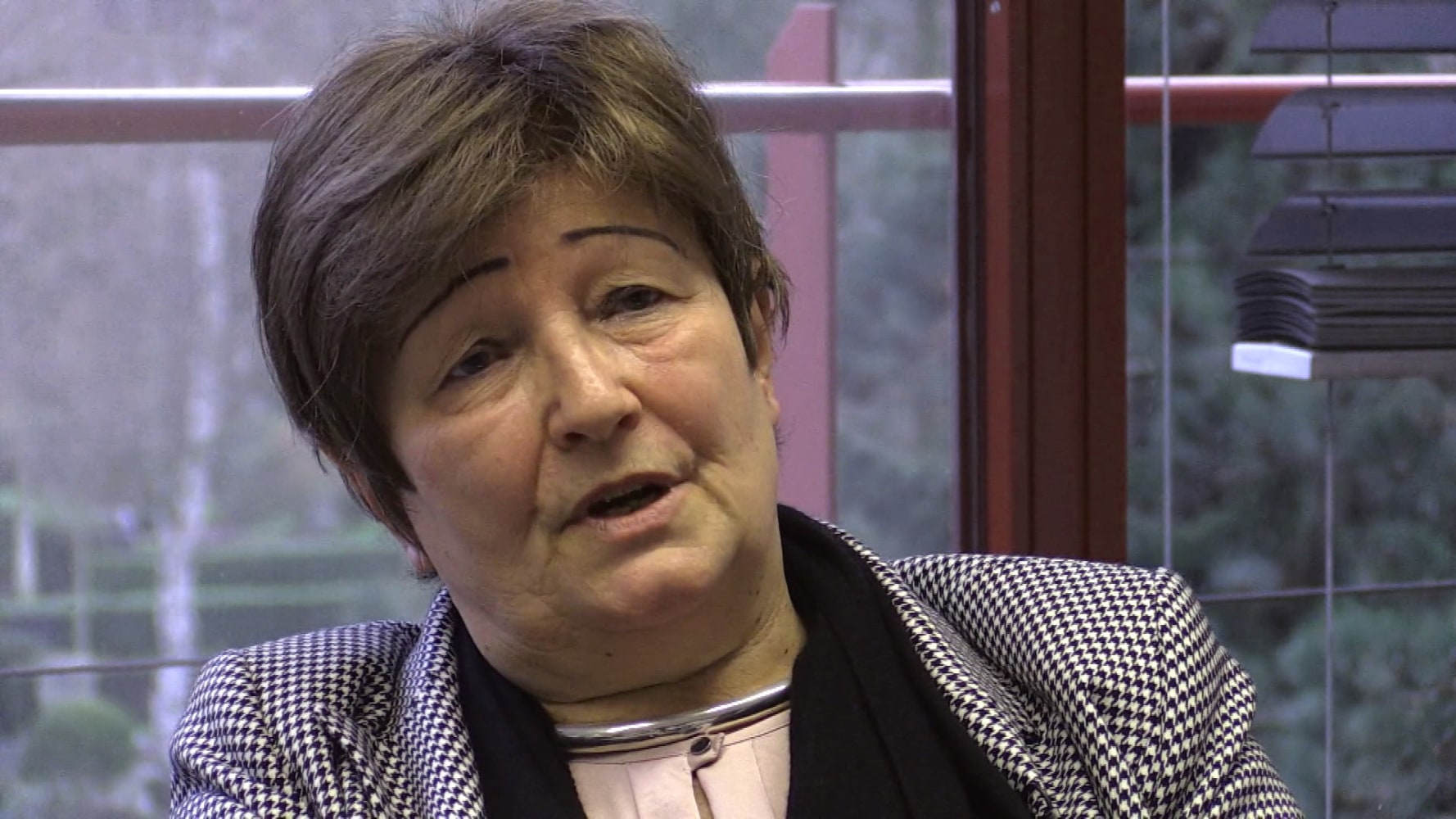
Image: Dorothea Rueland, secretary general of the German Academic Exchange Service (DAAD)
Dorothea Rueland, secretary general of the German Academic Exchange Service (DAAD) NBC News  "It's a common understanding in Germany that higher education is a public good."
A two-year master's program costs the government about $18,000 per student, while an enrollment for a bachelor's degree adds up to more than $30,000. A full degree program for medical students poses the highest burden for the German taxpayer, with total costs of more than $220,000 per student.
However, it still is "a win-win situation for Germany," Rueland said, because nearly 50 percent of all visitors from abroad remain in the country after their degree, paying taxes and providing the labor market with skilled workers.

That includes many American students, who view Germany as an attractive workplace.
"The longer I have been here, the more difficult it is to think of leaving," Johnson said.

Saturday, January 23, 2016

Information about Attending a German University

There are different requirements at every Uni.  I've put together a list of helpful websites
at http://www.gai-mn.org/studying-in-germany - and particularly recommend those under
the "General Requirements" and "Applying" sections.  They're really rather comprehensive.

In general, a high school diploma is not considered equivalent to an Abitur; American
students will need proof that they're competent enough to skip the "gen eds," and go
straight into the major-focused track.  This can be done with a significant number of AP
credits, a year or two of college, possibly high enough test scores.  Each University
should also have a Studienkolleg attached to help you complete your gen eds or attain a
sufficient enough level of German, after you have been "accepted" on a provisional basis.

As alluded to above, the requirements to get accepted to a Uni are different from the
Visa requirements.  For that, you need the money in your bank account (!).  You
will be able to find specific info on the German Embassy's site.

Good luck!  And if anyone has any other specific sites to share, please let me know.
This is such a common question these days, and I would love to expand our resources on
the GAI's webpage.

Mit freundlichen Grüßen
Anne Grossardt
Director of Language Services
agrossardt@gai-mn.org
Tel: 651-222-2979  Fax: 651-222-6295

NOTE:  GAI = German Academic Institute (I believe)

MORE Advice:  The first stop for foreign students at most universities is the Akademisches
Auslandsamt or Internationales Buero. Google those together with the university name, you should land at the right place for information.


MORE on international opportunities from Eckhard Kuhn-Osius --German Department  --Hunter College, CUNY:  
There are some social service opportunities in Germany. One could look into a “Freiwilliges soziales Jahr” or “Freiwilliges oekologisches Jahr,” which would offer an official status of some sort -- (without needing to attend school).

Saturday, February 14, 2015

Tuesday, February 10, 2015

Drive to double study abroad turns to schoolteachers

UNIVERSITY WORLD NEWS  Febr 10, 2015
UNITED STATES

Monday, October 27, 2014

URI's IEP ist SUPER!

My name is Katie Topp and I have been studying Anthropology and German at the University of Rhode Island. I have just got home from a year abroad in Germany as a guest student of the International Engineering Program (IEP). I would love to visit your junior level and possibly the senior level classes to speak briefly to your students about the great opportunities this program provides.

The following link is to the IEP website: http://www.uri.edu/iep/. In brief, the IEP is a 5 year, dual degree program during which the student studies a language of choice (Chinese, Spanish, French, German, Italian) in conjunction with an engineering discipline.

In the fourth year of study, the student spends the year abroad- the first six months are spent studying at a partner university, the following six months are spent doing an internship with a reputable company in your language of choice.

For the seniors, I would like to meet before December first, since that is the application due date for engineers at URI. For the juniors, Spring semester would be easier for everyone.

We would love to show the amazing students of North Kingstown the opportunities that the IEP program can give to them.

Please share this email with whom you believe may be interested in my visit, as I would like to tell as many students as possible about the IEP!

Thank you and best regards,

Katie Topp
North Kingstown Resident and Student of URI

Thursday, October 16, 2014

Tuition Free: GERMANY!


Where to get a free college degree


Want to attend college for free? It can happen if you learn German.
All German universities are now free to Americans and all other international students. The last German state to charge tuition at its universities struck down the fees this week.
Even before Germany abolished college tuition for all students, the price was a steal. Typically semester fees were around $630. What's more, German students receive many perks including discounts for food, clothing and events, as well as inexpensive or even free transportation.
In explaining why Germany made this move, Dorothee Stapelfeldt, a Hamburg senator, called tuition fees "unjust" and added that "they discourage young people who do not have a traditional academic family background from taking up study. It is a core task of politics to ensure that young women and men can study with a high quality standard free of charge in Germany."
Actually, German universities were free up until 2006 when they started charging tuition. That triggered such a crush of criticism that German states began phasing out this policy. Lower Saxony was the last holdout.
It's too bad that politicians in the U.S. don't feel that a college education is worth supporting appropriately. State aid to the nation's public universities took a nosedive during the 2008 recession and education funding remains well below those levels. The average state is spending 23 percent less per student than before the recession, according to a report by the Center on Budget and Policy Priorities.
Actually, state support has been declining for public universities for a quarter of a century. Using an interactive tool from The Chronicle of Higher Education, you can see how state government subsidies have cratered at individual institutions.
With the average undergrad borrower now leaving school with more than $29,000 in debt, the free ride in Germany can look awfully tempting.
How to handle the language barrier
German is not an easy language to learn. Fortunately, however, there are international language programs in Germany, which have become very popular with international students before they tackle obtaining a degree in a different language.
What's more, an increasing number of German universities are offering degrees in English. These are often called international studies programs or in some other way have the word international in their title.

Comments


COVERTOOM 
There are some things to consider when seriously thinking about a German University degree. Does this mean if I go to a German University I can then work in the European Union? There are some differences in the educational systems of the United States and Germany. There are three types of high schools in Germany. Their University bound high school teaches the equivalent of the first two years of University in the United States. Most German Universities don't offer bachelor degrees. Their degrees are the equivalent of a masters degree. If you cannot work in the European Union, then upon return to the United States, someone from this country must put an equivalency to your German education. Most Americans don't know what they are looking at and will assume you don't have the equivalent of a bachelors degree because no general requirements are taught at German University. General requirements are taught at their University bound High School. To get a fair assessment, you should take your degree to someone who has experience in both educational systems. Then it takes a minimum of two years to really learn a language. Dive in, go to Germany and live the culture. Immerse yourself. If you can work in the EU, you'll work about 40 hours a week even if you are a manager. Over 40 means overtime for managers too. Then there is at least two or three holidays a month in which everyone is off. You'll start off with either 5 or 6 weeks vacation a year. Good Luck.


ÅNGSTRÖM 
As an American who just completed her MSc. in physics at Uni Stuttgart, a few pointers.
1.) Gaining fluency in German is not an option. It is mandatory for living in the country for several years. More master's degree have English options. Still be prepared to speak, read and learn in German.
2.) Attend university in America for your bachelors, double major in German and whatever it is you want to study (for me it was physics)
3.) Don't plan on doing a bachelors degree in Germany, all bachelor programs have lectures in German. Attend a cheap university back in the states (like San Diego State) and study abroad for the maximum of 2 years. You can then study abroad in Germany and attend relevant courses to your major in German to know for sure whether or not the move is right for you. German universities are academically more challenging than American ones. A's (1's & 1,3's) aren't common. Most courses have one grade, one chance to pass, the final exam.
I have spent nearly five years in Germany now and am happier and healthy then the first 20 years of my life in San Diego.
More information about studying in Germany can be found at the DAAD[.]org or you contact your local DAAD young ambassador with specific questions. 


SEBASCHOEBEL 
Dear American friends,
as a German I'd just like to say: PLEASE don't all send you kids our way! Or at least don't send them to the bigger cities like Berlin, Munich or Hamburg. There are literally NO APARTMENTS left to rent and the state universities are bursting at the seams. Besides, judging from the fellows you keep sending already, they are NOT here to study (unless bar hopping is a major in the States, which sounds frighteningly possible). If you HAVE to pick a German university for your kid(s), look for smaller schools in the lesser known cities. BTU Senftenberg, University of Braunschweig, etc. 
Oh, and btw: There is an election coming up in your country. And if you like free (or at least affordable) education, decided to make THAT a priority instead of gun ownership, curtailing women's reproductive rights, a childish obsession with lower taxes (for rich folks) or limiting the ability for non-white people to vote and VOTE FOR ANY PARTY THAT DOES NOT HAVE AN ELEPHANT IN ITS LOGO!!!
Thank you.


MARIA LOPEZ VEGA 
This is where we should be focusing our taxpayers' dollars. Instead, we are hell-bent on destroying peoples and countries with our military might. $500,000,000 in military support to destabilize yet another country (Syria) may sound good politically, yet that amount would pay for a lot of tuition, books and housing for students. We are sending $500,000,000 to aid the gun deaths in Syria while our own FEMA has refused to allocate one dime to rebuilding our own citizens' homes destroyed by wildfires in Washington and other states. Shame on our politicians! 


IAMTHESHERM 
@Maria Lopez Vega Many, if not most Germans, do not go to a college like the US.  They have many technical apprenticeships and vocational schools that the US has moved away from.  If Germany tried to give everyone a free education in an American-style education system, they'd be bankrupt in a month.  


LINDAG20 
Those sneaky Germans, educating their children. No wonder they are so productive.


QUE 84 
What an outstanding effort by the German people to educate and produce productive citizens. America would be smart to rebuke the class system and cut down on violence and incarceration by giving their citizens a chance to make the country better by educating the masses.  No wonder the Germans are the top industrialized country in the world and their engineers are supreme. Sad that racism and profits come first instead of building a strong foundation for the future of a great nation.
MH  Be careful!
Remember you can "study" all you want in Germany but if you don't stay for the exams, you may have nothing but your knowledge to show for it.  Without a Burser's Office, no one but you holds your "transcript".  Many don't give the American "credits" that easily push our university students from step 1 to step 2, and after a certain number of credits, hand them a degree. In those cases, it is you who decides when you have learned enough to set in motion the procedure to take your exams. 
I had a good friend who studied in Germany and didn't pass the aeronautical exam at the end.  It was particularly exclusive, perhaps because they didn't need a lot of these engineers that year.  At any rate, while he clearly learned a lot in Germany, he had nothing concrete to show for 6 years of study.  (He came to America and got some credits transferred at a University here, finished his degree here and went on to get an MA, then started his own international business  .... and made millions.) 
 ECKHARD      As a result of the "Bologna process,"
all university systems who joined (29 European governments) now award BAs and MAs and count progress in ECTS credit units (European Transfer Credit System). The system is somewhat complicated
because in Germany people taking the same class may earn different credits, depending on the work they do for the class (attend and take test, write and submit a "Protokoll", write a research paper). The standard amount of ECTS points is 30 per semester, so a typical ECTS point is 'worth' about half a credit in the US. One of the attractions of the system was to avoid situations like the one Maureen wrote about above, where you have nothing to show if you don't pass your "Examen".

Generally speaking, the time towards the BA has become pretty tough with lots of classes and exams, and you are not admitted to the MA level if you do not reach a certain grade point average. The results is that, whereas many German students used to take in lectures from a variety of German universities over the course of their studies, they are now a lot less mobile.  Why?  While theoretically their foreign credits transfer easily, in practice their course of study is so tightly organized that many don't feel they can afford to leave their university lest they miss a specialized class at their university.

FYI:  Study for many government jobs (such as teaching) still presupposes a Staatsexamen, which has not really "succumbed" to the BA/MA structure.