Oder?? von Silbermond (gecovert? Ich denke nicht.)
Arme Kevin, am Ende!
Songtext
Ein Auto fährt 210
Die Polizei hat's nicht gesehn
Schon Kinder werden kriminell
Und fielen Bomben auf die Welt, er wär
--Nicht mein Problem
Eon macht Millionen Profit
Und schickt die Kündigung gleich mit
Der Boss macht Urlaub auf Hawaii
während die BVG hier streikt
Das ist mir viel zu unbequem
Und auch überhaupt nicht mein Problem
Gibt's Korruption im Komitee
Ganz Deutschland wählt die NPD
Die Taschen voll die Börsen leer
Selbst wenn Stoiber Bundeskanzler wär , -- wär das
Nicht mein Problem
Der nächste Park wird weggeknickt
Für die Filiale von McFit
In der Sahara Skilanglauf
Am Nordpol macht ein Freibad auf
Ist auch nicht mein Problem
Das ist mir viel zu unbequem
Und auch überhaupt nicht mein Problem
Kevin ist ein Einzelkind
Vater im Knast die Mutter trinkt
Kevin schlägt Leute ohne Grund
Kevin wiegt 300 Pfund
Na und nicht mein Problem
WM in eigenen Land verloren
Brunsbüttel fliegt uns um die Ohren
Die Welt schlägt sich die Köpfe ein
Die letzte Zeile reimt sich nicht
Na und nicht mein Problem
Das ist mir viel zu unbequem
Und auch überhaupt nicht mein Problem
Showing posts with label economics. Show all posts
Showing posts with label economics. Show all posts
Wednesday, November 11, 2015

Saturday, October 3, 2015
25 Years: UNITY October 3, 2015
THE BPB LINK: BundesZentrale für Politische Bildung
Find the film 2/3 of the way down on Left, which sums up the progress in assimilating the East with the West.
Find the film 2/3 of the way down on Left, which sums up the progress in assimilating the East with the West.
Thursday, September 24, 2015
World’s Football Price Index -- See why thousands of Brits travel to Germany every week
Calculating cost of attending top division games in 25 countries around the world

Wed 23rd Sep 2015 | Money & Finance FC BUSINESS online
With Premier League matches well underway, GoEuro.co.uk,
the search engine for comparing flights, coach and rail travel options
across Europe, has partnered with Onefootball to calculate the cost of
attending the top division games in 25 countries around the world.
Utilising several world rankings including UEFA, FIFA, and third party databases, GoEuro.co.uk and Onefootball found the best value leagues for Brits to travel to, based on the quality of the league and the cost of the ticket is Germany, followed by Spain, Portugal and finally England.
Naren Shaam, CEO of GoEuro said: "It costs almost the same to travel to Germany to see a Bundesliga match as it does to stay in the UK and attend a Premier League game. Each week more than 2,000 British fans travel to see Borussia Dortmund play, in addition to the 1,500 Brits travelling to St. Pauli games in Hamburg and the 1,000 Brits going to Union Berlin games on a weekly basis. These numbers might lead you to question whether home fans in the UK are really getting a fair deal for their money.''

Average ticket price was calculated using an average of first division game tickets for multiple stadiums and seat types across a standard football season.
*While it did not factor on the value ranking, we calculated away game costs for informational purposes, specifically for travelling football fans. The away game cost is intended to represent the actual cost of attending an away game in each league's country. Factors included transport costs (using data from the GoEuro Transport Price Index), one nights accommodation costs (using data from the GoEuro Accommodation Price Index), and food and beer costs (using data from The Economist's Big Mac Index and the GoEuro Beer Price Index).
Each league's ranking was determined by combining several world football rankings including UEFA, FIFA, and third party databases.
We use the 'value score' field to determine where you get the best value football for the money you're spending to see a game. The score is the result of a calculation combining average game costs and the league ranking. Teams with a better league ranking or a lower cost of a ticket will have more value. Formula = 10000/(TicketPrice*(3+LeagueRanking)^2)
Posted by: Kev Howland
Sunday, June 15, 2014
Was Bill Gates getwittert hat, ist kaum zu glauben
Es macht sehr nachdenklich
In atemberaubender Geschwindigkeit (In breathtaking speed) holt das Land zu den westlichen Staaten auf -
das wussten wir schon lange.
(We've known that for a long time.)
Welche Dimensionen das Wachstum hat,
(Which dimensions this growth has,)
macht aber erst ein Tweet so richtig klar, den Bill Gates nun absetzte:
"China hat in den vergangenen drei Jahren mehr Zement verbraucht als die USA im gesamten 20. Jahrhundert."

Seit 2011 hat China also genau soviel gebaut wie das mächtigste Land der Welt in 100 Jahren?
Das ist kaum zu glauben, aber wahr.
(That is hard to believe, but true.)
Die Zahlen stammen aus dem neuen Buch des Historikers Vaclav Smil: "Making the Modern World: Materials and Dematerialization".
Für Smil ist Beton (cement) das wichtigste Material, das der Mensch herstellt.
Er ist ein Indikator für Wohlstand und Wachstum.
("Cement" is an economic indicator of wealth and growth.)
Aber auch dafür, wie sehr der Menschen die Ressourcen der Erde für den Fortschritt ausbeutet.
Tuesday, June 10, 2014
Time Mag: Learn a Language and Earn MORE
Want to Boost Your Salary? Try Learning German

From TIME Magazine; section: MONEY
Fluency in foreign tongues may increase your job options — and your pay. Interpreters and translators are among the top five fastest growing occupations
The rewards of learning other tongues are many: more potential friends, easier travel, and even, some studies suggest, better decision-making. But what about greater earnings potential?
Research from Wharton and LECG Europe found that studying a second language is correlated with about 2% more in annual income.
That’s a pretty low return, on the face of it—and probably not even as good as the minuscule raise your boss gave you this year. As study author Albert Saiz points out in a recent Freakonomics podcast, for someone making $30,000 annually, 2% amounts to only about $600 more per year. But Robert Lane Greene at The Economist shows that once you factor in compounding, a foreign language could mean nearly $70,000 more in savings by retirement. Put that way, it’s not too shabby.
Of course, broad correlations aren’t so helpful if you’re looking for a concrete pay bump in the real world. But there are many specific cases where a second (or third) language could increase your job opportunities and income.
For example, interpreters and translators are among the top five fastest growing occupations, according to the Bureau of Labor Statistics, with opportunities expected to increase by 46% between 2012 and 2022. And for those who dream of being a real-life Jason Bourne, the C.I.A. loves polyglots.
When it comes to money, members of the U.S. military can earn up to $1,000 more per month if they are proficient in multiple languages.
A foreign language can also amp up your desirability—and therefore your pay—in business or law, particularly if you speak Chinese or Japanese, says Charles Volkert, executive director of the legal department of staffing agency Robert Half. Recently, 42% of employers at top law firms surveyed by Volkert’s team saw an increase in legal jobs requiring a second language.
“With so few qualified candidates, there’s a huge demand for professionals who can speak Asian languages, particularly at globalized auto and tech companies,” says Volkert.
If learning a whole new alphabet sounds intimidating, there is good news: Saiz’s study found that the pay premium for learning German was higher than the average, at 4%. And if you, say, want to test drive Deutsch before committing to a costly class—some top programs charge thousands of dollars to get you proficient—there are plenty of ways to learn beginner language skills for free.
Duolingo, for example, starts off by teaching you to read, write, and speak basic phrases like “Ich bin ein Junge,” then ramps up difficulty—while giving you opportunities to compete with Facebook friends who are also learning languages. Next stop might be one of the BBC’s well-reviewed free online courses. After that, you might want to shell out—either for Berlitz or plane tickets. ---KOMM MIT UNS, mit GAPP! -- rsb
Friday, May 23, 2014
US Dollar? Gold? Russian Ruble?
WARNING from Max Keiser on IN THE NOW (program)
-- Once the US Dollar loses it's value, our energy costs will triple.
-- US fracking industry has been overestimated by 96%..
-- US oil policy has been to BOMB ... to secure the world's oil supply.
What's the US recourse? "Nothing." We'll just have to "pass the baton." "We're done."
MORE ON THIS TOPIC, from OpEdNews Op Eds

Chinese President Xi Jinping shakes hands with his Russian counterpart Vladimir Putin after approving a joint declaration.
(image by The Presidential Press and Information Office)
http://rt.com rt.com is Russian television, which actually does a great job reporting on US news too.
PR: I would think so. I mean all countries need energy and all countries are getting tired of Western bullying. Western machinations, the air of superiority over the world that Washington has. It was not long ago that President Obama declared that the US was the exceptional country. That means we come first, you are second. Other people do not like thinking of themselves as second class, so I think that this is the beginning of transformation that has been long implicit in the organization known as BRICS. That is starting to form up and be a real thing.
RT: Do you think there's genuine concern from the West over growing ties between Russia and China?
PR: Yes, there is very much concern. The American foreign policy doctrine calls Washington to prevent the rise of other global powers. So now it is confronted not just with two rising global powers, but these two powers have a mutual alliance and both understand that Washington is surrounding them with military bases. Washington has land bases in the Baltics, in the Eastern Europe; possibly they are going to be in Azerbaijan, Georgia, Ukraine. And China is confronted with new American naval and air bases positioned to control the flow of ships through the South China sea. So both countries see that Washington has in mind hemming them in, preventing their rise and they are forming a strategic alliance because the two are stronger together than independently. And this worries Washington very much.
I think it has overreached, it should have accepted the Russian cooperation, it should not have seen the rise of China as some kind of the threat. But it made mistake in demonizing both countries and it is trying to operate in the ways that prevent or slow the rise of these two countries. So this is a very serious situation for the world because it has the implication of a serious war.
-- Once the US Dollar loses it's value, our energy costs will triple.
-- US fracking industry has been overestimated by 96%..
-- US oil policy has been to BOMB ... to secure the world's oil supply.
What's the US recourse? "Nothing." We'll just have to "pass the baton." "We're done."
MORE ON THIS TOPIC, from OpEdNews Op Eds
"World moving away from American financial hegemony"
Chinese President Xi Jinping shakes hands with his Russian counterpart Vladimir Putin after approving a joint declaration.
(image by The Presidential Press and Information Office)
With
the China-Russia deal conducted outside the dollar system we see the
beginning of the de-dollarization and de-Americanization of the world,
former assistant Secretary of the Treasury Paul Craig Roberts told RT.
RT: A number of Western businesspeople have boycotted the St. Petersburg economic forum. Are they going to lose out?
Paul Craig Roberts: I think it is just a symbolic way of accommodating Washington. I don't think it means anything, I do not think the firms in Germany, for example, want to harm the relationships with Russia, nor do they want it in France. So I do not think it means much. What is much more significant is that the number of Asian countries that are coming to this forum, and energy deal signed by Russia and China, is an indication that the world will be moving away from American financial hegemony.
This large energy deal will be conducted outside the dollar system, so here is the beginning of the de-dollarization, the beginning of the de-Americanization. This is an indication that the two large countries, Russia and China, are forming a strategic alliance because they are tired of being harassed and cut out of the Western mechanisms, they are tired of the threats. So they are moving in a new direction, and they will take much of the world with them. I do not think the European countries that have strong economic relations with Russia will want to lose those.
This is a beginning of a turn from Russia toward the East. Previously Russia was focused on being accepted by the West, being accepted by the Americans. It waited for years to be allowed to join the WTO. I think this was a mistake on Russia's part because the West is not the rising part of the world. The rising part of the world is the East.
RT: Pressure from Washington may account for some business figures not going to the forum, but are there other reasons too?
PR: They have made it for that reason, if there are
opportunities that they could have made there, if they are not present
they cannot make the deals. In that sense it is a bad decision. I do not
know how many countries actually decided not to come. I think in a way
the American credit card companies were hurt by the sanctions that
Washington kept talking about because this has now forced Russia to
develop its own credit card companies, which it should have done a long
time ago.
It has always been a mystery to me that economically stable countries continue to operate within the American financial system. They are dependent on American credit card companies, for example. They are dependent on American internet companies, which simply allows the NSA to spy on them better. Why do they accept such dependence on American economic institutions? I have never understood. I think in a sense these developments are good for Russia because it means it is now developing its own infrastructure and will not be dependent on Washington's infrastructure for communications, for finance, for credit. So this development is good for Russia, it is not good for Washington.

Russian President Vladimir Putin, accompanied by his Chinese counterpart Xi Jinping (not pictured), attends a ceremony to open the Chinese-Russian joint naval drills in Shanghai May 20, 2014.
(image by Reuters)
RT: A lot of people are expected to come from Asia for the forum. Can we expect any major trade deals between Russia and that part of the world?
Paul Craig Roberts: I think it is just a symbolic way of accommodating Washington. I don't think it means anything, I do not think the firms in Germany, for example, want to harm the relationships with Russia, nor do they want it in France. So I do not think it means much. What is much more significant is that the number of Asian countries that are coming to this forum, and energy deal signed by Russia and China, is an indication that the world will be moving away from American financial hegemony.
This large energy deal will be conducted outside the dollar system, so here is the beginning of the de-dollarization, the beginning of the de-Americanization. This is an indication that the two large countries, Russia and China, are forming a strategic alliance because they are tired of being harassed and cut out of the Western mechanisms, they are tired of the threats. So they are moving in a new direction, and they will take much of the world with them. I do not think the European countries that have strong economic relations with Russia will want to lose those.
This is a beginning of a turn from Russia toward the East. Previously Russia was focused on being accepted by the West, being accepted by the Americans. It waited for years to be allowed to join the WTO. I think this was a mistake on Russia's part because the West is not the rising part of the world. The rising part of the world is the East.
RT: Pressure from Washington may account for some business figures not going to the forum, but are there other reasons too?
It has always been a mystery to me that economically stable countries continue to operate within the American financial system. They are dependent on American credit card companies, for example. They are dependent on American internet companies, which simply allows the NSA to spy on them better. Why do they accept such dependence on American economic institutions? I have never understood. I think in a sense these developments are good for Russia because it means it is now developing its own infrastructure and will not be dependent on Washington's infrastructure for communications, for finance, for credit. So this development is good for Russia, it is not good for Washington.
Russian President Vladimir Putin, accompanied by his Chinese counterpart Xi Jinping (not pictured), attends a ceremony to open the Chinese-Russian joint naval drills in Shanghai May 20, 2014.
(image by Reuters)
RT: A lot of people are expected to come from Asia for the forum. Can we expect any major trade deals between Russia and that part of the world?
PR: I would think so. I mean all countries need energy and all countries are getting tired of Western bullying. Western machinations, the air of superiority over the world that Washington has. It was not long ago that President Obama declared that the US was the exceptional country. That means we come first, you are second. Other people do not like thinking of themselves as second class, so I think that this is the beginning of transformation that has been long implicit in the organization known as BRICS. That is starting to form up and be a real thing.
RT: Do you think there's genuine concern from the West over growing ties between Russia and China?
PR: Yes, there is very much concern. The American foreign policy doctrine calls Washington to prevent the rise of other global powers. So now it is confronted not just with two rising global powers, but these two powers have a mutual alliance and both understand that Washington is surrounding them with military bases. Washington has land bases in the Baltics, in the Eastern Europe; possibly they are going to be in Azerbaijan, Georgia, Ukraine. And China is confronted with new American naval and air bases positioned to control the flow of ships through the South China sea. So both countries see that Washington has in mind hemming them in, preventing their rise and they are forming a strategic alliance because the two are stronger together than independently. And this worries Washington very much.
I think it has overreached, it should have accepted the Russian cooperation, it should not have seen the rise of China as some kind of the threat. But it made mistake in demonizing both countries and it is trying to operate in the ways that prevent or slow the rise of these two countries. So this is a very serious situation for the world because it has the implication of a serious war.
Tuesday, April 29, 2014
Which country had the highest after-tax income in each income level since 1980
| Percentile | 1980 | 1984 | 1988 | 1992 | 1996 | 2000 | 2004 | 2008 | 2010 |
| 95th | United States | United States | United States | United States | United States | United States | United States | United States | United States |
| 90th | United States | United States | United States | United States | United States | United States | United States | United States | United States |
| 80th | United States | United States | United States | United States | United States | United States | United States | United States | United States |
| 70th | United States | United States | United States | United States | United States | United States | United States | United States | United States |
| 60th | United States | United States | United States | United States | United States | United States | United States | United States | United States |
| Median | United States | United States | United States | United States | United States | United States | United States | United States | U.S./Canada |
| 40th | United States | United States | United States | United States | United States | United States | Norway | Canada | Canada |
| 30th | United States | United States | Austria | Austria | Norway | Norway | Norway | Canada | Canada |
| 20th | United States | Canada | Austria | Denmark | Denmark | Norway | Norway | Netherlands | Netherlands |
| 10th | United States | Norway | Austria | Norway | Denmark | Norway | Norway | Netherlands | Netherlands |
| 5th | Norway | Norway | Austria | Norway | Denmark | Norway | Norway | Netherlands | Netherlands |
Comparing Income by Country
In
1980, the American rich and middle class and most of the poor had
higher incomes than their counterparts almost anywhere in the world. But
incomes for the middle class and poor
in the United States have since been growing more slowly than
elsewhere. Why? Among the reasons: This country has lost its once-wide
lead in educational attainment. Other countries have increased their
workers’ skill levels more quickly, helping create well-paying jobs. The
United States also tolerates more inequality: The minimum wage is lower
here. Executives make more money. The government redistributes less of
it. By 2010, the poor in several other countries had pulled ahead. And
Canada’s median income had reached a virtual tie with that of the United
States. Since 2010, other data suggest Canada has moved ahead.
Sunday, March 16, 2014
Language study Johnson: What is a foreign language worth?
by R.L.G. | BERLIN


My oldest daughter is a college freshman, and not only have I paid for her to study Spanish for the last four or more years — they even do it in grade school now! — but her college is requiring her to study EVEN MORE! What on earth is going on? How did it ever get this far? … Or to put it in economics terms, where is the ROI?To sum up the podcast’s answers, there are pros and cons to language-learning. The pros are that working in a foreign language can make people make better decisions (research Johnson covered here) and that bilingualism helps with executive function in children and dementia in older people (covered here). The cons: one study finds that the earnings bonus for an American who learns a foreign language is just 2%. If you make $30,000 a year, sniffs Mr Dubner, that’s just $600.
But for the sake of provocation, Mr Dubner seems to have low-balled this. He should know the power of lifetime earnings and compound interest. First, instead of $30,000, assume a university graduate, who in America is likelier to use a foreign language than someone without university. The average starting salary is almost $45,000. Imagine that our graduate saves her “language bonus”. Compound interest is the most powerful force in the universe (a statement dubiously attributed to Einstein, but nonetheless worth committing to memory). Assuming just a 1% real salary increase per year and a 2% average real return over 40 years, a 2% language bonus turns into an extra $67,000 (at 2014 value) in your retirement account. Not bad for a few years of “où est la plume de ma tante?”
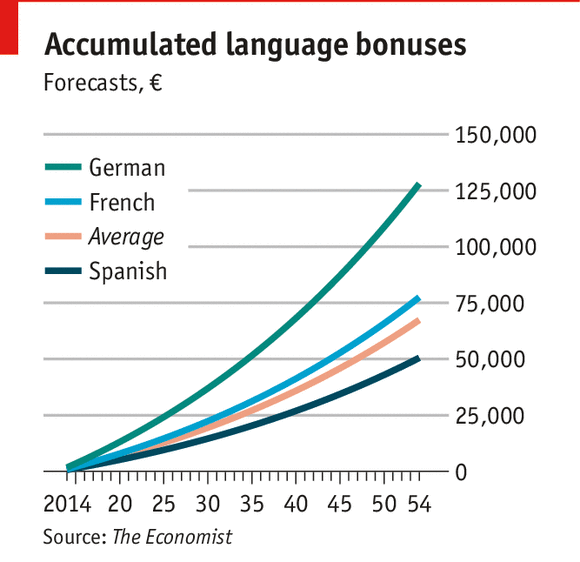
Second, Albert Saiz, the MIT economist who calculated the 2% premium, found quite different premiums for different languages: just 1.5% for Spanish, 2.3% for French and 3.8% for German. This translates into big differences in the language account: your Spanish is worth $51,000, but French, $77,000, and German, $128,000. Humans are famously bad at weighting the future against the present, but if you dangled even a post-dated $128,000 cheque in front of the average 14-year-old, Goethe and Schiller would be hotter than Facebook.
Why do the languages offer such different returns? It has nothing to do with the inherent qualities of Spanish, of course. The obvious answer is the interplay of supply and demand. This chart reckons that Spanish-speakers account for a bit more of world GDP than German-speakers do. But an important factor is economic openness. Germany is a trade powerhouse, so its language will be more economically valuable for an outsider than the language of a relatively more closed economy.
But in American context (the one Mr Saiz studied), the more important factor is probably supply, not demand, of speakers of a given language. Non-Latino Americans might study Spanish because they hear and see so much of it spoken in their country. But that might be the best reason not to study the language, from a purely economic point of view. A non-native learner of Spanish will have a hard time competing with a fluent native bilingual for a job requiring both languages. Indeed, Mr Saiz found worse returns for Spanish study in states with a larger share of Hispanics. Better to learn a language in high demand, but short supply.... The drop-off in recent years in the American study of German might be another reason for young people to hit the Bücher.
And studies like Mr Saiz’s can only work with the economy the researchers have at hand to study. But of course changes in educational structures can have dynamic effects on entire economies. A list of the richest countries in the world is dominated by open, trade-driven economies. Oil economies aside, the top 10 includes countries where trilingualism is typical, like Luxembourg, Switzerland and Singapore, and small countries like the Scandinavian ones, where English knowledge is excellent.
There are of course many reasons that such countries are rich. But a willingness to learn about export markets, and their languages, is a plausible candidate. One study, led by James Foreman-Peck of Cardiff Business School, has estimated that lack of foreign-language proficiency in Britain costs the economy £48 billion ($80 billion), or 3.5% of GDP, each year. Even if that number is high, the cost of assuming that foreign customers will learn your language, and never bothering to learn theirs, is certainly a lot greater than zero.
So if Mr Saiz had run his language-premium study against a parallel-universe America, in which the last half-century had been a golden age of language-learning, he might have found a bigger foreign-language bonus (and a bigger GDP pie to divide) in that more open and export-oriented fantasy America. And of course greater investment in foreign-language teaching would have other dynamic effects: more and better teachers and materials, plus a cultural premium on multilingualism, means more people will actually master a language, rather than wasting several years never getting past la plume de ma tante, as happens in Britain and America.
To be sure, everything has an opportunity cost. An hour spent learning French is an hour spent not learning something else. But it isn’t hard to think of school subjects that provide less return—economically, anyway—than a foreign language. What is the return on investment for history, literature or art? Of course schools are intended to do more than create little GDP-producing machines.
And there are also great non-economic benefits to learning a foreign language.
But if it is GDP you’re after, the world isn’t learning English as fast as some people think. One optimistic estimate is that half the world’s people might speak English by 2050. That leaves billions who will not, and billions of others who remain happier (and more willing to spend money) in their own language.
COMMENTS
Friday, January 3, 2014
BBC: Angela Merkel
The extraordinary story behind the public image ...
"She matters more to our future than ... 95% of British politicians." Program Host
You'll hear Wagner's music throughout.
"She matters more to our future than ... 95% of British politicians." Program Host
You'll hear Wagner's music throughout.
Thursday, March 7, 2013
Learning German in Ireland
The Irish Times - Monday, March 4, 2013
An Irishman's Diary
Derek Scally
There’s a little-known link between the Irish economy and the German language – something I call (Willy) Brandt’s Law.
The former West German chancellor Willy Brandt once explained the laws of linguistic engagement thus: “If I am selling to you I will speak English, but if you are selling to me, dann müssen Sie Deutsch sprechen.”
Brandt’s Law when applied to Ireland means that, when the Irish economy hits the skids, people start learning German to help find work and new opportunities. When the economy recovers, attitudes reverse and the Irish think Germans – and all others – should learn English.
Instead of seeing German as a language of culture, thought, or even love, many Irish view German as a ... "rescue ring" to fling at schoolchildren to keep them afloat in choppy economic waters.
In the grim 1980s, German language classes boomed as emigrants headed off to the BMW plant or a beer garden job. Three decades on, as the economy follows fashion back to the 1980s, .... Irish eyes have once again settled their gaze again on Germany and German.
A new promotional campaign and website – germanconnects.ie– is an attempt by the German, Austrian and Swiss embassies to explain the benefits of learning Europe’s most commonly-spoken native tongue – spoken by almost 120 million people daily.
Conscious of its audience, however, the new website front-loads the economic benefits. At this minute there are more than 1,000 job vacancies for German-speakers in Ireland, with many more positions for skilled, German-speaking staff in continental Europe.
So is the “German Connects” website a clever attempt to tap the Zeitgeist...? At the recent launch of the website, Dublin secondary school students presented their thoughts on the matter. Many gave unconscious nods to Brandt’s Law, saying they hoped learning German would improve their career prospects and earning potential. A few took the broader view, saying learning German “gives a better taste for Europe”.
“People think German is hard,” said Aindrias Ó hEachteirn, in fifth year at Coláiste Eoin in Booterstown. “But it’s actually a lot easier than Irish.”
Remarks like that might come as a surprise to many in Ireland, where stereotypes about the “hard” German language are stubbornly difficult to shift.
One of the greatest difficulties for Irish students learning German – or any other modern language – is facing a daunting crash course in grammar, thanks to the removal of English grammar teaching from the Irish school syllabus. Compulsory Irish lessons have caused further collateral damage.
Adding to the difficulties are special, German-only burdens. It has played second fiddle to French, which Minister for Education Ruairí Quinn suggested last month was linked to religious orders’ preference for Romance languages. Rather than learn French because the long-vanished nuns wanted to teach it, perhaps the time has come to look to German. If nothing else, it’s worth finding out what they think of us by learning their language, visiting their country and asking them directly.
Aindrias Ó hEachteirn already did that. At the website launch he brandished a well-thumbed, dual-language copy of Goethe’s epic tragedy, Faust. It’s a daunting read but, just back from a school exchange, Aindrias is anxious to learn German for more than just economic gain.
“With every language you learn,” he said, “you take off a pair of blinkers you didn’t even know you were wearing and suddenly see much more.” So is the German language hard to learn? It’s not easy but, then again, neither is watching monolingual children emigrate to far-flung English-speaking lands in search of work.
There is an emigration alternative to 23-hour flights to Sydney and watching grandchildren grow up on Skype. Learning German takes time but, long-term, the effort can open doors to new home and new opportunities just a two-hour flight from Ireland.
Before the shock of recent years passes, it’s worth learning one lesson of the economic crisis: speaking only English in a globalised world is as much a risk as it is a benefit.
Subscribe to:
Posts (Atom)
With the inside sales organizations of all major IT companies based here, this means the average German speaker can earn 10% or more compared to anyone else in the industry.
Add to that referral bonuses (2-7000 Euros), and retention bonuses (please don't leave us! Here's 5000 euros if you stay on another year!!) Also, add the extra upside OTE potential linked to working with the strongest economies in Europe (DE, AT, CH: multiyear contract for you support+subscription, Sir?), and I would not be surprised if the overall premium for German were in the tune of Eur 300,000+!!
NOTE: Is there much difference between Ireland and the USA here? -- rsb
But you are missing on understanding different aspects of people, their cultures and values. And that is what matters.
And of course it shows the laziness.