Showing posts with label musik. Show all posts

Friday, August 26, 2016

Deutsch durch Musik! So kann man gut lernen!

Learn German with Music: 

10 Songs with Hidden German Grammar Lessons

What I like about this article by   Published By FluentU August 24, 2016
is that the author suggests ways to focus on the language and grammar, while listening to (or reading--yes, I expect several of these songs will make it to the classroom) the text. -rsb 

learn German with music 10 songs
It’s test time in German class, but your mind is a total blank.
How are you supposed to remember all those convoluted rules in your textbook?
Try a new tactic and learn the lyrics of these awesome songs. The human brain has a much easier time remembering words attached to musicGerman songs can be like flashcards without the tedium, guiding you through the grammatical jungle with concrete examples of how the language actually works.
Don’t be caught off guard the next time the German teacher springs a pop quiz on you! Take these helpful songs for a spin, and you’ll have yourword ordercases and more memorized before you know it.
Download: This blog post is available as a convenient and portable PDF that you can take anywhere. 
Click here to get a copy. (Download)

Learn German with Music: 

10 Songs with Hidden German Grammar Lessons

1. Noun Declination: Annett Louisan – Mama will ins Netz

learn music 10 songs hidden german grammar lessons
A sweet, upbeat ditty with plenty of humor and fond mockery.
The scenario: The singer-songwriter’s mother ventures into the world of computing for the first time, hoping to figure out the process of sending an email. Louisan helps her on the phone, providing instructions.
Plenty of nouns, so plenty of article declination.
-- What to do mit der Maus (with the mouse)? 
                  -- Mit dem Karton (with the box)? 
-- Was hast du denn für ‘nen Provider (so what kind of provider do you have)?
                  -- Mama has no idea. Die Hoffnung stirbt zuletzt (Hope dies last).

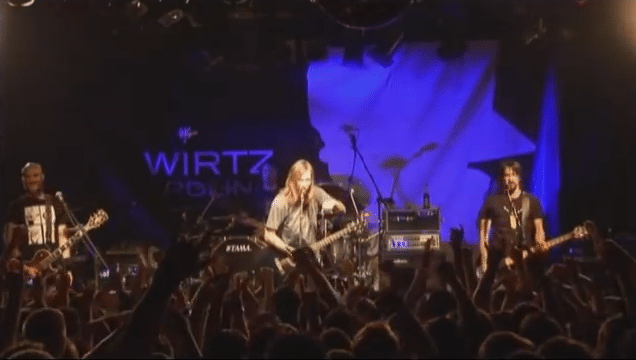
2. Adjective Declination: Wirtz – Im freien Fall
learn music 10 songs hidden german grammar lessons
Hard-rocking, compelling song about thinking critically and speaking the uncomfortable truth, even when it’s unpopular.
Daniel Wirtz uses vividly descriptive language, so we can observe how adjective endings change form with different cases. He starts with the image of mentale Müllentsorgung (mental trash disposal).
He employs dative and accusative declination of neutral-gender adjectives:
--Zieh’ mit dem schneidenden Wort, gegen das stumpfe Gelaber (move with the cutting word against the dull babble).
-- He presents his personal philosophy in reinster Form (in purest form)
-- as he describes das Leben im freien Fall(life in free fall).
Also a good example of adverbs.

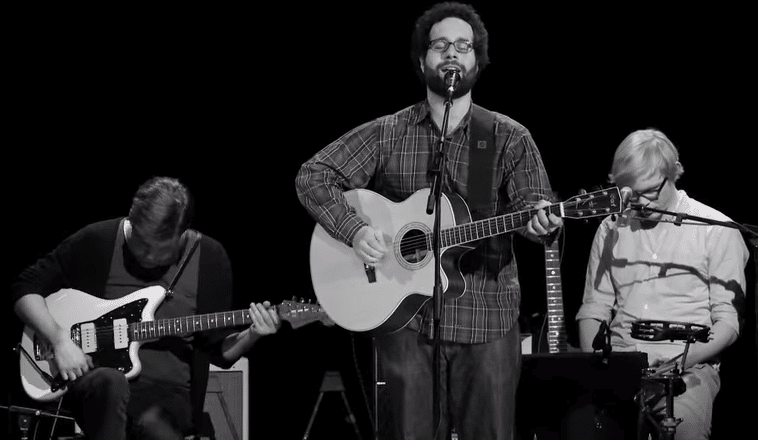
3. Prepositions: Herrenmagazin – Der langsame Tod eines sehr großen Tieres
learn music 10 songs hidden german grammar lessons
Zu, über, unten, in, vor, aus, bei (to, over, under, in, before, out, at) – this song is full of those luscious German prepositions. As the indie rockers from Hamburg paint a dark and abstract picture of dysfunctional love, you can cement in your brain the diverse ways in which prepositions act upon possessive pronouns, articles and adjectives. 
Also, the lyrics provide examples of imperative form in the second-person plural (you-all-guys).
The live acoustic version of the song on TV Noir, with a slower tempo and black-and-white aesthetic, is particularly lovely and haunting.

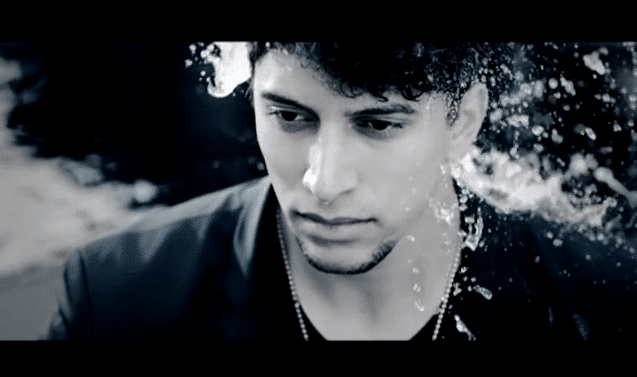
4. Two-way Prepositions and the Dative Case: Andreas Bourani – Eisberg
learn music 10 songs hidden german grammar lessons
Learning to sort out the proper form – accusative or dative – of two-way prepositions is key. While some prepositions are always clear – durch (through) and gegen (against) are accusative, while aus (out) and mit (with) are dative – it’s easy to get two-way prepositions like in, auf and über (in, on and over) mixed up. Think of this song and remember:
-- Dative is used to describe where something is statically existing – the wo (where at) state.
--Accusative is used for movement – the directional or wohin (to where) state.
This song shows many examples of the dative state, so you can refer back to it and work out the accusative by elimination, if ever confused.
Ich treib alleine auf dem Meer (I float alone on the sea) he sings, static state, with the dative particle dem. If he were to shove a boat into the sea and take off, it would be the directional accusative, (fahre hinaus) auf das Meer, shortened to aufs Meer (I’m sailing out onto the sea).
This song is also a good example of reflexive pronouns.

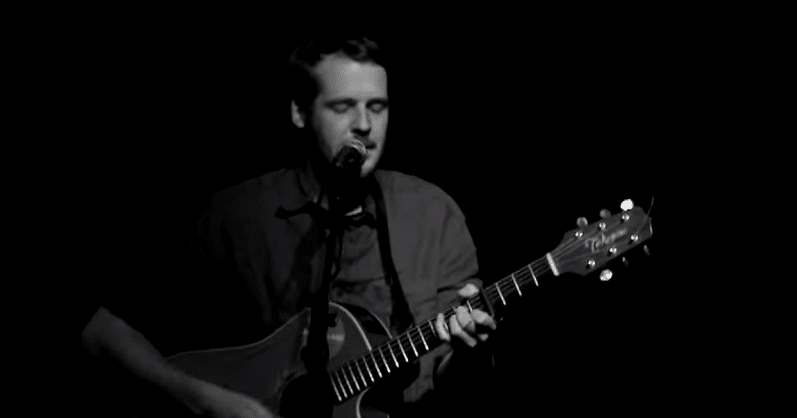
5. Separable Verb Prefixes: Gisbert zu Knyphausen – Dreh dich nicht um
learn music 10 songs hidden german grammar lessons
In this song, singer-songwriter Gisbert zu Knyphausen says goodbye to a failing romantic relationship. He tells his love gently to leave and not look back, and he employs a number of verbs with separable prefixes as he lays out the impending separation. Nimm deine Schuhe mit, he says – take your shoes with (you), the imperative form sending the “with” on the front of the infinitive verb mitnehmen (to take with) to the end of the clause.
The same rule returns as he applies the imperative to the verb umdrehen and tells her, dreh dich nicht um (don’t turn around) and with his construction based on the verb krummnehmen (take the wrong way), the imperative nimm sie uns nicht krumm (don’t take it wrongly). We also see a separable verb, einreden (talk into / persuade), staying whole, because the modal verb musst (must), at the start of a long sentence, keeps it united at the end of a subordinate clause.

6. Reflexive Verbs and Pronouns: Bushido “Zeiten ändern sich”

learn music 10 songs hidden german grammar lessons
This belongs to that particular brand of rap song which glorifies the money and possessions the rapper has accumulated while sneering at his haters, who so clearly underestimated him back in the day.
All that self-involvement produces great examples of reflexive verbs and pronouns! As reflexive verbs have the same object and subject, “me me me” songs are perfect. For instance, Bushido can now buy himself (sich kaufen) all kinds of things if he wished, like an entire Lidl grocery store and a villa. Why? Because the times have changed (themselves) – Zeiten ändern sich.

7. Subjunctive I: Frittenbude – Bilder mit Katze

learn music 10 songs hidden german grammar lessons
Subjunctive I (Konjunktiv I) can seem like a uselessly esoteric concept in language class, but it’s actually subtle, expressive and may end up being enormously helpful if you become professionally active in Germany. Why? It enables you to make passive assertions, relating unverified claims or hearsay without staking your own credibility on the statement, and is frequently used in journalism.
Good thing you have this catchy electro track with laconic hipster rap vocals to help you remember how the form works. Actually, there’s just one example – doch sie sei leider pleite (she was supposedly broke, unfortunately) – but the song is also packed with adjective declination, past tense verb conjugation, lots of slang and complex narrative lyrics, and the music video is utterly charming. Sei (subjunctive form of is) is basically the most important passive verb form anyway, along with habe(subjunctive form of have).
Watch the video, and then go buy a Polaroid camera and an Audiolith shirt. If you make it all the way to a Frittenbude concert, you can whip out your passive form humor and tell the merch guy: Man sagt, da draußen gebe es nichts wie dieses Shirt von Audiolith mit den schönen großen Buchstaben (they say there’s nothing out there like this shirt from Audiolith with the nice big letters).

8. Subjunctive II: Fräulein Wunder – Wenn ich ein Junge wär
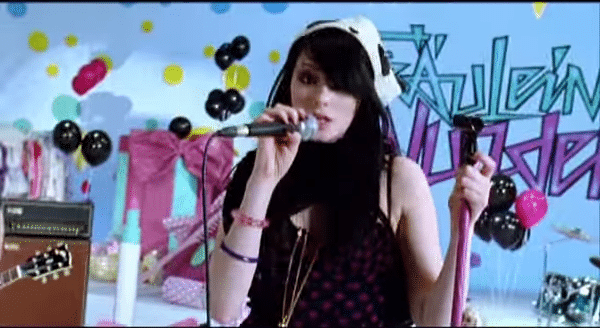
learn music 10 songs hidden german grammar lessons
Ah, subjunctive II (Konjunktiv II), the marvelous realm of theoretical, far-fetched possibilities and sheer imagination. What would you do if you were suddenly transformed from a girl to a boy? The ladies of Fräulein Wunder have a few ideas. Ich würd nur D-max gucken, und Jacky-Cola schlucken, ich würd mich selber küssen, und nur zum Spaß freihändig pissen – wenn ich ein Junge wär… (I would watch only D-max, gulp cola, kiss myself and piss with no hands for fun…) Drinking with Swedish girls, martial arts and donating sperm also make the list of subjunctive activities.

9. Possessive Pronouns and Genitive: Die Toten Hosen – Paradies

learn music 10 songs hidden german grammar lessons
Once upon a time in Poland, I got to tell the members of Die Toten Hosen that their music had helped me learn German, and it wasn’t an exaggeration. Campino’s voice simply has an unforgettable quality – this song is no exception. If you want to learn the tricks of possessive form, spend a bit of time with these lyrics. They feature possessive constructions using the genitive form, both feminine and masculine: Die Hölle der Wiedergeburt (the hell of rebirth), im Buch des Lebens (in the Book of Life). Possessive pronouns also show up: The genitive dessen Chancen stehen nicht schlecht (his chances aren’t bad) and the basic accusative wer sein Schicksal mit Demut trägt (he who bears his fate with humility).

10. Imperative: Silbermond – Krieger des Lichts
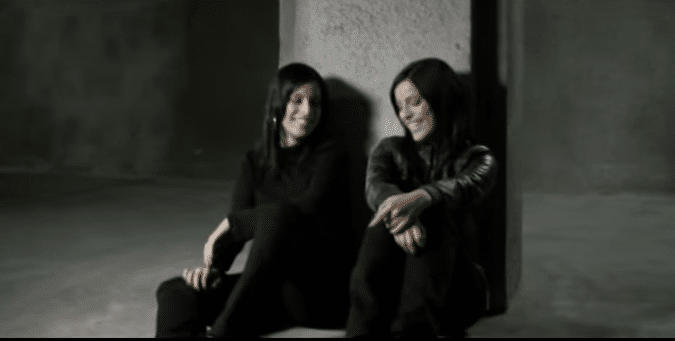
learn music 10 songs hidden german grammar lessons
A stirring song in general, and especially helpful if you’re studying the imperative form. Silbermond singer Stefanie Kloß is here to motivate the depressed and daunted listener, and she does it with a wide range of commands in second-person singular and plural.
Lasst uns aufstehen, macht euch auf den Weg, sei wie der Fluß, wenn dein Wille schläft, dann weck ihn wieder, hab keine Angst, fürchte nie, lass dich nicht täuschen, lerne zu fesseln und zu befreien (let us stand up, set out on the way, be like the river, when your will sleeps, wake it up again, never fear, don’t let yourself be deceived, learn to take hold and let go) – this song really spans the gamut of imperative verbs. Also, you’ll find some useful examples of possessive genitive.

Let us know if you have found a new favorite song or two, and which of these songs has helped you progress most in learning German!

Tuesday, October 6, 2015

Udo Juergens singt, Ich weiss was ich will (I know what I want) 1980


Uploaded on Oct 7, 2008  U.a. von dem Album: Udo '80

Was koennen wir nicht verstehen?  Wem gefaellt dieses Lied?? --rsb

Dein Haar weht im Wind,
Von meinem Fenster aus, da seh ich dich geh'n,
Du winkst herauf und bleibst sekundenlang steh'n.
Ich denk', wie schön war es doch eben noch hier,
Mit dir.

Ich weiß, was ich will,
Ich will dich fühlen, wenn der Morgen erwacht,
Mit dir den Tag verbringen bis in die Nacht
Und glauben, nirgends ist ein Ende in Sicht,
Nein, für uns nicht.

Ich weiß, was ich will,
Ich will die Leidenschaft, mit der du mich liebst,
Die sanfte Zärtlichkeit, wie du sie mir gibst,
Die Illusion, du lebst allein nur für mich,
Die brauche ich.

Ich weiß, was ich will,
Ich will, daß endlich etwas Neues beginnt,
Daß wir wie ein Gedanke, ein Körper sind,
Das ist mein Ziel,
Sag' mir nur eins: Will ich zuviel?

Ich weiß, was ich will,
Dir alles zeigen, was ich jemals geseh'n,
Was du auch immer tust, verzeih'n und versteh'n
Was ich noch nie vorher im Leben getan,
Fang' ich jetzt an.

Ich weiß, was ich will,
Ich will dich nie mehr aus den Augen verlier'n,
Will deine Hände sanft und weich auf mir spür'n,
Glauben daran,
Daß es auch so weitergeh'n kann.

Noch kann ich dich seh'n,
Mit schnellem Schritt gehst du die Straße entlang,
Mit deinem so vertrauten typischen Gang.
Ich denk', wie schön war es doch eben noch hier,
Mit dir.

Ich weiß, was ich will,
An einem leeren Strand allein mit dir sein,
Und alles tun, was man so tun kann zu zwei'n.
Und kein Gedanke von uns bleibt ungesagt,
Nichts wird vertagt.

Ich weiß, was ich will,
Wie ein Zigeuner durch die Welt mit dir zieh'n,
Dem ganzen Zirkus dieses Daseins entflieh'n,
Und alles das, bis uns die Sinne vergeh'n,
Wär das nicht schön?

Ich weiß, was ich will,
Daß jede Nacht für uns zum Karneval wird
Und jeder Weg nur zueinander uns führt.
Das ist mein Ziel.
Sag' mir nur eins: Will ich zuviel?

Ich weiß, was ich will,
Ich will dich ganz und gar und immer um mich,
Was uns im Wege steht, das ändere ich.
Ich hab' noch nie im Leben Berge versetzt,
Ich tu' es jetzt.

Monday, August 31, 2015

Musik zum Leben - und Text dabei zum Lesen, und Verstehen

von Thomas Riedel
aus Dresden               Musik für die Seele

Das Licht der Stille, von Thomas Riedel


Text:

Verborgen von der Welt
leuchtet eine Stille in Dir....
Du kannst sie nicht 
mit deinen Tagesaugen sehen
denn Du bist geblendet
von den Dingen dieser Welt.

         - - Zwischenspiel - -
Und trotzdem hast Du
Augen dieses Licht zu sehen. In diesem Licht steht die Welt
still und neu vor dir
strahlend in Unschuld,
lebendig voller Hoffnung und
gesegnet mit einer 
Liebe, die aus Dir entspringt.

     - - Zwischenspiel - - 

Wer könnte fürchten sich
in einer solchenWelt?

Sie heißt Dich jeden Tag
willkommen voller Freude.
Sie sieht das Licht in Dir,
und schützt es als ihr Eigen
Sie gibt Dir einen sanften,
warmen Platz zu sein.

Sie sieht Deinen Wert
und freut sich, dass Du da bist.

Sie gibt Dir ihren Schnee
und ihre Blumen,
in Dankbarkeit für Dein
wunderbares, stilles Licht.
Dies ist die Welt,
die Deine Liebe Dir enthüllt!
Du wirst sie sehen, 
wenn Du nach innen schaust. 

Sei also still für einen Moment
und lege alle Gedanken über die Welt
und Dich beiseite,
Leere Deinen Geist von allem,
was Du denkst und willst.
Halte nicht einen Gedanken fest,
egal wie wichtig und richtig 
er auch erscheinen mag.

Lass alles los!  Mach Platz 
in Deinem Geist und Deinem Herzen, 
für etwas Großes und Weites.
    
Und Liebe, die Du noch nie gekannt,
sie wird kommen, und sie kennt den Weg,
viel besser als Du ihn je erdenken könntest.
Die Liebe braucht Dein stilles Warten, 
deine freudige Gewissheit ihres Kommens.
Sie ist Dein, weil Du 
als liebevolles Licht erschaffen wurdest.

Schau heute nur auf 

dieses stille Licht in Dir, 
und segne es in allem, 
was Dir in der Welt begegnet!

Wer hat Fragen um den Text? --rsb


Sunday, July 12, 2015

Malaria - Kaltes klares Wasser

 Ein altes Lied. . . aus 1980


Kaltes klares Wasser -- 
über meine Hände,
über meine Arme,
über meine Schultern,
über meine Beine,
über meine Schenkel,
über meine Brust,
über mein Gesicht

Thursday, July 9, 2015

MINE singt: Und der Mond lacht über uns

 Outside in Mannheim.... First 2 Musicians, and then ....


...Und der Mond lacht über uns  (and the moon laughs at us)


Internet tips: Making music; Girls with Toys; Discovering that secret beach...

von Volle Kanne ...


1.  Touch Pianist  Musik online komponieren...
2.  Tone Matrix
3.  Type Drummer
4.  Girls with Toys . . .
5.  Trip in View ... aus der Vogelperspektive per Multicopter


Sunday, May 31, 2015

aufwachen v. aufwecken (Ich bin aufgewacht...ich habe mich aufgeweckt)


Word of the Day – “aufwachen”

aufwachenHello everyone,
and welcome to our German Word of the Day. This time we will have a look at the meaning of:
aufwachen (pron.: owf wa-HHHen… kinda sorta) 

Aufwachen… a burden at times and a relief at others. We usually do it once per day… or twice… or not at all if we are party animal. The word consists of the basic verb wachen and the prefix aufAuf can mean a number of things like open, up, on top of or on and wachen means something like… uh …just watch this video here.

See you in 2 minutes … … … … … … … … … … … …

Thank you Everly Brothers for that nice explanation.

Aaaaanyway… aufwachen means to wake up.
  • Wann bist du heute aufgewacht?
  • When did you wake up today?
  • Ich wache von allein auf.
  • I wake up by myself.
The 2 words wake up and aufwachen are of course related. Actually there some other examples where the English k is the softer German ch, an exhale with a little friction in your throat. Two other prominent examples are machen  to make or brechento break.

And I see we have some people calling. The first one is Martin from Sheffield, how are you doing?
“Hey Emanuel, nice song… would it be possible that you translate the hook line for us? A friend of mine who speaks German sometimes does that and it’s always  hilarious …”

Oh yeah that is true… great idea. We’ll do it in a little bit. Thanks Martin for that and our next call is Veronica from Madrid, hi Veronica…

“Ola… so in language class I learned aufwecken, and this also means to wake up… could you explain me the difference? “

Oh of course, don’t worry… I’ll talk about that a little later on but first I want to say some things about aufwachen.

The stem of the word wachen is the word wach which literally means awake.
  • Als du angerufen hast, war ich schon wach.
  • When you called I was already awake.
  • Bist du wach?
  • Are you awake?
If you want to say that you are wide awake you could say hellwach. Literally this would be bright awake.

But the word is also used in a more abstract sense. Calling a person wach can mean as much as smart, clever, alert or astute. And this is not far fetched after all as being awake in the literal meaning also comes with being able to concentrate, perceive and think … at least most of the time :).
  • John ist zwar schon 78 Jahre alt, aber er hat einen wachen Geist.
  • John might be already 78 years old but he is an alert, lifely mind.
You see that wach can have the notion of being alert. This becomes quite obvious in the words wachen and bewachen… they mean to guard or to watch over. On first sight these 2 seem to have little to do with wake but being awake is THE number one prerequisite for guarding so I hope you can see the connection.
  • Der Wachhund bewacht die Villa.
  • The watchdog is guarding the mansion.
Just for completion I want to mention the word erwachen here. This is kind of the poetic brother of aufwachen in that it has a string notion of dignity and gravity to it… nature does it, or Snow White after the kiss… A good translation is to awaken.
  • Im Frühling erwacht die Natur.
  • In Spring, nature awakens.
What you do every morning usually does not qualify as awakening with all than crankiness, smelly breath and wrinkly face . What you do is aufwachen which has only this one meaning: to wake up; so translating the lyrics of that song is a piece of cake:
Wach auf, kleine Suhusie, wach auf!
 Now onto something else.

Difference between aufwachen and aufwecken

To answer that I first want to present you with another video from 2 guys who’s thrust and jiggle ability makes the Everly Brothers look stiff as boards.


Yeah good old George Michael… his voice carried so far back then, that he didn’t  need a microphone AT ALL.  By the way have you hear of the Jitterbug before?  (From the video, you'll be able to tell that it's a kind of dance.)

OK.  So, the hook lines of both songs seem to be almost identical. They are both orders in a way.
  • Wake up (little Suzie)!
  • Wake me up (b4 you go go)!
BUT they are perfect examples for the difference between aufwachen and aufwecken. Suzie is told to wake up herself while whoever is told to wake up George Michael.

Aufwachen means to wake up YOURSELF. It is what you do every morning and you CANNOT do it to someone else. Even if an alarm clock is the reason for you waking up, you still aufwachen. So aufwachen is the EXACT opposite of falling asleep.


Aufwecken or simply wecken is what you do to others or what your alarm does to you. Here are some examples.
  • Thomas wakes up at 11.
  • Thomas wacht um 11 auf.
  • Thomas wakes up Suzie at 11.
  • Thomas weckt Susie um 11 auf.
  • Kannst du mich morgen um 8 (auf)wecken?
  • Can you wake me up at 8 tomorrow?
  • Ich wache immer mit guter Laune auf.
  • I always wake up in a good mood.
By the way… it should be obvious now why an alarm clock is called Wecker. It is simply a thing or person waking up others… just like Fahrer (driver) or Bäcker (baker).

So the Everly Brothers want Suzie to aufwachen and what they do by singing it to her is aufwecken.
So we are almost done but we need to talk about the grammar a little bit. I think you have already seen that both verbs are separable so auf is weakly linked to the stem.

The past is a little tricky. Aufwachen is sort of a movement of your mind and thus builds it’s spoken past with sein while aufwecken is just something you do so it needs haben. The ge-forms of both verbs are straight by the book though.
  • Thomas woke up at 10.
  • Thomas ist um 10 aufgewacht.
  • Thomas woke up Maria at 10.
  • Thomas hat Maria um 10 aufgeweckt.
You need to pay a little attention there because if you confuse haben and sein people might assume you mean the other wake up and misunderstand your sentence.
As far as the real or written past is concerned you don’t really need it, especially not for aufwecken but it is not a problem anyway since it is also completely regular.
  • Thomas wachte um 10 auf.
  • Thomas weckte Sam um 10 auf.
  • Thomas woke up (Sam) at 10.
And if you ask yourself why Thomas is waking up different people with different gender… well, he just gets around.

So… this was our Word of the Day. Aufwachen and aufwecken both mean to wake up but the former is to wake up yourself while the second one is to wake up others and the 2 are not interchangeable.
If you have any questions just leave me a comment. I hope you liked it and… oh and we have a call again… Jane from Dublin. Hey Jane, we don’t have much time left…

“Hi Emanuel… could you please please give the translation for that Wham song too?”
Good idea… but promise to sing it and post it to Youtube!

“Cool, will do… thank you so much, bye…”

Bye Jane… so here you go:
Weck mich auf, bevor du geh-hest!
Lass mich hier nicht hängen wie ein Jojo
Weck mich auf, bevor  du geh-hest,
Ich will dabei sein, wenn du voll abgehst.
Weck mich auf, bevor du geh-hest!
Denn ich hab’nich’ vor allein zu gehen.
Weck mich auf, bevor du geh-hest!
Geh mit mir tanzen heut naaaacht!
Ich will, dass es kraaaaaaaaaaaaaaaaaaacht!
Hope you liked it and see you next time.
/strong

Wednesday, May 27, 2015

Step Into German redesign.... noch nicht fertig

HIER KANN MAN ABER DEN LINK ZUR ALTEN WEBSEITE FINDEN!

Dear colleagues,

unfortunately, the Step into German re-design has turned out to be quite
time-consuming, but yes, we will upload all the old materials (music videos,
inventions, city portraits...) within the next couple of weeks. If you
can't wait ;-) please go to:

http://www.goethe.de/ins/us/saf/prj/tid/enindex.htm

Weiterhin viel Spaß mit Step into German alt und neu wünscht

Wednesday, May 13, 2015

Ten Pop Songs that Will Help You Learn German


Young Germany

Research has shown that listening to music can help you improve your language skills. These ten pop songs will help you master the German language.
 by Nicolette Stewart

“In the 1970s, extensive research was carried out into the powers of music in the learning process, by the Bulgarian physician Georgi Lozanov. He revealed that music puts listeners into a state of relaxed alertness, the ‘alpha state,’ the ideal state of consciousness for learning, and his tests were conclusive.
“More recently, in the March 2005 issue of the journal ‘Nature’ researchers at Dartmouth College in the US reported that they had pinpointed the region of the brain where ‘ earworms ‘ or catchy tunes reside, the auditory cortex. They found that the sounds and words that have actually been heard can be readily recalled from the auditory cortex where the brain can listen to them ‘virtually’ again and again. Music it seems is the ideal catalyst to the memorisation of words.”  (source)

Why learn German with music?

Add to the research the fact that listening to music is a lot more fun than staring at a textbook, and you have an ideal formula for language learning.  If you've ever gotten a song stuck in your head, you are familiar with the way that music and lyrics can work their way into your brain effortlessly.  The melody carries them in and while you're humming that tune, implants important grammatical concepts and vocabulary in your memory.
Songs with clear, easy-to-differentiate lyrics are ideal for language learning, but if you're having trouble understanding what the singer is saying, Google the song title + band name + lyrics.  Then listen to the song while reading the words. Repeat.  Once a catchy tune gets into your head, you'll find yourself repeating phrases and words to yourself even when you aren't studying.

99 Luftballons by Nena

You've no doubt heard this song before, but did you know that it is about a nuclear apocalypse brought about by accident? Use this catchy pop tune to practice your listening comprehension skills and learn vocab that will help you discuss the pros and cons of war.

Listen to 99 Luftballons:

Leider Geil by Deichkind

"Geil" ist a German slang word for cool (ok; it can also have overtones of meaning "horny").  This humorous song will hammer both "leider" (unfortunately) and "geil" (cool/awesome) into your active vocabulary while explaining which of the negative/stupid/bad things in the world that are actually kind of, well  "leider giel."

Listen to Leider Geil:

Elke by Die Ärzte

This song by Berlin band Die Ärzte tells the story of a couple who start as pen pals and then "12 seconds later" end up together. Those whose musical taste has punk leanings will enjoy this humorous and energetic love song.

Listen to Elke:

Wir trafen uns im Garten by 2RAUMWOHNUNG

This twee but upbeat pop song is about a couple who meet in a garden.  When after the break up thoughts about her ex-partner leave her feeling tired and sad, the singer tries to distract herself with other things.  It is one of the many songs that will help you learn the vocab you will need to talk about a break-up, but unlike many of its thematic relations, it has an upbeat and positive sound and attitude.

Listen to Wir trafen uns im Garten:

Für immer Immer by Fettes Brot

Practice geography and German vocab with this song about all the women from around the world that Fettes Brot have loved.

Listen to Für immer Immer:

Halt Dich an mir fest by Revolverheld

This emotional ballad from Hamburg band Revolverheld will provide you with vocabulary to talk about a failing relationship.

Listen to Halt Dich an mir fest:

Wo willst du hin? by Xavier Naidoo

Mannheimer singer Xavier Naidoo is generally a good starting point for German learners who enjoy soul and R&B. This song is about a failed relationship and forgiveness.

Listen to Wo willst du hin?:

Ja by Silbermond

Silbermond hail from Bautzen, Saxony, and they have been playing quiet, emotional pop music since forming in 1998.  Ja will help provide you with vocabulary for talking about feeling down, but strengthened by a relationship.

Listen to Ja:

Fallshirm by Mia

Mia (not to be confused with Sri Lanken/British performer M.I.A.) writes upbeat, dancey pop music.  The group are from Berlin and having been making music since 1997.

Listen to Fallschirm:

Tage wie diese by Die Toten Hosen

The list ends with an upbeat rock-pop anthem written to get stadium crowds holding their lighters in the air and signing along. Days like these (as the title would be in English) is about those perfect days when you feel like you can do and be anything.

Listen to Tage wie diese:

Tags:

Friday, April 24, 2015

Internet LESSONS for make-up / assignment days ...

Mit besten Dank an Frau Combs
Select one 
of the following 
activities.


OPTION #1 - MUSIK
Listen to and learn about some popular German music on the  
Step into German website.

  1. Watch 3 music videos on this site. 

  1. Choose your favorite video/song of the three and read the article about the band.

  1. Click on the link (at the bottom of the article) to visit the band’s page (if the link doesn’t work, google the band name to find it.) Browse around the site.

  1. Answer the following questions (either print out and complete or write on notebook paper.)
* * * * * * * * * * * * * * *
  1. Which three videos did you watch? 
    List them and give a brief summary of what was in the video or what the song was about (write 25 words for each video)
    1. Song Name:___________________________________________
      Singer/Band Name:_____________________________________
      Summary of video/song: ______________________________________________________
      ______________________________________________________
      ______________________________________________________

    2. Song Name:___________________________________________
      Singer/Band Name:_____________________________________
      Summary of video/song: _____________________________________________________
      _____________________________________________________
      _____________________________________________________

    3. Song Name:___________________________________________
      Singer/Band Name:_____________________________________ 
      Summary of video/song:
      _____________________________________________________
      _____________________________________________________
      _____________________________________________________

  2. Give some interesting details about the band: 
    (ie- where they’re from, how they started, how they got famous, etc.)  
    (minimum 25 words)
    1. _______________________________________________________

    2. ________________________________________________________

    3. ________________________________________________________


  3. After looking at the band’s site, what additional information did you find out? 
    Did you learn any new words? 
    What did you think of the site? (minimum 25 words) ______________________________________________________________
    ______________________________________________________________
    ______________________________________________________________ ______________________________________________________________
    ______________________________________________________________


OPTION #2 - FERNSEHEN

Watch episodes of a popular children’s television program

  1. Watch 3 videos of “Sachgeschichten” from “Die Sendung mit der Maus” on from these YouTube channels. You can choose any 3 that interest you. 
    There are hundreds to choose from! 


  1. Answer the following questions 
    (either print out and complete or write on notebook paper.)

* * * * * * * * * * * * * * *
  1. Which three videos did you watch? 
    List them and give a brief summary (including steps of the process or production), 
    and a new word or phrase you learned. (write 50 words for each video)
    1. Video title/subject matter:_______________________________________
      Summary___________________________________________________
      ___________________________________________________________
      ___________________________________________________________
       
       New word/phrase: ___________________________________________

    1. Video title/subject matter:_______________________________________
      Summary ___________________________________________________
      ___________________________________________________________
      ___________________________________________________________
       
       New word/phrase: ___________________________________________

    1. Video title/subject matter:________________________________________
      Summary___________________________________________________
      ___________________________________________________________
      ___________________________________________________________
       
       New word/phrase: ___________________________________________


OPTION #3 - KULTUR DOKU
Watch mini-documentaries produced by the Goethe-Institut 
about different cultural aspects of German culture.

  1. Watch 2 videos from the Goethe Institut’s YouTube channel. 
    You can choose any 2 that interest you (make sure you are watching the full videos, approximately 10-15 minutes each, not just the trailers)


  1. Answer the following questions (either print out and complete or write on notebook paper.) You should provide thorough answers

* * * * * * * * * * * * * * *
  1. Video Year __________

    1. Video Title_______________________________________________________

    2. Summary of documentary? (minimum 25 words) _______________________________________________________________ ________________________________________________________________
      ________________________________________________________________
      _______________________________________________________________

    3. What did you think of the documentary? (minimum 25 words) _______________________________________________________________ ________________________________________________________________
      ________________________________________________________________
      _______________________________________________________________


  1. Video Year __________
    1. Video Title_______________________________________________________

    2. Summary of documentary? (minimum 25 words) _______________________________________________________________ ________________________________________________________________
      ________________________________________________________________
      _______________________________________________________________

    3. What did you think of the documentary? (minimum 25 words) _______________________________________________________________ ________________________________________________________________
      ________________________________________________________________
      _______________________________________________________________