Saturday, November 17, 2012
Maikranz Tanz Endszene: Im weißen Rößl am See
Der Film ist aus 1980. Er ist nur lustig, und die Kostüme finde ich auch lustig! Diese Endszene ist nur 14 Minuten lang.
Werden Oberkellner, Leopold, und Gastwirtin Josepha sich je verstehen?

Friday, November 16, 2012
Lern Deutsch in 3 Monaten
• 3000 Wörter = 80%
• Tutors - Sprach-partner (Tandempartners)
• Filmen anschauen
• Mac: Genius Software or Windows: Anki Software
GUT?
Wednesday, November 14, 2012
Detlev Cordes singt BUCHSTABEN ZOO

HIER DER MUSIKER, Detlev Cordes!
HIER DAS LIED!
HIER DEN TEXT!
Refrain: , (5)
A B C D E : hier kommt die Buchstaben-Fee! - - - - , ----- ---- ‘ ; -----
F G H I J: zauber für uns flott! ••••• ‘’’’’ ••••• ‘’’’’’’’
K L M N O: einen Buchstaben-Zoo.
P Q R S T: (komm) zeig uns, liebe Fee,
U V W und X: deine Zaubertricks! ,,,,, ..... ---- - ‘ ,,,,
Y und Z: bitte sei so nett.
Strophen:
_ _ _
K U und H: schon ist die Kuh da. - - - -- - - ( ,3)
H U N und D: schön, dass ich den Hund seh. , ... : , ...
A F F und E: (einen) Affen zaubert die Fee. (‘1) _
R E und H: (das) ist ein Reh, na klar! - - - ‘ (,6) - - - ‘’’’’’
••••••• ‘
_ _ _
T I G E R : Tiger zaubern ist nicht schwer!
P F E R D: zauber mir ein Pferd, liebe Fee. ‘ ’ ‘ ; . ‘ ‘’ ‘ ‘ ’ ’(3)
I G E L: (der) Igel rollt sich auf ganz schnell. • - - • ----
K A T Z E schau-schau: (schon) ist die Katze da - miau! ; ; ; ; ; ; -
- - - - - - ‘ (6) - - - ‘ /
. (‘1)
_ _ _ • ‘
Summary of Anne Applebaum's Book Iron Curtain
By: Pulitzer Preis Gewinner: Anne Applebaum SLATE ONLINE MAGAZINE 
HIER DIE 4 ARTIKEL IM ORIGINAL
 4: How One Artist Attempted To Work Alongside the Regime
3: How One Man Accidentally Confided in the Communist Regime
 2: Why the Communist Party Was Helpless Against Faith
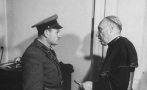
 Hier ist der 1. Artikel: 1: What Happens When Everything You Thought Was True Proves False?
Iron Curtain: The Crushing of Eastern Europe, 1944-56 is a book about the imposition of Soviet totalitarianism on Eastern Europe: how institutions were transformed, how civil society was undermined, how violence and propaganda were used to create communist regimes. It is also a book about the people who lived through this confusing period. Faced with impossible choices, some chose to collaborate, though they bitterly resented it. Others found ways to oppose the new regimes in subtle ways. This series of excerpts offers, in abbreviated form, a few of these stories.
* * *
Many people have tried to describe what it feels like to endure the disintegration of one’s entire civilization, to watch the buildings and landscapes of one’s childhood collapse, to understand that the moral world of one’s parents and teachers no longer exists and that one’s respected national leaders have failed. Yet it is still not an easy thing to understand for those who have not experienced it. Words like “vacuum” and “emptiness” when used about a national catastrophe such as an alien occupation are simply insufficient: They cannot convey the anger people felt at their prewar and wartime leaders, their failed political systems, their own “naive” patriotism and the wishful thinking of their parents and teachers. Different parts of Eastern Europe experienced this collapse at different times. But whenever and however it came, national failure had profound effects, especially on young people, many of whom simply concluded that everything they had once thought true was false.
Certainly that was what happened to Tadeusz Konwicki, a Polish novelist who spent the war as a partisan. Brought up in a patriotic family near Vilnius, in what was then eastern Poland, Konwicki eagerly joined the armed wing of the Polish Resistance, the Home Army, during the war. First he fought the Nazis. Then, for a time, his unit fought the Red Army. At some point their struggle began to deteriorate into armed robberies and gratuitous violence, and he found himself wondering why he was still fighting. Eventually he left the forests and moved to Poland, a state whose new borders no longer included his family home. Upon arrival, he realized that he had nothing. At age 19, he was in possession of a coat, a small backpack, and a handful of fake documents. He had no family, no friends, and no higher education.
Konwicki had also lost his faith in much of what he had believed to be true in the past. “During the war,” he told me, “I saw so much slaughter. I saw a whole world of ideas, humanism, morality collapse. I was alone in this ruined country. What should I do? Which way should I go?” Konwicki drifted for many months, considered escaping to the West, tried to rediscover his “proletarian” roots by working as a laborer. Eventually he fell, almost accidentally, into the Communist literary world and into the Communist Party—something he would never have considered possible before 1939. For a very brief time, he even became a “Stalinist” writer, adopting the style and mannerisms dictated by the Communist Party.
His was a dramatic fate, but not an unusual one. Many young people focused their disappointment on the old political elite who had so catastrophically failed to prepare Poland for war, and on the patriotic nationalism that had previously sustained them. Another Polish writer, Tadeusz Borowski, satirized the saccharine patriotism of the prewar politicians: “Your fatherland: a peaceful corner and a log burning obediently in the fire. My fatherland: a burnt house and an NKVD summons.”
For young Nazis, the experience of failure was even more apocalyptic, since they had been taught not just patriotism, but a belief in German physical and mental superiority. Hans Modrow—later a leading communist politician—was about the same age as Konwicki in 1946, and equally disoriented. A loyal member of the Hitler Youth, he had joined the Volkssturm, the “people’s militia” which put up the final resistance to the Red Army in the last days of the war. At age 17 he was filled with intense hatred of the Bolsheviks, whom he thought of as subhumans, physically and morally inferior to Germans. But he was captured by the Red Army in May 1945, and immediately experienced a moment of profound disillusion. He and another group of German prisoners of war were put on a truck and transported to a farm to work:
“I was a young man, and I wanted to help. I stood on the truck and handed down the others’ backpacks, and then gave my pack to somebody else, so that I could jump off the truck myself. By the time I landed on the ground, it was stolen. I never got it back. And it was not a Soviet soldier who had done it but one of us, the Germans. Not until the next day did the Red Army turn us all into equals: They collected all of our backpacks—nobody was left with one—and we were given a spoon and cup to eat with. Because of this episode I started thinking about the Germans’ so-called camaraderie in a different way.
A few days later, he was appointed driver to a Soviet captain who asked him about the German poet, Heinrich Heine. Modrow had never heard of Heine, and felt embarrassed that the people he had thought of as “subhuman” seemed to know more about German culture than he. Eventually Modrow was transported to a POW camp near Moscow, where he was selected to attend an “antifascist” school, and where he would receive training in Marxist-Leninsm—training which, by that point, he was more than eager to absorb. So profound was his experience of Germany’s failure that he very quickly came to embrace an ideology that he had been taught to hate throughout his childhood. Over time, he also came to feel something like gratitude. The Communist Party offered him the chance to make up for the mistakes of the past—Germany’s mistakes, as well as his own. The shame he felt at having been an ardent Nazi could be erased.
This article is the first of four excerpts drawn from Anne Applebaum’s book, The Iron Curtain: The Crushing of Eastern Europe 1944-1956.

HIER DIE 4 ARTIKEL IM ORIGINAL
3: How One Man Accidentally Confided in the Communist Regime
2: Why the Communist Party Was Helpless Against FaithHier ist der 1. Artikel: 1: What Happens When Everything You Thought Was True Proves False?Iron Curtain: The Crushing of Eastern Europe, 1944-56 is a book about the imposition of Soviet totalitarianism on Eastern Europe: how institutions were transformed, how civil society was undermined, how violence and propaganda were used to create communist regimes. It is also a book about the people who lived through this confusing period. Faced with impossible choices, some chose to collaborate, though they bitterly resented it. Others found ways to oppose the new regimes in subtle ways. This series of excerpts offers, in abbreviated form, a few of these stories.
* * *
Many people have tried to describe what it feels like to endure the disintegration of one’s entire civilization, to watch the buildings and landscapes of one’s childhood collapse, to understand that the moral world of one’s parents and teachers no longer exists and that one’s respected national leaders have failed. Yet it is still not an easy thing to understand for those who have not experienced it. Words like “vacuum” and “emptiness” when used about a national catastrophe such as an alien occupation are simply insufficient: They cannot convey the anger people felt at their prewar and wartime leaders, their failed political systems, their own “naive” patriotism and the wishful thinking of their parents and teachers. Different parts of Eastern Europe experienced this collapse at different times. But whenever and however it came, national failure had profound effects, especially on young people, many of whom simply concluded that everything they had once thought true was false.
Certainly that was what happened to Tadeusz Konwicki, a Polish novelist who spent the war as a partisan. Brought up in a patriotic family near Vilnius, in what was then eastern Poland, Konwicki eagerly joined the armed wing of the Polish Resistance, the Home Army, during the war. First he fought the Nazis. Then, for a time, his unit fought the Red Army. At some point their struggle began to deteriorate into armed robberies and gratuitous violence, and he found himself wondering why he was still fighting. Eventually he left the forests and moved to Poland, a state whose new borders no longer included his family home. Upon arrival, he realized that he had nothing. At age 19, he was in possession of a coat, a small backpack, and a handful of fake documents. He had no family, no friends, and no higher education.
Konwicki had also lost his faith in much of what he had believed to be true in the past. “During the war,” he told me, “I saw so much slaughter. I saw a whole world of ideas, humanism, morality collapse. I was alone in this ruined country. What should I do? Which way should I go?” Konwicki drifted for many months, considered escaping to the West, tried to rediscover his “proletarian” roots by working as a laborer. Eventually he fell, almost accidentally, into the Communist literary world and into the Communist Party—something he would never have considered possible before 1939. For a very brief time, he even became a “Stalinist” writer, adopting the style and mannerisms dictated by the Communist Party.
His was a dramatic fate, but not an unusual one. Many young people focused their disappointment on the old political elite who had so catastrophically failed to prepare Poland for war, and on the patriotic nationalism that had previously sustained them. Another Polish writer, Tadeusz Borowski, satirized the saccharine patriotism of the prewar politicians: “Your fatherland: a peaceful corner and a log burning obediently in the fire. My fatherland: a burnt house and an NKVD summons.”
For young Nazis, the experience of failure was even more apocalyptic, since they had been taught not just patriotism, but a belief in German physical and mental superiority. Hans Modrow—later a leading communist politician—was about the same age as Konwicki in 1946, and equally disoriented. A loyal member of the Hitler Youth, he had joined the Volkssturm, the “people’s militia” which put up the final resistance to the Red Army in the last days of the war. At age 17 he was filled with intense hatred of the Bolsheviks, whom he thought of as subhumans, physically and morally inferior to Germans. But he was captured by the Red Army in May 1945, and immediately experienced a moment of profound disillusion. He and another group of German prisoners of war were put on a truck and transported to a farm to work:
“I was a young man, and I wanted to help. I stood on the truck and handed down the others’ backpacks, and then gave my pack to somebody else, so that I could jump off the truck myself. By the time I landed on the ground, it was stolen. I never got it back. And it was not a Soviet soldier who had done it but one of us, the Germans. Not until the next day did the Red Army turn us all into equals: They collected all of our backpacks—nobody was left with one—and we were given a spoon and cup to eat with. Because of this episode I started thinking about the Germans’ so-called camaraderie in a different way.
A few days later, he was appointed driver to a Soviet captain who asked him about the German poet, Heinrich Heine. Modrow had never heard of Heine, and felt embarrassed that the people he had thought of as “subhuman” seemed to know more about German culture than he. Eventually Modrow was transported to a POW camp near Moscow, where he was selected to attend an “antifascist” school, and where he would receive training in Marxist-Leninsm—training which, by that point, he was more than eager to absorb. So profound was his experience of Germany’s failure that he very quickly came to embrace an ideology that he had been taught to hate throughout his childhood. Over time, he also came to feel something like gratitude. The Communist Party offered him the chance to make up for the mistakes of the past—Germany’s mistakes, as well as his own. The shame he felt at having been an ardent Nazi could be erased.
This article is the first of four excerpts drawn from Anne Applebaum’s book, The Iron Curtain: The Crushing of Eastern Europe 1944-1956.
SO hat sie Deutsch gelernt (THIS is how she learned German)
Gibt es Interesse? Sie hat ihre eigene Kanal...(she has her own channel).
Tuesday, November 13, 2012
NKHS Graduate Learns Arabic and MORE!
Wer will Sprachen lernen? Und welche Sprachen sollen gelernt werden? Hier ist eine Antwort, die von Jojo:
Hey "NK"! *
Hey "NK"! *
Everything in Morocco is going really well! Arabic is so incredibly difficult, but my teacher is great. We don't speak any English in class (if we do, we have to do pushups), so I'm picking it up quickly, but it's still pretty frustrating at times. I don't really have the same familiarity with Arabic that I do for Spanish, and my ear isn't trained to hear what sounds right and what sounds wrong, so it's a lot more work. The grammar is insane. There are more than 12 different plural patterns, excluding the duals. I study classical Arabic (which is what all literature, news, and most Arab governments are conducted in) in school and attempt to speak Darija (the colloquial Moroccan dialect) with my host family. So I'm basically learning two separate languages and it would take years to become really fluent in them, but I'm still enjoying it lots.
Plus, the other kids in my class (there are only 5 of us) are some of the smartest kids I've met and they're all passionate about learning languages. So I guess you could say it's been a humbling experience, which is definitely something I needed before college/in life in general, and I'm actually enjoying it. However my Spanish is probably going to suffer some.
Plus, the other kids in my class (there are only 5 of us) are some of the smartest kids I've met and they're all passionate about learning languages. So I guess you could say it's been a humbling experience, which is definitely something I needed before college/in life in general, and I'm actually enjoying it. However my Spanish is probably going to suffer some.
My host family is the best. I have three sisters and a little brother who's 6 years old and adorable/insane/obsessed with Karate. A few weekends ago we celebrated Eid Kiber, a big Islamic holiday during which each family sacrifices a ram, so I got to experience that. I've also been hiking in the Atlas Mountains, saw the largest mosque in Africa, visited Casablanca, started studying calligraphy, am working to get certified to teach English as a foreign language, and leaving this thursday for a week long excursion to the Sahara.
I had my doubts about taking a year off at first, but it has absolutely been worth it. I wanted to thank you* so much for pushing me to excel in your classes, teaching me how to learn another language has been so important to me through this process.
I had my doubts about taking a year off at first, but it has absolutely been worth it. I wanted to thank you* so much for pushing me to excel in your classes, teaching me how to learn another language has been so important to me through this process.
I will write again in a few months to update you on my progress!
Jojo C.
* Vielen DANK, Herr L., mir diesen tollen Brief hier im Blog zu erlauben.Monday, November 12, 2012
800 Jahren Thomanerchor in Leipzig
Juchhe! In der Thomanerkirche war ich von diesen Hundert Knaben völlig erstaunt 8-stimmige Musik zu erleben. Ich werde dieses Gefühl davon nie vergessen.
Hier: Trailer von einem Film:
> Wer [sonst] war mal Thomanerchorister?
Hier: Trailer von einem Film:
> Wer [sonst] war mal Thomanerchorister?
Subscribe to:
Posts (Atom)