A new service -- Eight Hours And Change -- to help you transition into a German university.
Why study in Germany?
Benefits?
What did these 2 young people like best about Germany?
Showing posts with label Bayern. Show all posts
Showing posts with label Bayern. Show all posts
Sunday, September 4, 2016

Friday, November 20, 2015
Julian David geht seinen eigenen Weg (voXXclub Singer goes his own way)
Trennung bei Voxxclub: Sänger verlässt Band!
AZ, 05.05.2015 14:42 Uhr
Julian David (roter Kringel) verlässt die Band Voxxclub. Foto: dpa
Schock für die Voxxclub: Sänger und Tänzer Julian David verlässt die Band und will offenbar mit einer Solo-Karriere durchstarten. Was die Mitglieder der Gruppe dazu sagen.
Für die Fans der Coverband Voxxclub dürfte diese Meldung ein Schock sein: Sänger Julian David verlässt die Gruppe und will eigene Wege gehen. Darüber informierte Voxxclub auf seiner Facebook-Seite. In Zukunft besteht die Band aus Christian, Michael, Stefan, Florian und Korbinian.
Warum geht Julian? Zu den Gründen gibt es von den Mitgliedern der Musikgruppe ein Statement direkt an die Fans:
Liebe voXXclub-Fans
uns ist es wichtig diejenigen zuerst zu informieren, welche uns am meisten am Herzen liegen - und das seid ihr!
Wir haben heute die Meldung an die Presse gegeben, dass Julian voXXclub verlässt. Julian David wird jetzt seine eigenen Ideen und musikalischen Ziele verfolgen. Es war eine tolle Zeit mit ihm und wir wünschen ihm alles Gute. Lieber Julian, vielen Dank für alles und wir drücken dir die Daumen für deine Vorhaben.
Wir verstehen natürlich, dass diese Neuigkeit für euch sehr überraschend kommt.
Liebe Fans, da wir alle friedlich und mit viel Spaß durchs Leben gehen wollen, möchten wir Euch bitten, keine Diskussionen darüber zu entfachen, ob es gut oder schlecht ist, wenn Julian nicht mehr dabei ist. Wir wollen keinen Streit unter den Fans und keine Spaltung zwischen Euch. Wir bitten euch keine „Julian ist blöd“-Sprüche und auch keine „voXXclub ohne Julian ist blöd“-Sprüche oder Ähnliches zu posten. Sowohl Julian als auch wir voXXclubber freuen uns nun mit neuem Schwung und voller Tatendrang auf die Zukunft.
Um möglichen Gerüchten sofort gemeinsam mit euch den Wind aus den Segeln zu nehmen, war und ist es für uns von grosser Bedeutung, euch diese Nachricht persönlich zu überbringen.
Ab Juli heißt es dann: voXXclub startet zu fünft voll durch! Wir haben einen riesen Rucksack, vollgepackt mit vielen Aktionen und Überraschungen mit und für euch im Gepäck! Wir versprechen euch, es wird einiges kommen – ihr dürft gespannt sein. Wir freuen uns über einen vollen Terminkalender und auf haufenweise Konzerte und gute Stimmung mit euch!!
AUF GEHT'S MADLN UND BUAM !! Euer voXXclub
(Auf geht's -- Maedels und Jungs?)
Und mehr, diesmal von Julian:


 Seite gefällt mir
Es fällt schwer los zu lassen …
Die Entscheidung war nicht einfach und sie tut auch noch weh.
Vor allem, wenn ich sehe, wie traurig ihr seid.
Ich hänge meine Lederhose an den Nagel und ziehe aus der voXXclub-WG aus …
Es war eine unglaubliche Zeit, die ich jetzt schon vermisse.
Am 11.07. werde ich das letzte Mal gemeinsam mit den Jungs auftreten.
Genau auf der Bühne, auf der damals alles begann.
Und auch dieses Mal wird es ein Anfang sein, von etwas Großem, von etwas Tollem, von etwas Neuem … Mehr wird noch nicht verraten.
Die Entscheidung war nicht einfach und sie tut auch noch weh.
Vor allem, wenn ich sehe, wie traurig ihr seid.
Ich hänge meine Lederhose an den Nagel und ziehe aus der voXXclub-WG aus …
Es war eine unglaubliche Zeit, die ich jetzt schon vermisse.
Am 11.07. werde ich das letzte Mal gemeinsam mit den Jungs auftreten.
Genau auf der Bühne, auf der damals alles begann.
Und auch dieses Mal wird es ein Anfang sein, von etwas Großem, von etwas Tollem, von etwas Neuem … Mehr wird noch nicht verraten.
Liebe Freunde und Fans:
Danke für all die wunderbaren Stunden mit Euch, Danke für Eure Liebe, Danke für Eure Treue!
Wir werden gemeinsam noch sehr viel erleben.
Ich freue mich darauf,
Euer Julian David
Im Interview gleich nach seinem letzten Auftritt mit VoXXClub in der Passauer Neue Presse am 12. Juli 2015:


Danke für all die wunderbaren Stunden mit Euch, Danke für Eure Liebe, Danke für Eure Treue!
Wir werden gemeinsam noch sehr viel erleben.
Ich freue mich darauf,
Euer Julian David
Im Interview gleich nach seinem letzten Auftritt mit VoXXClub in der Passauer Neue Presse am 12. Juli 2015:
Julian David war das Gesicht von Voxxclub. Gestern hatte er mit der Band seinen letzten gemeinsamen Auftritt. In der AS verrät er exklusiv, wie es bei ihm weiter geht. (Foto: Katja Kuhl/Electrola)
Mit ihren Flashmobs wurde die Coverband Voxxclub deutschlandweit bekannt. Im Mai gab die Gruppe über Facebook bekannt, dass Julian David (24) die Band verlassen wird. Am Samstag traten sie zum letzten Mal komplett als Sextett bei der Florian-Silbereisen-Show "Die Besten im Sommer" in der ARD auf. Beim Open Air auf dem Bad Griesbacher Thermenplatz am kommenden Donnerstag (20 Uhr) wird Julian David nicht mehr dabei sein. Die "Am Sonntag" sprach mit ihm exklusiv über den Abgang und seine neuen Pläne.
AS: Drei Jahre lang warst du Frontmann, Sänger und Gesicht von Voxxclub. Samstagabend hattet ihr euren letzten gemeinsamen Auftritt. Was ging dir dabei durch den Kopf?
Julian David: Erst einmal danke für das Kompliment (lacht). Ich bin nach wie vor überwältigt. Das Publikum hat mich durch den Abend getragen. Für mich war es wie ein Film der an mir vorüber zog. Genau auf der selben Bühne, auf der 2013 alles begann, durfte ich auch das große Finale erleben. Viele Fans und meine besten Freunde sind gekommen um mit dabei zu sein. Es war genau der festliche und würdige Rahmen, den ich mir gewünscht hatte.
Schon im Mai wurde überraschend dein Ausstieg von der Band verkündet. Was sind die Gründe für die Trennung?
Puh, das ist eine lange Geschichte. Angefangen hat damals alles in der kleinen Küche meiner Münchner Studenten-WG. Zusammen mit Freunden und Fremden ging es einfach nur darum, Musik zu machen und Spaß zu haben. Dann kam die Öffentlichkeit, die ersten Erfolge, kleine TV-Sendungen, und so wurde aus unserem Studentending langsam ein Unternehmen. Wir alle sind in dieser Zeit reifer und erwachsener geworden, jeder hat unterschiedlich schnell gelernt mit dieser neuen Situation umzugehen. Wir haben uns einfach in verschiedene Richtungen entwickelt. Ich konnte in der Band nicht mehr so sein, wie ich bin und immer schon war. Unter dem Strich ging es nur um Kleinigkeiten. Ist es ok, dass ich noch bei unseren Fans bin, während die anderen schon in der Garderobe feiern? Darf ich silberne Jacken und Schuhe tragen oder muss es zu hundert Prozent die "Band-Uniform" sein? Muss jeder bei jedem Interview den selben Redeanteil haben? Ziehe ich die Aufmerksamkeit bewusst auf mich oder passiert das von selbst? Darf ich weiter so Strahlen oder nicht? Irgendwann haben wir dann gesagt, bevor wir uns wegen solchen Kinkerlitzchen in die Haare bekommen, macht eben jeder sein Ding, so, wie es ihm liegt. Es war sozusagen eine Trennung, zugunsten der Freundschaft. So ist es halt, wenn mann erwachsen wird. Irgendwann ist es Zeit, den nächsten Schritt zu gehen und aus der WG auszuziehen.
Viele Voxxclub-Fans sind nun traurig− wie gehst du damit um?
Für die meisten kam die Trennung sehr überraschend, andere haben es schon vorausgesehen. Wenn du Samstagabend bei Silbereisen ins Publikum geschaut hast war das mehr als krass. Das war ein Julian-David-Fan-Fest. Meine Fans haben mit mir gefeiert, mich mit süßen Aufmerksamkeiten überhäuft und haben so einen unvergesslichen Moment für mich geschaffen. Dafür bin ich ihnen ungeheuer dankbar. Sicher sind einige im Augenblick sehr traurig. Nach der Bekanntgabe der Trennung ist eine regelrechte Lawine über mich hereingebrochen. Ich habe so viele Nachrichten bekommen, dass ich sie kaum lesen konnte. Einige Fans haben auch geweint, nach den letzten Konzerten, am Bühnenausgang. Es hat mich wirklich mitgenommen, zu sehen, wie schwer es einigen fällt. Aber das ist nur eine Momentaufnahme, wenn sie merken, dass ich aus ihrem musikalischen Leben nicht verschwinde, sondern sofort wieder da bin, geht es hoffentlich bald wieder besser.
Was war dein schönstes Voxxclub-Erlebnis, das du besonders in Erinnerung behalten wirst?
Es gab viele schöne Momente: Der erste Liveauftritt vor zig Tausend im Olympiastadion, mit Florian Silbereisen den Sixpack trainieren, das erste Mal Helene Fischer küssen, oder gerade erst mit Michelle das Duett bei den Schlagernächten singen. So sexy hat noch niemand "Idiot" zu mir gesagt. Aber auch die fünfjährige Ilse, die so tapfer gegen ihren Krebs kämpft. Ihr selbstgemachtes Armband trage ich jeden Tag bei mir.
Du hast in Facebook geschrieben, du hängst deine Lederhosen an den Nagel. Hast du einen Imagewechsel geplant und wird der neue Julian David ein ganz anderer sein?
Die Lederhose war Teil der Band-Uniform, und die wird an den Nagel gehängt. Dort wird sie aber nicht lange hängen bleiben. Sie wird für einen wohltätigen Zweck versteigert. Über Image habe ich mir nie groß Gedanken gemacht. Daran wird sich auch jetzt nichts ändern. Ich bin halt so wie ich bin. Julian David bleibt Schlager, bleibt modern, bleibt frisch, bleibt frech. Und ich strahle weiter. In anderen Hosen halt (lacht).
Wir haben gehört, dass du einige Songs für deine neue CD selbst schreibst aber auch interessante Künstler mit im Boot hast.
Maite Kelly hat mir einen mega Song auf den Leib geschneidert und Legende Roland Kaiser hat mit mir an einem anderen Text gefeilt. Ich habe ein klasse Team um mich herum, das mich unglaublich inspiriert. Wer das ist, wird jetzt noch nicht verraten. Das steht dann auf dem Album.
Bei TV- und Konzertauftritten erleben wir dich als "Rampensau" und perfekten Entertainer. Wurde dir das Bühnen-Gen schon in die Wiege gelegt?
Mein Leben war nicht immer so glamourös wie heute. Ich bin in einfachen Verhältnissen aufgewachsen. Mit meinem Bruder und meiner Mutter am Stadtrand von Mannheim. Urlaub, Auto oder Taschengeld kannte ich nicht. Jetzt könnte man sagen, da ist es schwierig, groß raus zu kommen. Aber der Vorteil daran war, dass ich nie im Leben etwas zu verlieren hatte. Auf jeden Fall nichts Materielles. Ich habe immer alles auf eine Karte gesetzt. Auf die Musik. Dafür habe ich gebrannt. Immer schon. Mit zehn Jahren war ich im Kinderchor des Nationaltheaters, mit 16 zog ich von Zuhause aus um an der Theaterakademie August Everding Musical zu studieren. Und die Rampensau war von Anfang an mit dabei.
Du giltst als Frauenschwarm und hast viele weibliche Fans − die natürlich eines wissen wollen: Bist du noch Single oder gibt es da jemanden an deiner Seite?
Erst Rampensau, jetzt Mädchenschwarm. Da werd ich direkt rot. Die nächste Frage bitte (lacht).
Heute ist Tag 1 nach Voxxclub: Wie wirst du diesen Sonntag verbringen?
Für mich ist heute ein Feiertag! Und nichts anderes werde ich tun.
Sunday, May 17, 2015
Historic village near Mainz, but in Bayern, Amorbach
Leave it to Andrew Bossom to feature a village not mentioned in yesterday's post.
I couldn't resist keying along as I watched this a second time:
Tithe Barn
Timber framed house: Templer's Haus
Mary's Peace Column 17th Century; town was spared.
Lion's Club anniversary with Kyrgyzstani Guests
8th Century Benedictine Monastery
French
Prince of Leiningen was given this principality as his summer residence.
His son married Princess Victoria, Saxe-Coburg Gotha, but he died young.
She later married Eduard, Duke of Kent, and lived next to the monastery before leaving for England.
They became the parents of Queen Victoria, sealing the current lineage to the british throne.
There is quite a story of the Patron Saint of unhappily married husbands (!) and also of horses and their riders. In his honor, nearly every 2nd Sunday in May (since about 880 ! but with several breaks, including a long one from 1848-1948), there is a parade -- featuring plenty of horses.
I couldn't resist keying along as I watched this a second time:
Tithe Barn
Timber framed house: Templer's Haus
Mary's Peace Column 17th Century; town was spared.
Lion's Club anniversary with Kyrgyzstani Guests
8th Century Benedictine Monastery
French
Prince of Leiningen was given this principality as his summer residence.
His son married Princess Victoria, Saxe-Coburg Gotha, but he died young.
She later married Eduard, Duke of Kent, and lived next to the monastery before leaving for England.
They became the parents of Queen Victoria, sealing the current lineage to the british throne.
There is quite a story of the Patron Saint of unhappily married husbands (!) and also of horses and their riders. In his honor, nearly every 2nd Sunday in May (since about 880 ! but with several breaks, including a long one from 1848-1948), there is a parade -- featuring plenty of horses.
Saturday, April 18, 2015
Experts Baffled by Mysterious Underground Chambers
Germany, Bavaria
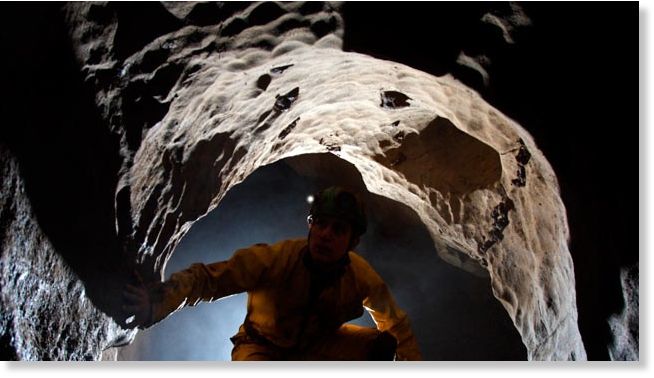
© Getty Images A cave explorer crawls through an arched section of cave passage.
Beate Greithanner, a dairy farmer, is barefoot as she walks up the lush meadows of the Doblberg, a mountain in Bavaria set against a backdrop of snow-capped Alpine peaks. She stops and points to a hole in the ground. "This is where the cow was grazing," she says. "Suddenly she fell in, up to her hips."
A crater had opened up beneath the unfortunate cow.
On the day after the bovine mishap, Greithanner's husband Rudi examined the hole. He was curious, so he poked his head inside and craned his neck to peer into the darkness. Could it be a hiding place for some sort of treasure, he wondered? As he climbed into the hole to investigate, it turned out to be a narrow, damp tunnel that led diagonally into the earth, like the bowels of some giant dinosaur.
Suddenly the farmer could no longer hear anything from above. He panicked when he realized that it was getting difficult to breathe the stifling air -- and quickly ended his brief exploration.
The Greithanners, from the town of Glonn near Munich, are the owners of a strange subterranean landmark. A labyrinth of vaults known as an "Erdstall" runs underneath their property. It is at least 25 meters (82 feet) long and likely stems from the Middle Ages. Some believe that it was built as a dwelling for helpful goblins.
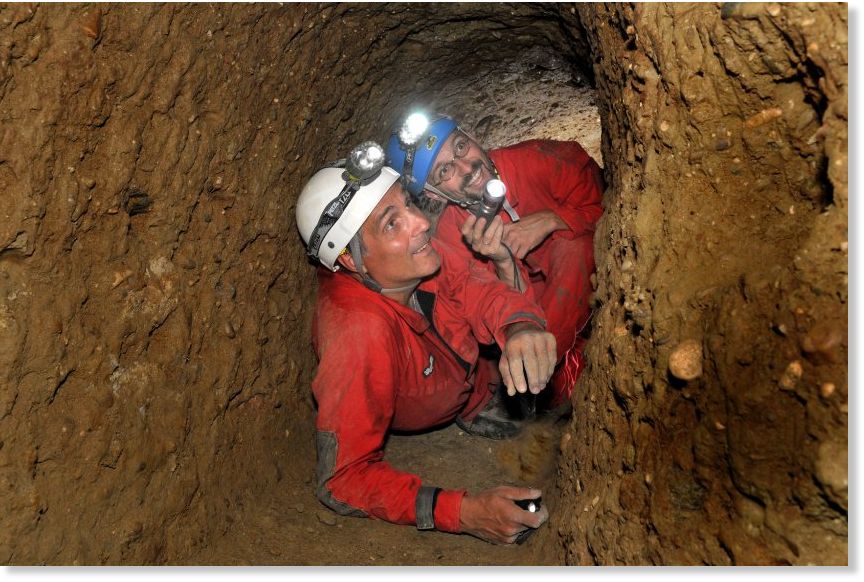
The geologists and land surveyors who appeared on Greithanner's property at the end of June were determined to get to the bottom of the mystery. Three members of a group called the "Working Group for Erdstall Research," wearing red protective suits and helmets, dragged the heavy concrete plate away from the entrance and disappeared into the depths.
Their leader, Dieter Ahlborn, began by crawling through a passageway only about 70 centimeters (2 foot 3 inches) high. His colleague Andreas Mittermüller had to return to the surface when the lack of oxygen in the tunnel gave him a headache. Ahlborn continued crawling into the space until his lamp revealed a decayed piece of wood.
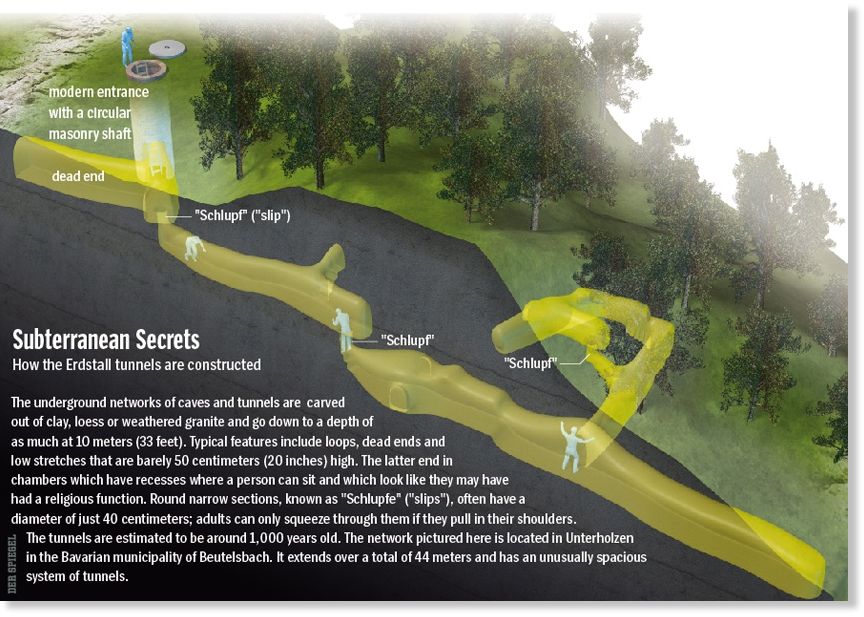
© Der Spiegel Bavaria's mysterious Erdstall tunnels
Meanwhile, in the meadow above, a group from the State Office of Historic Preservation in Munich had marked off the site with colored tape. Then they rolled a three-wheeled cart equipped with ground-penetrating radar across the grass. "The gallery has collapsed at the back," one member of the group explains. "We're figuring out its actual size."
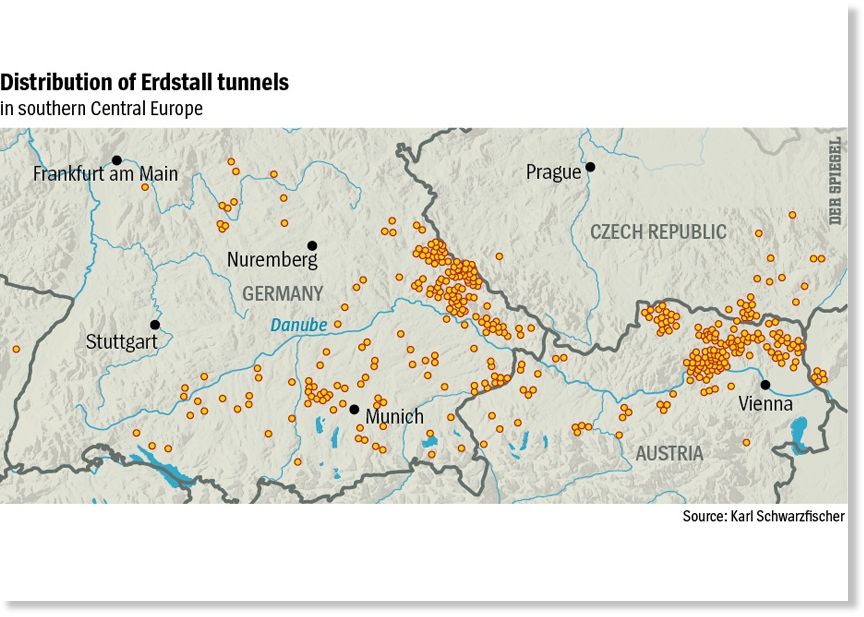
The exploration of the site is a pioneering activity, marking the first time an archeological agency in Germany is showing an interest in an extremely unusual ancient phenomenon. Similar small underground labyrinths have been found across Europe, from Hungary to Spain, but no one knows why they were built.
At least 700 of these chambers have been found in Bavaria alone, along with about 500 in Austria. In the local vernacular, they have fanciful names such as "Schrazelloch" ("goblin hole") or "Alraunenhöhle" ("mandrake cave"). They were supposedly built by elves, and legend has it that gnomes lived inside. According to some sagas, they were parts of long escape tunnels from castles.
In reality, the tunnels are often only 20 to 50 meters long. The larger passageways are big enough so that people can walk through them in a hunched position, but some tunnels are so small that explorers have to get down on all fours. The tiniest passageways, known as "Schlupfe" ("slips"), are barely 40 centimeters (16 inches) in diameter.
The ground beneath the southern German state of Bavaria is literally perforated with these underground mazes -- and no one knows why.
Many galleries are connected to the sites of former settlements. The tunnel entrances are sometimes located in the kitchens of old farmhouses, near churches and cemeteries or in the middle of a forest. The atmosphere inside is dark and oppressive, much as it would be inside an animal den.
'Completely Hushed Up'
For those curious to see what it's like inside the tunnels, innkeeper Vinzenz Wösner offers tours, or "guided crawls," in Münzkirchen, a town in northern Austria.
The tour begins in the taproom and proceeds down a stone stairway into the cider cellar, where there is a trap door that opens into a gaping hole. "We don't let people with heart conditions do the tour," Wösner says in his thick Austrian accent. He keeps a large sling on hand for emergencies, so that if anyone faints he can pull them out of the narrow tunnel.
© Karl Schwarzfischer
Distribution of Erdstall tunnels in southern Central Europe
Distribution of Erdstall tunnels in southern Central Europe
There is not a single written record of the construction of an Erdstall dating from the medieval period. "The tunnels were completely hushed up," says Ahlborn.
Archeologists have also been surprised to find that the tunnels are almost completely empty and appear to be swept clean, as if they were abodes for the spirits. One gallery contained an iron plowshare, while heavy millstones were found in three others. Virtually nothing else has turned up in the vaults.
Until recently, the secret caves were explored only by amateur archeologists. The pioneer of Erdstall exploration, Lambert Karner (1841 to 1909), was a priest. According to his records, he crawled through 400 vaults, lit only by flickering candlelight, with "strange winding passages" through which "one can often only force oneself like a worm."
The tunnels later became the realm of local historians armed with vivid imaginations. They speculated that the caves were used as "winter quarters by the Teutonic tribes" or as dungeons for the disabled. Some of today's more esoteric souls interpret them as "spaces of nonbeing."
© Ben Behnke/ Der Spiegel
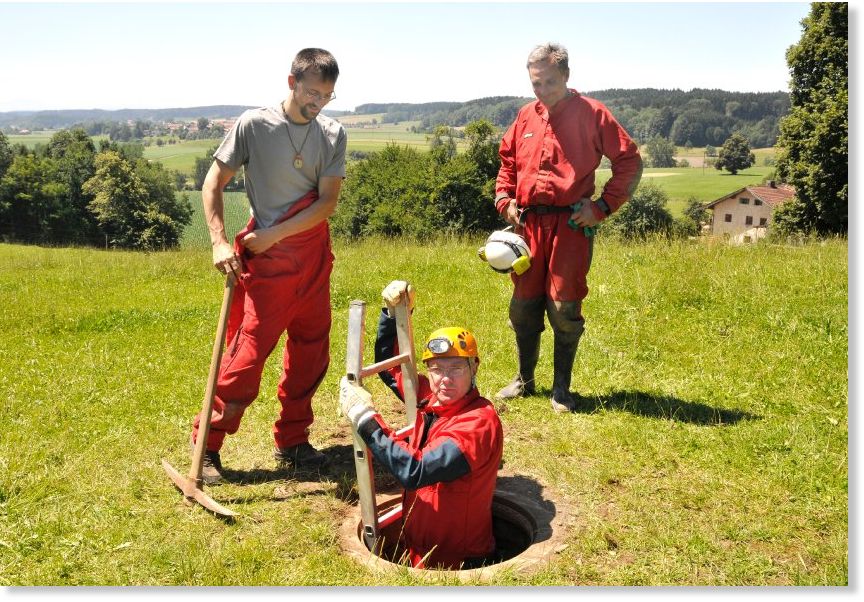
There are more than 700 curious underground passageways in Bavaria, but their purpose remains a mystery. Here, SPIEGEL reporter Matthias Schulz (middle) enters an "Erdstall," as the tunnels are known, together with experts Dieter Ahlborn (right) and Andreas Mittermüller (left).
There are more than 700 curious underground passageways in Bavaria, but their purpose remains a mystery. Here, SPIEGEL reporter Matthias Schulz (middle) enters an "Erdstall," as the tunnels are known, together with experts Dieter Ahlborn (right) and Andreas Mittermüller (left).
At their annual meeting, the amateur explorers combine shoptalk with bold subterranean expeditions. To avoid suffocating, says one member of the group, they recently blew air into a tunnel with a "reversible vacuum cleaner."
An exhibition in the Bavarian city of Passau now makes the subject of these mysterious galleries more accessible to a broader public. One of the hands-on exhibits is a tunnel made of plywood. Posters refer to the actual tunnels as "Central Europe's last great mystery."
The show is generating urgently needed attention. Road and construction crews often stumble upon subterranean galleries, and not knowing what they are, promptly fill them up with dirt.
© Ben Behnke/ Der Spiegel
Ahlborn (left) and Mittermüller investigate an Erdstall in Doblberg
Ahlborn (left) and Mittermüller investigate an Erdstall in Doblberg
The story of Josef Wasmeier from Beutelsbach in Lower Bavaria shows how difficult it is to track them down. There was once a castle not far from his farmstead. It was torn down in the 18th century, and now there is a grove of locust trees on the site.
"According to the legend, there were escape tunnels emanating from the castle hill," says Wasmeier. He and a few friends decided to search for the tunnels. They dug and drilled, day in and day out. "In the end, the only one still digging was Rudi Eichschmied -- every evening, sometimes in the moonlight," says Wasmeier.
The man finally came across an underground cavity.
It led to a unique gallery with walls made of sand. Initially the tunnel went down vertically for 4 meters, and then it continued in a zigzag pattern. There was a narrow "Schlupf" section at the end of the labyrinth. It reminds the researchers of a vagina.
Wasmeier once took a group of female healers down into his cave. The women slid headlong through the tunnel, in complete darkness, as if passing through a birth canal.
© Ben Behnke/ Der Spiegel
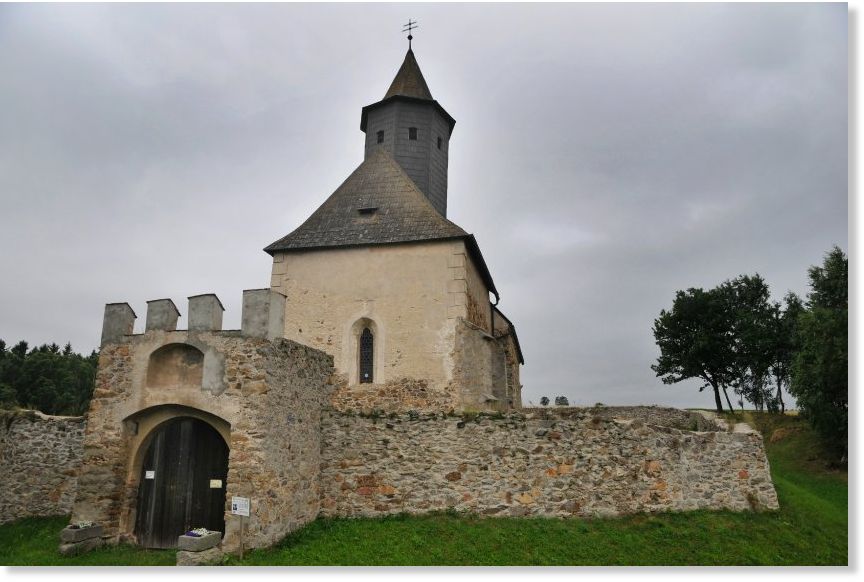
There is an Erdstall tunnel complex under this church in Kleinzwettel, Austria
There is an Erdstall tunnel complex under this church in Kleinzwettel, Austria
'Gateways to the Underworld'
But how old is the vault? The members of the task force were so eager to find an answer that they paid for pollen analyses out of their own pockets.
A few radiocarbon dating analyses have also been performed, and they indicate that the galleries date back to the 10th to the 13th century. Bits of charcoal recovered from the Erdstall tunnels in Höcherlmühle date back to the period between 950 and 1050 A.D.
Heinrich Kusch, a prehistorian from the Austrian city of Graz, believes that these results are incorrect. He suspects that some of the subterranean systems were built about 5,000 years ago, in the Neolithic period. For several years now, he has been probing Austria's Steiermark region with giant drills for "gateways to the underworld."
But Kusch's theory has lost some of its appeal. All of the radiocarbon dating analyses completed to date indicate that the tunnels were built in the Middle Ages, challenging the validity of the prevailing school of thought. It holds that the tunnels were built during the Migration Period (known as the "Völkerwanderung" in German) in the 5th and 6th centuries, when entire tribes left their homes and abandoned the cemeteries of their ancestors. The assumption was that the tunnels and galleries were created so that the dead could still be venerated.
© Ben Behnke/ Der Spiegel
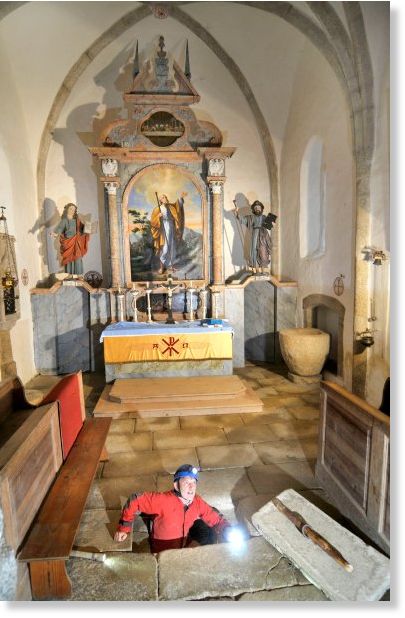
Explorer Josef Weichenberger emerges from the Erdstall into the church
Explorer Josef Weichenberger emerges from the Erdstall into the church
Around the year 1200, the underground labyrinths were filled in and the entrances blocked with rubble. The rubble contained ceramics clearly attributable to the Gothic period.
The confusion over the tunnels is hardly surprising. Some believe that they were used as dungeons for criminals, while others see them as places of healing, where the sick could cast off their afflictions. Still others speculate that they were used by druids.
As a result of the international cooperation of the Erdstall working group, new clues have come to light. The galleries are also concentrated in parts of Ireland and Scotland, and there are also clusters in central France.
This distribution bears intriguing parallels to the routes of the Irish-Scottish traveling monks who, coming from the Celtic north in the 6th century, traveled across the continent as missionaries. The tattooed monks made the passage to the continent from the islands, carrying long staffs and wearing coarse habits.
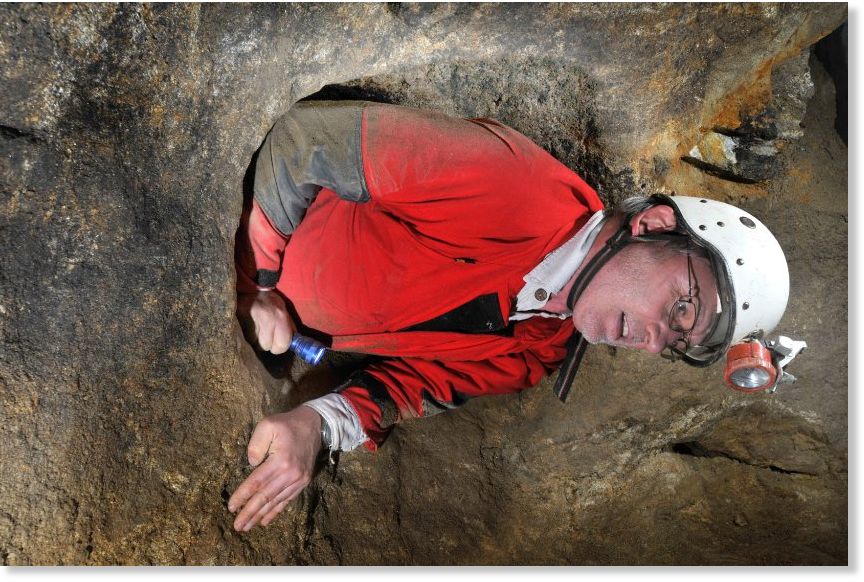
© Ben Behnke/ Der Spiegel Weichenberger in a tunnel complex in Reichersberg. Some of the passages are so narrow that one has to squeeze through them
Ahlborn speculates that these early Christian missionaries also brought along heathen ideas, the remnants of Druid scholarship or special Celtic concepts of the afterlife, which led to the construction of the subterranean galleries.
Perhaps the tunnels were also prisons for demons, evil dwarves and the undead. Some galleries contain traces of building stones and remnants of doors or locks. A sandstone relief was found in an Erdstall at Bösenreutin near the town of Lindau on Lake Constance. It depicts a goblin with a tail attached to its rump.
Were the galleries temples for the superstitious?
Hiding from Bandits
Not everyone finds these spiritual interpretations convincing. Josef Weichenberger can only shake his head when he hears them. He is talking himself into a rage as he speeds from the Bavarian city of Passau toward the Waldviertel region in Lower Austria. "The cult theories are completely erroneous."
Then he offers his interpretation: "The Erdstall galleries were simply hiding places."
Weichenberger's opinion carries some weight. An archivist by profession, he has been crawling through the labyrinths for the last 34 years. He also runs an alarm center from his office. When construction workers report the discovery of an Erdstall, he rushes to the site to document it with a compass and a measuring tape.
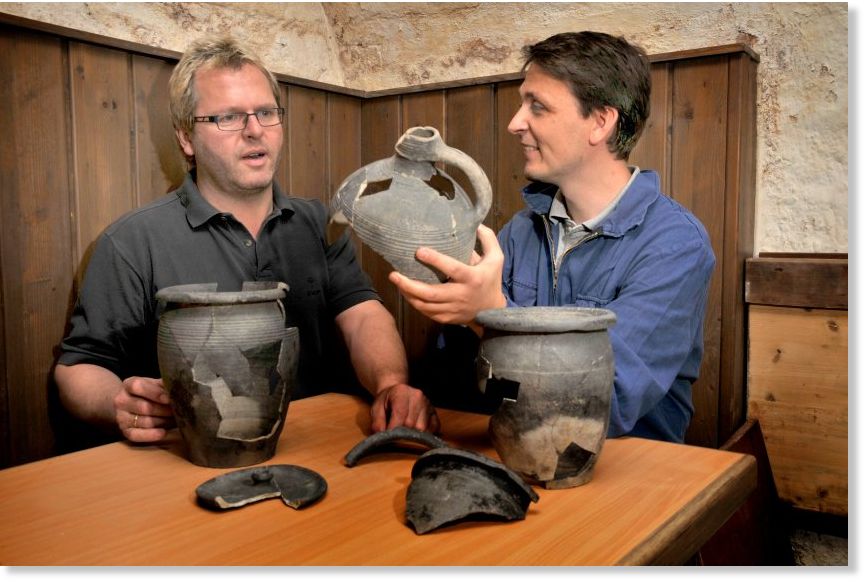
© Ben Behnke/ Der Spiegel Austrian
archaeologist Heinz Gruber (right) shows restored clay pots that were
found in tunnels. On the left is Vinzenz Vösner, who owns an Erdstall
located under his inn
According to Weichenberger, the galleries in his native Austria were built during the "medieval clearing period" in the 11th century. At the time, settlers from Bavaria traveled down the Danube to cultivate land in the east.
Armed with hatchets, they cut swaths into the wilderness. It was not an entirely safe undertaking. Magyars flooded into the area around 1042. Around 1700, the Hungarian rebels known as Kurucs, with the backing of the Ottoman Turks, ransacked the countryside.
Robbers also posed a threat in the region. They raided remote villages and used crowbars to get into the houses. Weichenberger believes that the farmers quickly fled underground "from this vermin," taking their valuables with them.
In Weichenberger's version of the mystery of the subterranean galleries, the terrified villagers would sit in their hiding places underground, their hearts pounding, while the intruders raged above ground, searching in vain for valuables.
He also offers written evidence. "An old account of a death tells the story of a woman who was so afraid of being discovered that she suffocated her screaming baby in an Erdstall."
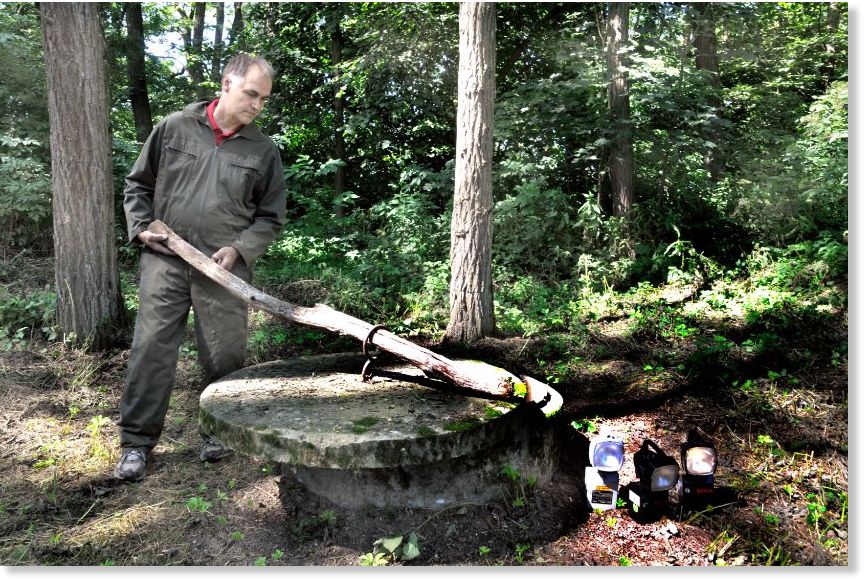
© Ben Behnke/ Der Spiegel Farmer Josef Wasmeier has an Erdstall tunnel complex on his property in Unterholzen
After four hours on the road, we approach the Kleinzwettl fortified church. The ruins once included a drawbridge and a circular rampart. As churches go, it must have been a veritable fortress.
There is also a system of passageways directly beneath the church. When he surveyed it last November, Weichenberger determined that it was 62 meters long. The entrance is under the granite cobblestones in the sanctuary.
A special permit is needed to enter the dim vault, because of the danger of collapse. At first, we make our way through a muddy, serpentine passageway.
The tunnel gradually becomes narrower. A water leak has transformed the rear section into a mud pit. Water drips from the ceiling. The thought of the heavy church columns resting on the ground above is terrifying.
"It's certainly a little uncomfortable here," Weichenberger admits, "but the people were desperate to stay alive."
To substantiate his theory, Weichenberger even hazarded a survival experiment. He and two colleagues were locked into an Erdstall for 48 hours. The oxygen monitors were soon beeping and the candles they had brought along started flickering oddly. The men dozed away, and whenever breathing became too difficult they crawled into other tunnels. The test was a success.
But what does it prove?
"Some galleries were indeed used as hiding places, but only much later," says Ahlborn, promptly dismissing his rival's theory. "They were also uses as toilets and refuse pits."
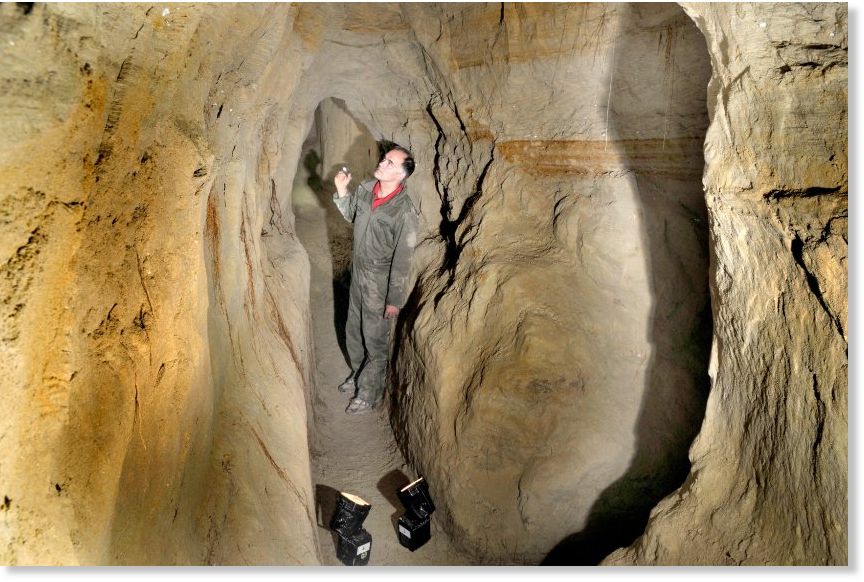
© Ben Behnke/ Der Spiegel Wasmeier enjoys spending time in the underground chambers
Besides, if the terrified villagers were tightly packed into the subterranean vaults during attacks, why did nothing fall out of anyone's pockets? There are no food remains or traces of torches.
For these reasons, most experts attribute a sacred and ritual function to the underground landmarks. Many find the idea of a "chamber of souls" particularly attractive.
According to this theory, the galleries were essentially waiting rooms in which the souls of the dead were to spend the period until the Second Coming of Christ -- the Day of Judgment, when Jesus Christ would judge "the living and the dead."
It wasn't until the 12th century that the theology of purgatory became established, which made it possible for souls to become purified. This meant that good people could ascend to heaven right away. The caves would have been useless at that time, which corresponds to the period when they were filled in.
But even this view doesn't explain why the sacred vaults were kept such a secret. And why are there no Erdstalls in Switzerland or in the Black Forest?
For now, the mystery must remain unsolved. "We could use the help of physicists with radiocarbon dating expertise, theologists and specialists in prehistoric mining," says Ahlborn. Not a single doctoral thesis has been written on the subject to date. The dark tunnels are still virtually unknown among academics.
This doesn't trouble farmer Josef Wasmeier. He loves his Erdstall, particularly because of its mysterious aura. Sometimes he crawls into his sandy private cave for half an hour in the evening and meditates. It's "completely quiet" inside, he says, dark and distant like a womb.
"And when I climb back up again, the stars seem so bright you feel you could almost touch them."
Source: Der Spiegel
Translated from the German by Christopher Sultan
Thursday, March 12, 2015
Brezel in Bayern ist 250 Jahre alt !
Look what's been FOUND! From a Step into German post

The 250 year-old pretzel being analyzed by experts. Photo: DPA
Bavarian archaeologists find 250-year-old pretzel
Archaeologists have made a remarkable - and delicious - discovery in Bavaria, where during an excavation they dug up a 250 year-old pretzel.
Silvia Codreanau-Windauer from the Bavarian Bureau for the Conservation of Historic Monuments confirmed that: "this is definitely the oldest pretzel ever found" - although she would give no word on whether it was past its expiration date.
Alongside the remains of the pretzel, archaeologists also found the charred remains of a bread roll and a croissant - suggesting that someone missed out on quite the historical breakfast buffet in the 18th century, the period the find has been dated to.
The baked goods are only preserved because they were burnt when originally made. Archaeologists suggest that the baker must have thrown them away in disappoinment.
The excavation site in the eastern Bavarian city of Regensburg has already proven a fruitful source for archaeologists, who discovered a wooden house thought to be up to 1200 years old there.
On this site, which lies on the Danube, there are plans to build a museum for Bavarian history to mark the centenary of the region's status as a free state in 2018.
The mayor of Regensburg Joachim Wolbergs said. "This discovery is really extraordinary, because it depicts a snippet of everyday life."
The baked delicacy is very much a part of everyday life. Pretzels may be seen as typically German by non-Germans, but really are very much a south German and Austrian delicacy.
It has been at the heart of southern German baking traditions for centuries, and in Bavaria in particular is often eaten for breakfast alongside Weißwürst (white sausage) with sweet mustard.
Codreanu-Windauer added some historical context to the discovery: "The form of the pretzel is supposed to represent the crossed arms of monks. Eventually it ended up as a fasting meal."
Monks are the symbol for the state capital Munich, and different orders and monasteries give their names to many of the Free State's most famous beers, from Augustiner to Weihenstephan - any of which are all the more delicious when enjoyed with a salty pretzel.
Saturday, June 14, 2014
Our Story: Levy Strauss and his Jeans
Levi
Strauss, the inventor of the quintessential American garment, was born
in Buttenheim, Bavaria on February 26, 1829 to Hirsch Strauss and his
second wife, Rebecca Haas Strauss; Levi had three older brothers and
three older sisters. Two years after his father succumbed to
tuberculosis in 1846, Levi and his sisters emigrated to New York, where
they were met by his two older brothers who owned a NYC-based wholesale
dry goods business called “J. Strauss Brother & Co.” Levi soon began
to learn the trade himself.
The Invention of the Blue Jean
May
20, 1873 marked an historic day: the birth of the blue jean. It was on
that day that Levi Strauss and Jacob Davis obtained a U.S. patent on the
process of putting rivets in men’s work pants for the very first time.
The very first jeans were made out of denim - the traditional fabric for men's
workwear. Within a very short time, the jean was a bona fide success.

Soon, the first riveted clothing was made and sold. We made our first jeans out of denim — the traditional fabric for men’s workwear. Within a very short time, the jean was a bona fide success. (Although, we should note that they were called “waist overalls” or “overalls” until 1960, when baby boomers adopted the name “jeans.”)
May 20, 1873 is the “birthday” of blue jeans, because, although denim pants had been around as work-wear for many years, it was the act of placing rivets in these traditional pants for the first time that created what we now call jeans.
The next time you see someone wearing a pair of Levi’s® jeans, remember that these pants are a direct descendant of that first pair made back in 1873. That year, two visionary immigrants — Levi Strauss and Jacob Davis — turned denim, thread and a little metal into what has become the most popular apparel on earth.
Family History and Business
Levi
Strauss, the inventor of the quintessential American garment, was born
in Buttenheim, Bavaria on February 26, 1829 to Hirsch Strauss and his
second wife, Rebecca Haas Strauss; Levi had three older brothers and
three older sisters. Two years after his father succumbed to
tuberculosis in 1846, Levi and his sisters emigrated to New York, where
they were met by his two older brothers who owned a NYC-based wholesale
dry goods business called “J. Strauss Brother & Co.” Levi soon began
to learn the trade himself.
Around 1872, Levi received a letter from one of his customers, Jacob Davis, a Reno, Nevada tailor. In his letter, Davis disclosed the unique way he made pants for his customers, through the use of rivets at points of strain to make them last longer. Davis wanted to patent this new idea, but needed a business partner to get the idea off the ground. Levi was enthusiastic about the idea. The patent was granted to both men on May 20, 1873; the day the blue jean was born.

Levi carried on other business pursuits during his career, as well. He became a charter member and treasurer of the San Francisco Board of Trade in 1877. He was a director of the Nevada Bank, the Liverpool, London and Globe Insurance Company and the San Francisco Gas and Electric Company. In 1875, Levi and two associates purchased the Mission and Pacific Woolen Mills.
He was also one of the city’s greatest philanthropists. Levi was a contributor to the Pacific Hebrew Orphan Asylum and Home, the Eureka Benevolent Society and the Hebrew Board of Relief. In 1897 Levi provided the funds for twenty-eight scholarships at the University of California, Berkeley, all of which are still in place today.
At the end of the 19th century, Levi was still involved in the day-to-day workings of the company. In 1890 — the year that the XX waist overall was given the lot number “501®” — Levi and his nephews officially incorporated the company.
Levi Strauss passed away on Friday, September 26th 1902. His estate amounted to nearly $6 million, the bulk of which was left to his four nephews and other family members, while donations were made to local funds and associations.
We’re proud to honor Levi Strauss’s legacy by celebrating his commitment to community, philanthropy and an unswerving devotion to quality. To this day, Levi Strauss & Co. strives to align itself with the same principles that guided Levi’s life.
Wednesday, January 15, 2014
voXXclub singt UNSER LIED: Rosamunde!
Rosamunde beginnt nach dem Geburtstagslied zu Claudia , ungefaehr in der 2. Minute:
UND...
Hier ein neuer Version des Lieblingslied: ROCK mi...
UND:
Noch ein schoenes voXXclub Lied:
He mein Maedel, wollen wir tanzen??
Die Nacht gehoert uns zwei...
UND: Ein kleines Kind... mit Florian Silbereisen
(Ich will verstehen, genau welche Jungen immer noch in der voXXclub Band sind; bin immer noch nicht sicher...)
Alle sechs Mitglieder interviewen, ueber Oktoberfest, ueber ihr Wiesenhit, und ueber Wiesen-Maedls (Bayrisch: Maedchen / in "Bavarian: Girls"). Interessant.
UND...
Hier ein neuer Version des Lieblingslied: ROCK mi...
UND:
Noch ein schoenes voXXclub Lied:
He mein Maedel, wollen wir tanzen??
Die Nacht gehoert uns zwei...
UND: Ein kleines Kind... mit Florian Silbereisen
(Ich will verstehen, genau welche Jungen immer noch in der voXXclub Band sind; bin immer noch nicht sicher...)
Alle sechs Mitglieder interviewen, ueber Oktoberfest, ueber ihr Wiesenhit, und ueber Wiesen-Maedls (Bayrisch: Maedchen / in "Bavarian: Girls"). Interessant.
Tuesday, September 17, 2013
Politik und die Wahl
vom Kinder Radio Kanal Willst du zuhoeren? DANN HIER CLICKEN!

Seehofer siegt (wins) in Bayern
Am Wochenende wurde in Bayern gewählt.
Wednesday, August 15, 2012
Subscribe to:
Posts (Atom)