Who in the US is working up Russian dance numbers?
Hier bei einem Sommerfest geht es, auf Deutsch, weiter... (More of this type of music, but this time in German - at a Summer Festival)
Etwas zu Karneval?
Showing posts with label Russia. Show all posts
Showing posts with label Russia. Show all posts
Saturday, October 24, 2015

Friday, September 4, 2015
Sprechen Sie power?
I am always interested to read this British publication's articles about its neighbor and in many ways, still its nemesis, Germany. -rsb
ECONOMIST - Charlemagne
Once the language of Schiller and Goethe, then of Hitler, German is hip again


-- It used to take an introduction to this old script to decipher German. Hitler did away with that.--rsb
SUCH was the status of German in the 19th century—for Europeans generally and for Jews in particular—that Theodor Herzl, the founder of Zionism, once proposed making it the official language of a future state of Israel. In the event, devotees of Hebrew won out. After the Holocaust, German was particularly despised. But times change. Israeli 14- to 15-year-olds going back to school after the summer holidays now have the option of German as a foreign language for the first time at five public schools, to be followed by more.
German is also becoming popular among adult Israelis, and not only the more than 20,000 who have moved to Berlin in recent years. This reflects a broader shift in perceptions.
Fifty years after Germany and Israel established diplomatic relations, 70% of Israelis have a positive view of the country, according to a poll by the Konrad Adenauer Foundation, a German think-tank. Many find Germans honest and trustworthy. With the possible exception (at least lately) of Greece, people elsewhere agree, polls show.
This suggests a big gain for Germany in “soft power”. Joseph Nye of Harvard University, who coined the term in 1990, defines it as the ability of a country to hold international sway not by brandishing hard (military) power but by getting others to want what it wants. It is the value of being attractive culturally, commercially, gastronomically, ideologically, or indeed linguistically.
Germans, who are forever coping with their dark past, are thrilled by any suggestion that they are popular. They have come to distrust hard power since 1945 (to a fault, if you ask Germany’s partners in NATO). The country’s political dominance in Europe during the euro-zone crisis discomfits many Germans. Economic prowess and soft power is (almost) all they will allow themselves. And now they have it. Monocle, a British magazine, ranks countries by soft power and had Germany as the surprise winner in 2013 and runner-up in 2014, wedged between anglophone America in first place and Britain in third.
In a chicken-and-egg way, language both reflects and generates soft power, says Ulrich Ammon, author of “The Status of the German Language in the World”, published this year. German ranks tenth in the number of native speakers. But it is fourth in the economic output produced by them (including Austrians, Belgians, Liechtensteiners, Luxembourgers, Swiss and others). German is also fourth by number of learners, trailing English, Chinese and French and roughly tied with Spanish, according to Mr Ammon. Some 15.5m people now study German, 4% more than five years ago.
In the slow-moving world of language, that is a steep rise, says Mr Ammon.
The overall increase is especially impressive since teaching of German is collapsing in Russia, where privileges given to German over English during the cold war have been phased out. Interest is growing fastest in Africa, Asia and eastern Europe, with the Balkans a hotspot. Many learn it mostly to boost their careers. Some hope to get a job in Germany, where certain industries are short of labour because the population is shrinking. Others want to engage Germany’s prodigious exporters. An interest in German culture develops along the way.
Germany’s government tries to promote the trend. But compared with, say, China, which is aggressively pushing its Confucius Institutes, Germany seems shy about it. It does not share France’s prickly obsession with defending the national tongue. And when France talked of a school reform that would have the (unintended) consequence of reducing German teaching, officials in Berlin merely muttered. German is hardly ever taught as a first foreign language in schools anywhere. Officials simply hope to make German the second or third on offer in more places.
Moreover, ordinary Germans seem blasé about pushing their language on others. Linguistically ambitious expats in Germany complain that many locals prefer to reply in English. And even when Germans speak Deutsch, it is so littered with Anglicisms that purists fret about a spreading patois called Denglisch. (Beware false friends, foreigners: Handy is not an adjective but a mobile phone.)
An even older gripe is that German is too hard to bother with. In 1880 Mark Twain complained in “The Awful German Language” that the treatment of gender—so that “a young lady has no sex, while a turnip has”—borders on perverse. And nouns “are not words, they are alphabetical processions”. Twain sensibly suggested the language should be “trimmed down and repaired”.
The Germans have not heeded his advice, in fact, changes to spelling in the 1990s, many think, made matters worse. Fortunately, however, the task is not as futile as Twain suggested. With its predictable spelling and pronunciation, German can be mastered, whereas English, with its protean spelling and word order, may seem easy but prove treacherous.
Cunning linguists?
It is obviously beneficial to a country if more people speak its language. At best, that language becomes a lingua franca,
as English is. German never will be. But its growing use still helps.
It equips more people around the world to work in Germany, which the
country needs as it ages.Proficiency lets more foreigners understand how Germans think. It may convey, for example, the moralistic approach Germans have towards debt (Schulden), which is etymologically close to guilt (Schuld). The word for nipple (Brustwarze, or “breast wart”) may point to export limitations in the romantic genre. But no other language matches German’s capacity to describe Fahrvergnügen (driving pleasure). And though many languages have polite forms of address, the awkwardness over when to switch from the formal Sie to the informal du says much about German social norms. Even as German power grows, more may see in each German the whole human, or rather the Mensch.
Tuesday, December 2, 2014
German troops to tip new Nato 'spearhead'
Danke, Jaeger.
Ich moechte auch heraufladen wo du diesen Artikel fandest. -- rsb

Soldiers of the German/Netherlands Corps will form much of the new Nato force. Photo: DPA
Published: 02 Dec 2014 16:30 GMT+01:00
Amid rising tensions with Russia over Ukraine, Nato foreign ministers met in Brussels on Tuesday to accelerate the formation of a rapid response force due to include 4,000 German troops.
"Ukraine has conducted itself honorably in holding up the [Minsk] Protocol, Russia and the separatists haven't done so", Nato Secretary-General Jens Stoltenberg said.
"We call on Russia to fulfill its obligations."
The Minsk agreement, signed in early September, called for a ceasefire and the establishment of a buffer zone between Ukrainian government forces and pro-Russian separatists.
But fighting has continued in the conflict zone, with evidence pointing to Russia delivering tanks and heavy weapons to separatist fighters and breaking international law.
Nato has also criticized Russia's plans for increasing its military presence in the Black Sea, saying that it could further destabilize the region.
"We strongly condemn Russia's continuing and wilful destabilization of eastern Ukraine", the Nato foreign ministers said in a joint statement with the Ukrainian government.
'Spearhead' to deploy to crisis zones
Responding to Russian actions in Ukraine this year, the 28-member Nato alliance agreed at a September summit in Wales to create a 'spearhead' to the existing Nato Reponse Force (NRF).
Capable of deploying in 2-5 days to crisis zones, especially at Nato's periphery, the 'Very High Readiness Joint Task Force' (VJTF) may now take shape next year rather than in 2016.
The exact size and composition of the force - and who will pay for it - are still under discussion and are expected to be announced at a meeting of Nato defense ministers in Munich in February.
Poland and the three Nato members of the former Soviet Baltic republics are especially fearful of Russian military incursions as the conflict deepens in Ukraine.
The decision to form the VJTF was a "clear sign to our allies in the East and a clear sign to Russia," a Nato official told Die Welt newspaper earlier.
Ukraine to join Nato?
Meanwhile, Stoltenberg said on Monday that the alliance would increase its support for Ukraine and that the former Soviet republic's long-sought membership of Nato was not ruled out.
Russia responded to the statement by announcing new naval exercises.
Defense officials in Berlin have said Germany will provide around 4,000 troops for the new force, drawn mainly from the Münster-based German/Netherlands Corps.
The alliance currently maintains an immediate response force of 13,000 high-readiness troops. As scheduled, Germany will in 2015 assume the rotating command of this force. It will also take a lead role in the formation of the VJTF.
Nato has indicated that the spearhead will be a multi-service as well as multi-national formation. It will comprise a land component with air, maritime and Special Operations Forces available.
As for the geographical extent of its potential deployment, this will depend on specific threats towards Nato members and how the alliance as a whole responds to them.
Asked whether Nato would take part in a land operation in Syria, for example, Stoltenberg said in Warsaw last month that Nato remained fully committed to defending the territorial integrity of all allies, including Turkey, which directly borders on the Syrian conflict region.
“There will be possibilities to deploy land forces if we see any actions or developments that put security at risk,” Stoltenberg said.
Monday, October 20, 2014
Study Abroad Scholarship Opportunities 2015
Hi Students:
Might you be inspired by the opportunities offered by these programs? They are all worth a look!
They have been pursued by only a handful of NKHS students in the past, but they have made amazing - certainly life-changing differences on each of those individuals!
Last year for instance, Katja (Kayla L.) spent the year in Leipzig through CBYX (which started the day after owe had returned from our GAPP exchange; this summer we should have a bit more breathing room). This past summer, Sadie H. spend 5 weeks in Russia through NSLI-Y. Both are recently back. Perhaps you'd like to approach them with your questions as well.
Let me know how I might help!
Yours truly
Frau Baker
Dear Mrs. Baker
Please see the message below from the U.S. Department of State regarding some well-known and highly regarded opportunities for K-12 language learners, (particularly HIGH SCHOOL STUDENTS) including:
· National Security Language Initiative for Youth (NSLI-Y);
· Kennedy-Lugar Youth Exchange and Study Abroad (YES Abroad); and
· Congress-Bundestag Youth Exchange (CBYX) with Germany
Please note that the deadlines for these initiatives are fast-approaching.
Please forward this message to your networks if you are able to do so.
Many warm regards,
Ryan T. Wertz
President
National Council of State Supervisors for Languages
From: Rougle, Tara E [mailto:RougleTE@state.gov]
Sent: Friday, September 26, 2014 3:38 PM
To: Wertz, Ryan
Subject: U.S. Dept. of State Study Abroad Scholarship Programs for U.S. High School Students
Sent: Friday, September 26, 2014 3:38 PM
To: Wertz, Ryan
Subject: U.S. Dept. of State Study Abroad Scholarship Programs for U.S. High School Students
Dear Mr. Wertz:
I am a Program Officer in the Youth Programs Division at the U.S. Department of State, and I am writing to let you know about several opportunities we have for U.S. high school students to study abroad. We would like to ask if you could share this information with your networks. Thank you so much for your previous assistance in sharing information about our programs with your networks. We greatly appreciate your spreading the word about these opportunities.
Our study abroad programs for U.S. high school students are merit-based scholarship programs. Most programs have no language prerequisites and usually beginners are welcome. Gap year students are also encouraged to apply for most programs, as long as they remain age eligible. We are particularly trying to reach young people who would not otherwise have the opportunity to participate in a study abroad experience.
Here are the upcoming deadlines by program, which are also included in the attached announcement. Please note the first deadline, for the NSLI-Y program, is coming up soon.
- National Security Language Initiative for Youth (NSLI-Y) October 30, 2014.
- Kennedy-Lugar Youth Exchange and Study Abroad (YES Abroad) January 7, 2015
- Congress-Bundestag Youth Exchange (CBYX) with Germany deadlines vary by state (Dec., 2014 – Jan., 2015) ______________
The attached short announcement about our programs can be shared via an email distribution list, e-newsletter, Facebook or website posting, etc. I have also cut and pasted the announcement below. In addition, please let me know if you would like to receive printed brochures and/or posters about our programs, which we can also send to you.
Thank you again for your assistance in spreading the word about these programs. If you have any questions, please feel free to email or call me at the number below.
Sincerely,
Tara Rougle
Tara E. Verdonk Rougle
Program Officer
Youth Programs Division
Bureau of Educational and Cultural Affairs (ECA)
U.S. Department of State
2200 C Street, N.W.
Building SA-5, Third Floor
Washington, D.C. 20522-0503
Tel: 202-632-6082
Fax: 202-632-9355
The U.S. Department of State Announces
Scholarships for American High School
Students to Study Abroad
The National Security Language Initiative for Youth (NSLI-Y) offers merit-based scholarships to study one of seven critical foreign languages: Arabic, Chinese (Mandarin), Hindi, Korean, Persian (Tajiki), Russian and Turkish. The NSLI-Y program is designed to immerse participants in the cultural life of the host country, provide formal and informal language practice, and spark a lifetime interest in foreign languages and cultures. The application deadline for summer 2015 and academic year 2015-2016 programs is October 30, 2014. Visit www.nsliforyouth.org for more information.
The Kennedy-Lugar Youth Exchange and Study (YES) Abroad Program offers merit-based scholarships to spend an academic year in countries that may include Bosnia & Herzegovina, Egypt, Ghana, India, Indonesia, Macedonia, Malaysia, Mali, Morocco, Oman, Philippines, South Africa, Thailand, Tunisia, and Turkey. This program increases understanding between people in the United States and people in countries with significant Muslim populations. Students live with host families, attend local high schools, do community service, and complete a capstone project. Applications for academic year 2015-16 programs are due January 7, 2015. Visit www.yes-abroad.org for more information.
The Congress-Bundestag Youth Exchange Program (CBYX) offers merit-based scholarships to spend an academic year in Germany. The program was established in 1983 to celebrate German-American friendship based on common values of democracy. Students live with host families, attend local schools, and participate in community life in Germany. For more information and application deadlines, visit the organization in charge of recruitment for your state at http://www.
For more information on exchanges sponsored by the U.S. Department of State’s Bureau of Educational and Cultural Affairs, visit www.exchanges.state.gov or watchthis video about U.S. high school student exchanges. To receive printed brochures and/or posters about our study abroad opportunities, send an email with your request toyouthprograms@state.gov.
For information on having an international experience without leaving home, consider hosting a Department of State- sponsored exchange student. Learn more athttp://hosting.state.gov
Friday, August 22, 2014
25 Years Since the Fall of the Berlin Wall
Border patrol guards had lost permission to shoot at will at border crossings in the spring of 1989. This inspired East-Germans to abandon their apartments and risk everything to live elsewhere. For better or worse, these people felt a need to leave the guided life available to them under Russian influence, and instead, wanted to be in charge of their own futures.
25 years later, there are plenty of people who miss the security they had under communism. The term for this is "Nostalgie," or nostalgia for the East (Ost).
Differences between the two styles of government are becoming even more clear now, with
Here is a 2 minute news clip, which follows the emotions on both sides of this historical event from the perspective of the Soebel family. They were on a camping trip in Hungary 25 years ago, read about the offer to pass through a gap in the wall that afternoon on a flier posted to a tree in their campground, and took up the offer! Guards did not fire upon the picnickers in Hungary, who on the afternoon of August 19, 1989, slipped through a momentarily-opened border with Austria. Rather than just freeing a handful of citizens, hundreds slipped through that brief gap, setting the tone for what was soon to follow.
http://www.zdf.de/
hes-Picknick#/beitrag/video/
BERLIN IN PHOTOS TODAY
20 second video: Berlin today:
Pilpop filmt Berlin (in Miniatur?) "Little Big Berlin"
"I dedicate this film to Berlin where I have been living for 19 years now. While the architecture of Berlin is stunningly beautiful, only its inhabitants make Berlin the unique city that it is. In every corner there is something new to discover. And the best thing to do is to film it.
Filmed with my beloved Sony HC9. Edited with Sony Vegas Pro 9.The miniature effect is called tilt-shift, which originates from a particular lens that was used to photograph architecture. The miniature effect is a by-product of that. It can also be achieved by digital postprocessing.
Music: "Hungarian Rhapsody No. 2" by Franz Lisz "
-- Does life in Berlin seem that much different than our own? Different in which ways?
All sorts of press infos regarding the Fall of the Berlin Wall can be found here:
HIER GIBT ES ALLERLEI PRESSEMATERIAL ZUM MAUERFALL
25 years later, there are plenty of people who miss the security they had under communism. The term for this is "Nostalgie," or nostalgia for the East (Ost).
Differences between the two styles of government are becoming even more clear now, with
- the border disputes between Russia and the Ukraine;
- attacks by radical islamic organizations against capitalist democracies;
- Edward Snowden finding shelter in Russia after his revelations;
Here is a 2 minute news clip, which follows the emotions on both sides of this historical event from the perspective of the Soebel family. They were on a camping trip in Hungary 25 years ago, read about the offer to pass through a gap in the wall that afternoon on a flier posted to a tree in their campground, and took up the offer! Guards did not fire upon the picnickers in Hungary, who on the afternoon of August 19, 1989, slipped through a momentarily-opened border with Austria. Rather than just freeing a handful of citizens, hundreds slipped through that brief gap, setting the tone for what was soon to follow.
http://www.zdf.de/
hes-Picknick#/beitrag/video/
BERLIN IN PHOTOS TODAY
20 second video: Berlin today:
Pilpop filmt Berlin (in Miniatur?) "Little Big Berlin"
"I dedicate this film to Berlin where I have been living for 19 years now. While the architecture of Berlin is stunningly beautiful, only its inhabitants make Berlin the unique city that it is. In every corner there is something new to discover. And the best thing to do is to film it.
Filmed with my beloved Sony HC9. Edited with Sony Vegas Pro 9.The miniature effect is called tilt-shift, which originates from a particular lens that was used to photograph architecture. The miniature effect is a by-product of that. It can also be achieved by digital postprocessing.
Music: "Hungarian Rhapsody No. 2" by Franz Lisz "
-- Does life in Berlin seem that much different than our own? Different in which ways?
All sorts of press infos regarding the Fall of the Berlin Wall can be found here:
HIER GIBT ES ALLERLEI PRESSEMATERIAL ZUM MAUERFALL
Tuesday, August 19, 2014
Herzlich willkommen nach Hause, Königin der Herzen, Conchita Wurst
Bei einem freien Konzert in Wien Ballhausplatz-
1. Do You Believe in Life After Love (No Matter How Hard I Try, There's No Talking To You..I really don't think I'm strong enough..)
2. That's My Destiny (Conchita's 2012 Eurovision Song attempt, in which she placed 2nd in Austria)
3. Rise Like a Phoenix (Europe's 2014 Eurovision's Top Song)
4. My Heart Will Go On (This song changed Conchita's life)
Der Sieg der Freiheit, der Offenheit, der Toleranz...was Tom Neuwirth vom Anfang an gekämpft hat.
Und ist Conchita plötzlich eine Politikerin?
1. Do You Believe in Life After Love (No Matter How Hard I Try, There's No Talking To You..I really don't think I'm strong enough..)
2. That's My Destiny (Conchita's 2012 Eurovision Song attempt, in which she placed 2nd in Austria)
3. Rise Like a Phoenix (Europe's 2014 Eurovision's Top Song)
4. My Heart Will Go On (This song changed Conchita's life)
Der Sieg der Freiheit, der Offenheit, der Toleranz...was Tom Neuwirth vom Anfang an gekämpft hat.
Und ist Conchita plötzlich eine Politikerin?
Eurovision’s Conchita brings out Russia’s worst and Europe’s best

The most complicated thing said over this past weekend by a public figure came from the perfectly rouged lips of the winner of the Eurovision song contest, Conchita Wurst. “I really dream,” she said, “of a world where we don’t have to talk of unnecessary things like sexuality.”
That’s silly on two levels and deeply idealistic on a third. It’s silly, first and most evidently, because sexuality won’t be unnecessary for a long while, and may last as long as this world does.
It’s silly, second and most personally, because Wurst (her second, adopted name means “sausage” but apparently is also Austrian German slang for “whatever…”) had just won the first prize in the world’s wackiest tournament – the Eurovision Song Contest held this year in the Danish capital Copenhagen. She was dressed in the slinkiest of gowns hugging a perfectly sexy figure, the perfectly rouged lips set off by a perfectly trimmed black beard. ‘Unnecessary’ had nothing to do with it.
The statement is deeply idealistic because what she was saying was: it’s time we stopped thinking that it’s necessary to make a fuss about a man who’s become a woman and grown a beard. I have my thing and you have yours and if we don’t hurt each other, who is to say who’s better? It’s like … whatever.
Conchita, born Thomas Neuwirth in a small Austrian town is a kind of mascot for the European Union, which takes pride in being neither one thing nor the other – it passes laws, but is most definitely not a single state.
Conchita is everything the EU aspires to be in the eyes of the world – open, tolerant, plural, wholly accepting of every kind of sexuality in every kind of expression, shorn of narrow, cramping, sexual assumptions. She sang, in her winning number “Rise like a Phoenix” that “once I’m transformed, once I’m reborn, (I will) Rise like a phoenix!” – like the mythical bird, rising from the ashes, in Conchita’s case, the ashes of sexual prejudice.
The Russians didn’t see things that way: Conchita was fully aware of that, telling reporters on Sunday that “This was of course directed against some politicians that we know…” “Putin?” “Among others.”
Maybe she also meant back home in Austria, where less than a quarter of one of the EU’s more conservative states had expressed themselves in polls as proud that she was representing their country.
But none expressed themselves publicly like leading Russian politicians felt it was necessary to do. Deputy Prime Minister Dmitry Rogozin employed sarcasm: he tweeted that the win “showed supporters of European integration their European future: a bearded girl.”
Culture Minister Vladimir Medinsky preferred irony. Claiming he was distressed that his children had watched Eurovision, he tweeted — “how am I going to explain all this to them in a ‘politically correct’ and ‘tolerant’ way?”
More crudely, the never-to-be-outdone leader of the Liberal Democratic Party Vladimir Zhirinovsky spat that “Fifty years ago the Soviet Army occupied Austria. We should have stayed there.”

As Conchita celebrated the ballot results in Copenhagen, the organizers of a grimmer referendum in eastern Ukraine set up booths in schools, churches and the streets to tally support for a vaguely worded resolution that could lead Donetsk, Slavyansk and Luhansk to greater autonomy and, perhaps, a union with Russia. And what a Russia it has become.
European tolerance is seen by its leaders as degeneracy; a willingness to acquire territory by force and by guile; an attachment to race, so that ethnic Russians everywhere outside of Russia should be seen as “ours” and, where possible, brought back – along with the land they live on — to Mother Russia.
In case there’s any question about how all of this is playing in the rest of Europe, the Eurovision contest offers another insight.
Russia’s contestants, two sweet-faced sisters named Tolmachevy, suffered boos when they qualified for the finals. A long way from its 2012 entry, the Buranovskiye Babushki, a group of grannies whose sprightly number — “Party for everybody” — got a standing ovation and nearly won the whole competition.
What a difference intolerance, and an invasion, makes.
PHOTO: Conchita Wurst representing Austria performs the song “Rise Like a Phoenix” after winning the grand final of the 59th Eurovision Song Contest at the B&W Hallerne in Copenhagen May 10, 2014. REUTERS/Tobias Schwarz
The most complicated thing said over this past weekend by a public figure came from the perfectly rouged lips of the winner of the Eurovision song contest, Conchita Wurst. “I really dream,” she said, “of a world where we don’t have to talk of unnecessary things like sexuality.”
That’s silly on two levels and deeply idealistic on a third. It’s silly, first and most evidently, because sexuality won’t be unnecessary for a long while, and may last as long as this world does.
It’s silly, second and most personally, because Wurst (her second, adopted name means “sausage” but apparently is also Austrian German slang for “whatever…”) had just won the first prize in the world’s wackiest tournament – the Eurovision Song Contest held this year in the Danish capital Copenhagen. She was dressed in the slinkiest of gowns hugging a perfectly sexy figure, the perfectly rouged lips set off by a perfectly trimmed black beard. ‘Unnecessary’ had nothing to do with it.
The statement is deeply idealistic because what she was saying was: it’s time we stopped thinking that it’s necessary to make a fuss about a man who’s become a woman and grown a beard. I have my thing and you have yours and if we don’t hurt each other, who is to say who’s better? It’s like … whatever.
Conchita, born Thomas Neuwirth in a small Austrian town is a kind of mascot for the European Union, which takes pride in being neither one thing nor the other – it passes laws, but is most definitely not a single state.
Conchita is everything the EU aspires to be in the eyes of the world – open, tolerant, plural, wholly accepting of every kind of sexuality in every kind of expression, shorn of narrow, cramping, sexual assumptions. She sang, in her winning number “Rise like a Phoenix” that “once I’m transformed, once I’m reborn, (I will) Rise like a phoenix!” – like the mythical bird, rising from the ashes, in Conchita’s case, the ashes of sexual prejudice.
The Russians didn’t see things that way: Conchita was fully aware of that, telling reporters on Sunday that “This was of course directed against some politicians that we know…” “Putin?” “Among others.”
Maybe she also meant back home in Austria, where less than a quarter of one of the EU’s more conservative states had expressed themselves in polls as proud that she was representing their country.
But none expressed themselves publicly like leading Russian politicians felt it was necessary to do. Deputy Prime Minister Dmitry Rogozin employed sarcasm: he tweeted that the win “showed supporters of European integration their European future: a bearded girl.”
Culture Minister Vladimir Medinsky preferred irony. Claiming he was distressed that his children had watched Eurovision, he tweeted — “how am I going to explain all this to them in a ‘politically correct’ and ‘tolerant’ way?”
More crudely, the never-to-be-outdone leader of the Liberal Democratic Party Vladimir Zhirinovsky spat that “Fifty years ago the Soviet Army occupied Austria. We should have stayed there.”
As Conchita celebrated the ballot results in Copenhagen, the organizers of a grimmer referendum in eastern Ukraine set up booths in schools, churches and the streets to tally support for a vaguely worded resolution that could lead Donetsk, Slavyansk and Luhansk to greater autonomy and, perhaps, a union with Russia. And what a Russia it has become.
European tolerance is seen by its leaders as degeneracy; a willingness to acquire territory by force and by guile; an attachment to race, so that ethnic Russians everywhere outside of Russia should be seen as “ours” and, where possible, brought back – along with the land they live on — to Mother Russia.
In case there’s any question about how all of this is playing in the rest of Europe, the Eurovision contest offers another insight.
Russia’s contestants, two sweet-faced sisters named Tolmachevy, suffered boos when they qualified for the finals. A long way from its 2012 entry, the Buranovskiye Babushki, a group of grannies whose sprightly number — “Party for everybody” — got a standing ovation and nearly won the whole competition.
What a difference intolerance, and an invasion, makes.
PHOTO: Conchita Wurst representing Austria performs the song “Rise Like a Phoenix” after winning the grand final of the 59th Eurovision Song Contest at the B&W Hallerne in Copenhagen May 10, 2014. REUTERS/Tobias Schwarz
Wednesday, May 14, 2014
Eurovision Song Contest is Political?
The hidden threats in Russia’s Eurovision song
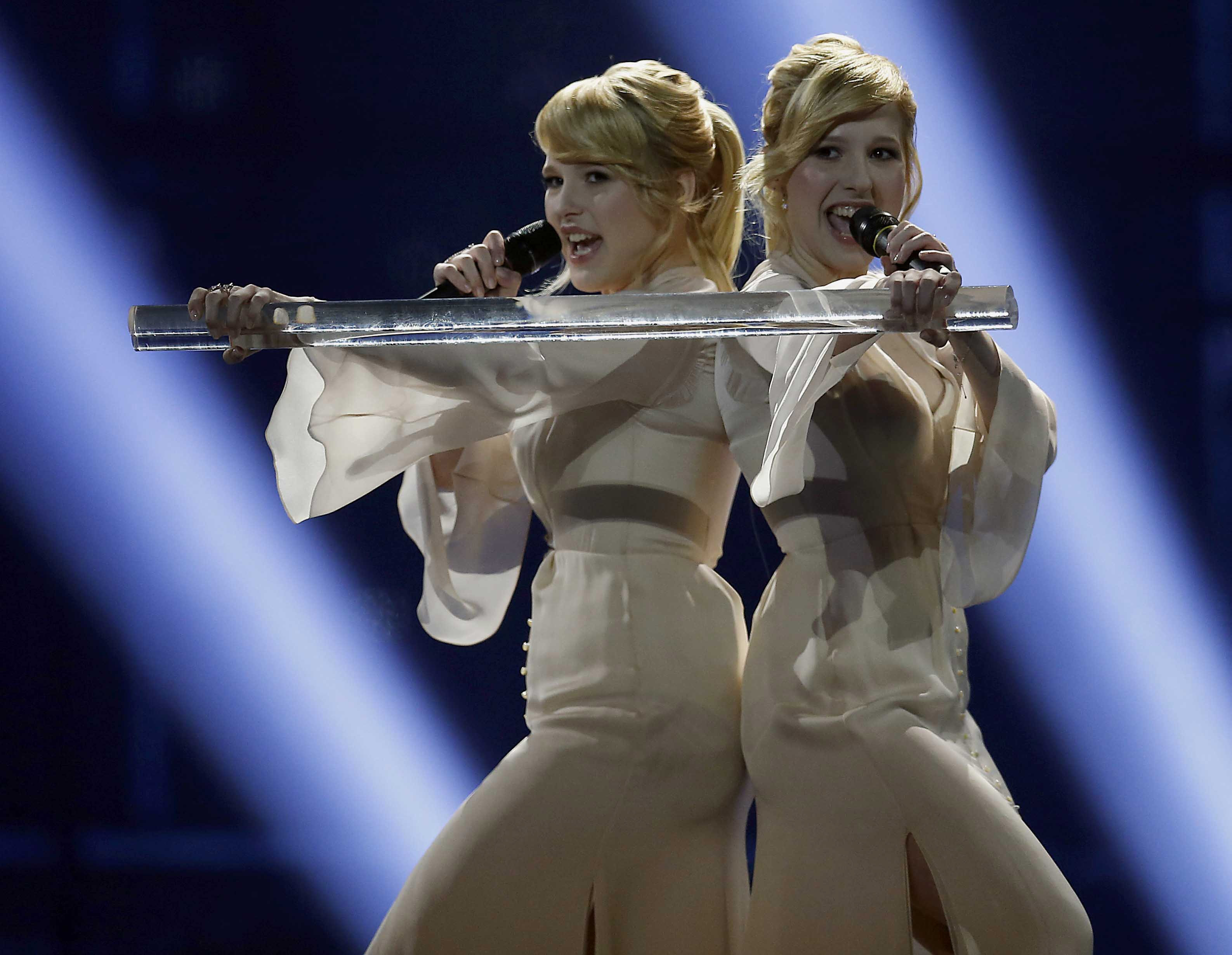
The Tolmachevy Sisters (AP Photo/Frank Augstein)
The politics of the Eurovision Song Contest are, as a rule, reassuringly simple: countries with shared cultures, languages or borders, or a combination thereof, can generally be relied on to support each other. So the Greeks vote for Cyprus and the Cypriots vote for Greece; all the Scandinavians vote for each other, as do the Balts, as do Austria and Germany… and Russia and Ukraine.
It is a pattern that seems to transcend historical differences including war, genocide and economic catastrophe. For instance, Serbia and Bosnia-Herzegovina have been reliable co-supporters for years; in 2009 Greece came a creditable seventh despite being widely blamed across the continent as the feckless idlers responsible for the eurozone’s woes; and in 2011, just as the Germans were being vilified for their insistence on hairshirt austerity – with frequent references to the Nazis – they managed a reasonable tenth. At Eurovision, it appears, ancient grudges that have started fights in bierkellers and tavernas from Hamburg to Trieste are generally submerged in a welter of kitsch and predictably awful key changes. When in 2009 Georgia, still smarting from its defeat at Russian hands in South Ossetia, tried to enter a song entitled “We’re Not Gonna Put In” (geddit?), the Eurovision organisers rejected it as too political.
On Saturday, however, Russia and Ukraine will face off in the Eurovision final and the whiff of politics will be hard to avoid. For one thing, Russia’s progress from this week’s semi-final was greeted with loud boos from the audience, which was remarkable given how relentlessly upbeat the Eurovision crowd usually is. For another, the Russian song is laced with sinister undertones. “Shine”, performed by the Tolmachevy sisters, is an apparently innocent piece of europop; in fact, it contains numerous coded threats of drastic action.
First, the singers themselves. The Tolmachevy twins – Anastasia and Maria – are already Eurovision winners, triumphing in the junior competition (yes, there is a junior Eurovision contest) in 2006 at the tender age of nine. With “Shine”, they present themselves as a wholesome duo belting out a message of love (in English, mind you, the language of the decadent west).
Yet spool back to May 9 2007 – exactly seven years ago today – and one finds them in very different circumstances. Still only 10 but with the panache of seasoned pros, the Tolmachevy girls – in Soviet Army uniforms, complete with caps and boots – performed a famous wartime song called “Katyusha” in the middle of Red Square as part of the country’s Victory Day celebrations.
The symbolism of “Katyusha” – a song so patriotic, it even gave its name to amultiple rocket launcher – is hard to overstate. One of the biggest hits of the Great Patriotic War, it tells the tale of a young girl singing a song as she goes out for a walk along the river bank, dreaming of her sweetheart at the front:
Let him remember an ordinary girl,And hear how she singsLet him preserve the MotherlandAs Katyusha preserves their love
The interim government in Kiev, being well versed in this sort of semiology, will have seen beyond the Tolmachevy twins’ outer innocence and identified the military message immediately. (The girls are even from Kursk, location of the most famous tank battle in history.) And in case it needed hammering home, the lyrics of “Shine” contain these chilling sentiments:
Living on the edge, closer to the crimeCross the line a step at a timeMaybe there’s a place, maybe there’s a timeMaybe there’s a day you’ll be mine
I know who’ll they will be voting for in Slavyansk.
Friday, April 25, 2014
Which USA entertainer might resemble Helene Fischer? Hit song: Atemlos durch die Nacht
Yet another entry for Ms Fischer??
Here, she sings her Nr. 1 song in today's charts. Later in the medley, she demonstrates some of her training as a dancer.
Do you sense the audience is put off that she's singing in Russian?
Here, she sings her Nr. 1 song in today's charts. Later in the medley, she demonstrates some of her training as a dancer.
Do you sense the audience is put off that she's singing in Russian?
Monday, July 29, 2013
Beethoven's 9th Symphony--revisited!
165+ instrumentalists; only a few different parts along with piano accompaniment.
Electronic instrument: Matryomin. Why? I suppose, because the electronics are embedded in a Russian doll called the Matryoshka Doll. Not my favorite rendition, but whose to criticize? I find it fascinating.
Electronic instrument: Matryomin. Why? I suppose, because the electronics are embedded in a Russian doll called the Matryoshka Doll. Not my favorite rendition, but whose to criticize? I find it fascinating.
Subscribe to:
Posts (Atom)