Danke, Alli. Ich besuchte selbst die Georg-August Uni in Göttingen, und bin stolz, dass Dr. Noether dort eine Lehrstelle als Professorin fand. http://www.agnesscott.edu/lriddle/women/noether.htm -- From Agnes Scott College: Biographies of Women Mathematicians
Emmy Noether
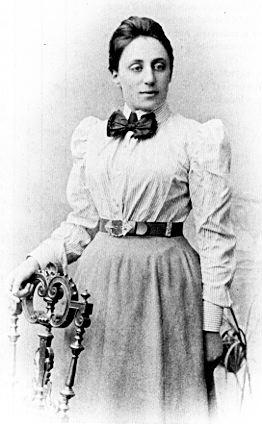
March 23, 1882 - April 14, 1935
Written by Mandie Taylor, Class of 1998 (Agnes Scott College)
Traditionally, people consider mathematicians to be men. However, throughout history, there have been many women mathematicians who have contributed just as much as their male-counterparts, and their contributions to mathematics have not been forgotten. One of these women mathematicians was German-born Emmy Noether.Emmy Noether was born in Erlangen, Germany on March 23, 1882. She was named Amalie, but always called "Emmy". She was the eldest of four children, but one of only two that survived childhood. Her brother, Fritz also made a career of mathematics. Her father was Max Noether, a noted mathematician of his time. Her mother was Ida Amalie, for whom Emmy was named.
As a child, Emmy Noether did not concentrate on mathematics. She spent her time in school studying languages, with a concentration on French and English. Her mother taught her the traditional skills of a young woman of that time. She learned to cook, clean, and play the clavier. At the time of her graduation from high school, she passed a test that allowed her to teach both French and English at schools for young women.
At the age of 18, Emmy Noether decided to take classes in mathematics at the University of Erlangen. Her brother, Fritz, was a student there, and her father was a professor of mathematics. Because she was a woman, the university refused to let Emmy Noether take classes They granted her permission to audit classes. She sat in on classes for two years, and then took the exam that would permit her to be a doctoral student in mathematics. She passed the test, and finally was a student in good standing at the University. After five more years of study, she was granted the university's second degree to a woman in the field of mathematics; the first had graduated one year earlier.
Now that Emmy Noether had her doctorate in mathematics, she was ready to find a job teaching. The University of Erlangen would not hire her, as they had a policy against women professors. She decided to help her father at the Mathematics Institute in Erlangen. She began doing research there, and helped her father by teaching his classes when he was sick. Soon, she began to publish papers on her work.
During the ten years Emmy worked with her father, Germany became involved in World War I. Emmy was a pacifist at heart, and hated the war. She longed for a Germany that was not at war. In 1918, her wish was granted, as the war ended. The German monarchy was removed and the country became a republic. Noether, and all women in Germany, were given the right to vote for the first time. Even with the new rights granted to women, Noether was not paid for her work teaching.
During this time, Felix Klein and David Hilbert were working on further defining one of Einstein's theories at the University of Gottingen. They felt that Emmy Noether's expertise could help them in their work. They asked her to come and join then, but since there were no women on the faculty, Noether was unsure if she would be welcome. Many of the faculty did not want her there, but in the end, she came. She worked hard and soon was given a job as a lecturer. Even though she still was not paid for her efforts, for the first time, Noether was teaching under her own name. Three years later, she began receiving a small salary for her work.
During her time at the University of Gottingen, she accumulated a small following of students known as Noether's boys. These students traveled from as far as Russia to study with her. Noether was a warm person who cared deeply about her students. She considered her students to be like family and was always willing to listen to their problems. Her teaching style was very difficult to follow, but those who caught on to her fast style became loyal followers. Noether's teaching method led her students to come up with ideas of their own, and many went on to become great mathematicians themselves. Many credited Noether for her part in teaching them to teach themselves.
Peace-loving Noether was soon to wish for peace again. In 1933, Hitler and the Nazis came into power in Germany. The Nazis demanded that all Jews be thrown out of the universities. Noether's brother, Fritz, who was also a professor at the time, accepted an offer to teach in Siberia. Even though friends tried to get Emmy a position at the University of Moscow, she opted to move to the United States, where Bryn Mawr College offered her a position teaching. [The appointment of Noether was made possible by a gift from the Institute of International Education and the Rockefeller Foundation.]
Teaching at a women's college was very different for Noether, where, for the first time, she had female colleagues. Anna Pell Wheeler, another mathematician, was the head of the department at Bryn Mawr, and became a great friend of Noether. Wheeler understood about how Emmy had had to struggle to have a career in mathematics in Germany, and also about the difficulties of being uprooted from her homeland and family. Noether kept up her charismatic teaching style, as a caring and compassionate teacher, even while occasionally lapsing into German if her ideas weren't getting across to her students.
Noether's death in 1935 surprised nearly everyone, as she had told only her closest friends of her illness.
Emmy Noether made many contributions to the field of mathematics. She spent her time studying abstract algebra, with special attention to rings, groups, and fields. Because of her unique look on topics, she was able to see relationships that traditional algebra experts could not. She published over 40 papers in her lifetime. She was also a teacher who was able to inspire her students to make their own contributions to the field of mathematics.
April, 1995
References
- Angier, Natalie. "The Mighty Mathematician You've Never Heard Of," New York Times Science section, page D4, March 27, 2012 (print edition). Available online March 26, 2012.
- Noether, Gottfried. "Emmy Noether," in Women of Mathematics, A Biobibliographic Sourcebook, Louise Grinstein and Paul Campbell, Editors, Greenwood Press, 1987.
- Noether, Emiliana Pasca. "Emmy Noether," in Complexities: Women in Mathematics, Bettye Anne Case and Anne Leggett, Editors, Princeton University Press (2005), 30-37.
- Morrow, James. "Emmy Noether," in Notable Women in Mathematics: A Biographical Dictionary, Charlene Morrow and Teri Perl, Editors, Greenwood Press (1998), 152-157.
- Olsen, Lynn M. Women in Mathematics, Massachusetts Institute of Technology, 1974.
- Perl, Teri. Women in Mathematics, Lives of Women Mathematicians, plus Discovery Activities, World Wide Publishing, 1993.
- Slachman, Virginia. Portraits for Classroom Bulletin Boards - Woman Mathematicians, Dale Seymour Publications, 1990.
- Noether, Emiliana P. "Emmy Noether: Twentieth Century Mathematician and Woman," AWM Newsletter, Vol. 6, No. 7 (Nov.-Dec. 1976), 1-6.
- Smith, Martha K. "Emmy Noether's Contributions to Mathematics," AWM Newsletter, Vol. 6, No. 7 (Nov.-Dec. 1976), 6-10.
- Profile in the "Emmy Noether Lectures," Association for Women in Mathematics.
- Kimberling, C. "Emmy Noether," American Mathematical Monthly 79 (1972), 136-149. [JSTOR, subscription required]
- Kimberling, C. "Emmy Noether and her influence," in Emmy Noether: A Tribute to her Life and Work, James W. Brewer and Martha K. Smith, Editors, M. Dekker, New York, 1981.
- Kimberling, C. "Emmy Noether, Greatest Woman Mathematician," Mathematics Teacher 84 no. 3 (March 1982), 246-249. (Available at the Houghton Mifflin web site http://www.matharticles.com under section 10.1 in the drop down menus.)
- Srinivasan B. and J. Sally. Emmy Noether in Bryn Mawr: Proceedings of a Symposium, Springer-Verlag, 1983.
- Dick, Auguste. Emmy Noether, 1882-1935, translated by H.I. Blocher, Birkhäuser, 1981.
- Dictionary of Scientific Biography
- Van der Waerden, B. L. "The school of Hilbert and Emmy Noether," Bull. London Math. Soc. 15(1)(1983), 1-7.
- Weyl, H. "Emmy Noether," Scripta Mathematica, 3(1935), 201-220.
- Emmy Noether, mathematician, Clark Kimberling's web site contains a list of publications about Emmy Noether.
- Emmy Noether, from Wikipedia
- Einstein, Albert. "The Late Emmy Noether," letter to the Editor of the New York Times, May 1, 1935.
- MathSciNet [subscription required]
- Author Profile at zbMath
- Mathematics Genealogy Project
- Biography at the MacTutor History of Mathematics Archive.
Copyright © 1995-2014
Larry Riddle
LRiddle@AgnesScott.edu
Agnes Scott College - A liberal arts, women's college in metro Atlanta, Georgia
Last Modified: April 6, 2014
Larry Riddle
LRiddle@AgnesScott.edu
Agnes Scott College - A liberal arts, women's college in metro Atlanta, Georgia
Last Modified: April 6, 2014


