Vorsicht! Der Tanz geht schnell.
Sie kennen auch den Tanz... und machen daraus eine echte Schau, denkst du auch?
Thursday, April 23, 2015

Wednesday, April 22, 2015
Ein bekanntes Märchen -- Der Igel und der Hase
Vorgelesen von Axel Prahl
There are significant differences between the US version of fairy tales and the "original" German version. For instance, which differences do you notice between this story and our "version": The Tortoise and the Hare?
Na? Jetzt muss ich noch ein Märchen hier hochladen: Das Märchen vom dicken guten Pfannkuchen:
Hier gibt es sehr viele Wiederholung. Versteht ihr das Märchen?
There are significant differences between the US version of fairy tales and the "original" German version. For instance, which differences do you notice between this story and our "version": The Tortoise and the Hare?
Na? Jetzt muss ich noch ein Märchen hier hochladen: Das Märchen vom dicken guten Pfannkuchen:
Hier gibt es sehr viele Wiederholung. Versteht ihr das Märchen?
Sunday, April 19, 2015
Ben Bloom Sport...Blog in Dortmund oh-oh!
Some bright spark has decided to see what happens if I go to Dortmund (via Düsseldorf). I don't speak German.
Hi kids, you know when your teacher tells you to learn German. Well, do it.

"You'll Never Walk Alone" Dortmund-style
10.50
Hello everyone. Have you heard the news? Jurgen Klopp is leaving Borussia Dortmund. Reportedly.Probably.
Almost definitely.
Dortmund are due to hold a press conference at 12.30 pm to explain what the devil is going on so I'll ring you all the news from that and all the reaction. The piece below is what we know so far...
News story
Borussia Dortmund manager Jurgen Klopp has reportedly asked to leave the German club at the end of season.Klopp, 47, won the Bundesliga with Dortmund in 2010-11 and 2011-12 before guiding them to the Champions League final where they lost to Bayern Munich the following year.
However, a disastrous start to the current domestic season has left them 10th in the table with just six games to play and almost certain to miss out on European football next season.
That prospect appears to have been crucial in making up Klopp's mind and any imminent departure is likely to alert a number of English club to his availability.
Klopp has been heavily linked with Arsenal and Liverpool in the past, although it is unlikely Arsene Wenger or Brendan Rodgers are in immediate danger of being replaced.
11.00
Where is Klopp going next? Which clubs are on RED ALERT? Who will make a STUNNING bid to snap him up? When will a SHOCK move be made?We can only speculate. So let's do just that.
The people at Paddy Power have emailed me some odds on where Klopp will end up next in the hope that I will give them some free publicity. And I certainly will.
15/8 - Man City
11/2 - Real Madrid
6/1 - Arsenal
6/1 - Liverpool
7/1 - Barcelona
10/1 - Chelsea
10/1 - Bayern Munich
12/1 - Man United
17/1 - Everton
33/1 - Southampton
33/1 - Atletico Madrid
45/1 - Newcastle
45/1 - West Ham
11.08
Yes, he's won a couple of German league titles and made a Champions League final but what else does can Klopp bring to the Premier League?This... (you will watch it at least three times):
(Video of Klopp laughing and misunderstanding...what?)
11.22
Word is that Klopp's people have already had enquiries from a number of clubs about his availability. Let us do some of that speculating again.Man City - Manuel Pellegrini is likely to be sacked at the end of the season after failing to mount a successful title challenge this campaign. The powers that be want Pep Guardiola to take over when he leaves Bayern Munich though. But will they change their mind now that Klopp is available?
Real Madrid - The Spanish giants might not win La Liga and might not win the Champions League. That's usually about enough to ditch their manager. Carlo Ancelotti is the current man in charge but they have Zinedine Zidane waiting in the wings.
Arsenal - They have been keen on Klopp for some time and feelings toward Wenger fluctuate between in and out on an almost weekly basis. In the words of Generic Foreign Manager, Wenger is very much "in a good moment" right now though.
Liverpool - For Arsenal, read Liverpool.
Barcelona - For Real Madrid, read Barcelona.
Chelsea - They are about to win the Premier League and they have Jose Mourinho as their manager. It's not going to happen.
A far more likely destination is Manchester City, with manager Manuel Pellegrini's job far less secure after a poor run of form all-but ended his side's hopes of retaining their Premier League title.
11.30
<noframe>Twitter: Salim Masoud Said - Klopp not a 'hipster' manager unless he uses this opportunity to coach TP Mazembe.</noframe>11.38
 Our man Jeremy Wilson has the latest from Arsenal on whether they will make a move for Jurgen Klopp. Can you guess what they said?
Here is a snippet and HERE is the full piece: "Arsenal have given thought to how they would deal with the succession to Wenger..." Oooh what a tease.
11.50
We are but 40 minutes away from the Borussia Dortmund press conference. Excited? This is what Klopp does when he gets excited:12.10
We want to hear from you. Well sort of. We just want you to vote in our poll of where you think Jurgen Klopp will go next. You can cast your vote by clicking HERE.
If you do want to say anything else then you can reach me on email (ben.bloom@telegraph.co.uk) or via Twitter (@benbloomsport).
12.00
What might Klopp's departure mean for Dortmund's players and a certain Mats Hummels in particular?The centre-back has been heavily linked with a move to Manchester United this summer and you can only assume Klopp leaving will make his departure even more likely. Here is our latest story on Hummels's future:
12.25
The Dortmund press conference is imminent, but while you wait do have a look at our Premier League manager sack race gallery with odds on who will be the next man to be given the boot.

12.32
BORUSSIA DORTMUND CONFIRM JURGEN KLOPP WILL LEAVE THE CLUB ON JULY 1
12.34
Klopp has just sat down to face the media...12.37
Right we have a slight issue... they are speaking in German and my GCSE in the subject isn't much help.What I can deduce is that the bloke currently speaking (I'm assuming he's the Dortmund chief exec or something) genuinely sounds like someone has died. He's properly choked. Oh he just said "fantastisch". I'm guessing he wasn't describing Klopp's decision to leave the club.
12.39
Why can't I speak German???????12.41
I'd love to tell you what Klopp is saying. He is saying a lot. But I can understand precisely none of it. So here's a photo of him pouring some water instead:
12.44
I have a couple of translations coming through.Klopp: "I chose this time to announce it because in the last years some player decisions were made late and you couldn't react."
"It's not that I am tired, I don't have any contact with another club but I don't plan to take a year off either."
I'm afraid I cannot verify how correct those sentences is. I'm rapidly realising that I am as close to useless right now as I have ever been in my life.
12.46
I am going to email my old German teacher Dr Plow after this and apologise.<noframe>Twitter: Jobo - <a href="http://www.twitter.com/benbloomsport" target="_blank">@benbloomsport</a> Learn German! Quick!</noframe>
12.49
Klopp has finished speaking and we have just heard from a chap with a lovely slicked back hairstyle. Although most hairstyles look lovely to me.12.53
So, in lieu of someone with any semblance of knowledge of the German language, I shall now consider what we know:- Klopp has not planned a sabatical.
- Klopp is not tired.
- Klopp has not had contact with any other club.
If that's not insightful then I don't know what is.
12.55
They have just opened up questions the floor. I'm afraid the questions are just as German as the answers.Oh, we have one more translated line! ""I don't think of it as a load off my shoulders. I'm not tired, even though I look like this."
12.56
WHY DON'T WE HAVE A UNIVERSAL LANGUAGE ACROSS THE GLOBE???12.58
I am genuinely sorry about this. I realise this is highly unprofessional. Don't tell my boss I can't speak German. He thinks I'm translating this press conference word for word.13.02
The big man is still answering questions. I managed to catch the following words: "Extreme", "Sport" and "And". Make of that what you will. In my mind he's considering a new career as a skydiver.

13.03
Klopp just cracked a gag and the entire press conference audience laughed. A joker to the end. Or almost the end. Remember he's staying in the job until July 1.(Thanks to the person who tweeted me a "How to learn German in 60 seconds" video. It didn't work I'm afraid.)
13.05
It's finished! What? I didn't expect that. They said thank you, got up and left. What on Earth do I do now??? I haven't enlightened one reader and they've already left!!! Erm...13.08
Someone that speaks German has actually done some proper translating! Praise the lord. Right I'm going to pass this off as my own and hope no one notices.Klopp: "I always said in that moment where I believe I am not the perfect coach anymore for this extraordinary club, I will say so.
"I believe this is the right decision at the right time.
"I have not had any contact with any other clubs, nor have I any plans to take a sabbatical.
"I just wanted to make my decision known now so that the club can plan for the future.
"I chose this time to announce it, because in the last few years, some player decisions were made late and there was no time to react."
13.16
Oh what??Sky Sports News have just played a snippet from the press conference and they had a bloke translating Klopp's words. How did they find a German speaker and the Telegraph was lumbered with me? I fear I have damaged the reputation of this once great institution considerably.
Es tut mir leid. (Google translate tells me that is "I am sorry" in German)
13.14
So it turns out the bloke almost in tears earlier was Dortmund's sporting director Michael Zorc and these were some of the words he managed to get out before breaking down completely (N.B. He didn't actually break down)."We have written football history with you, Jurgen. You have given the club much energy and optimism."
Can you feel the love in the room?
13.26
So I think we should recap. From what I understood that press conference saw Klopp announce he is embarking on a new career in extreme sports and his boss describe his decision to leave as "fantastisch".In reality Klopp confirmed he was leaving the club and doesn't know what he is going to do next, while his boss paid tribute to him multiple times.
And that, in a nutshell, sums up just little use I have been over the past hour.
13.38
Seeing as how I have been unable to find a translated question asking "Which Premier League club are you going to join next season" I shall assume no one asked such a question. Which leaves us able to continue to speculate on what the future holds for our German friend Mr Klopp.I, for one, would put my pennies on Manchester City. Manuel Pellegrini isn't going to last the summer holidays is he? My other educated guess would be that Arsenal make a poor start to the season, Arsene Wenger is subjected to his usual #WengerOut campaign and Klopp replaces him at Christmas.
13.48
Right then, it's just about time for me wrap up. Excuse me while I breathe a sigh of relief after getting through one of the more bizarre live blogs of my career and celebrate in the manner of Jurgen Klopp.14.00
And with that I bid you farewell. Again, many apologies for a hopeless lack of German knowledge. You'd think it would have been a prerequisite to live blog a Borussia Dortmund press conference but perhaps not. Only time will tell if the person who tweeted me suggesting I am getting "sacked in the morning" is correct.I also apologise for this live blog becoming far too much about me. I can assure you it will not happen again. Let us end on what we came here for: Jurgen Klopp. It isn't often that one of the world's leading managers becomes available so expect the speculation to run, run and run some more until he gets another job. It'll be interesting.
Thanks for joining me. Cheerio.
Saturday, April 18, 2015
Experts Baffled by Mysterious Underground Chambers
Germany, Bavaria
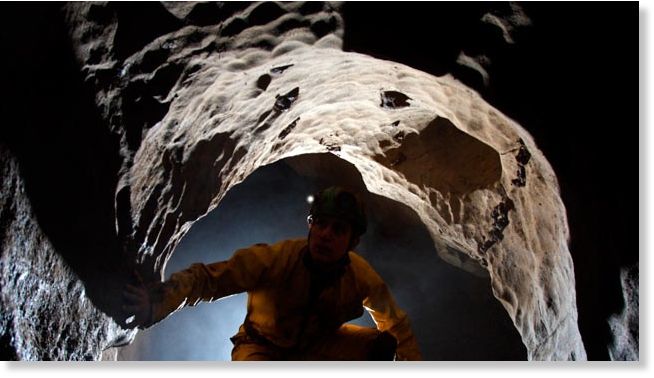
© Getty Images A cave explorer crawls through an arched section of cave passage.
Beate Greithanner, a dairy farmer, is barefoot as she walks up the lush meadows of the Doblberg, a mountain in Bavaria set against a backdrop of snow-capped Alpine peaks. She stops and points to a hole in the ground. "This is where the cow was grazing," she says. "Suddenly she fell in, up to her hips."
A crater had opened up beneath the unfortunate cow.
On the day after the bovine mishap, Greithanner's husband Rudi examined the hole. He was curious, so he poked his head inside and craned his neck to peer into the darkness. Could it be a hiding place for some sort of treasure, he wondered? As he climbed into the hole to investigate, it turned out to be a narrow, damp tunnel that led diagonally into the earth, like the bowels of some giant dinosaur.
Suddenly the farmer could no longer hear anything from above. He panicked when he realized that it was getting difficult to breathe the stifling air -- and quickly ended his brief exploration.
The Greithanners, from the town of Glonn near Munich, are the owners of a strange subterranean landmark. A labyrinth of vaults known as an "Erdstall" runs underneath their property. It is at least 25 meters (82 feet) long and likely stems from the Middle Ages. Some believe that it was built as a dwelling for helpful goblins.
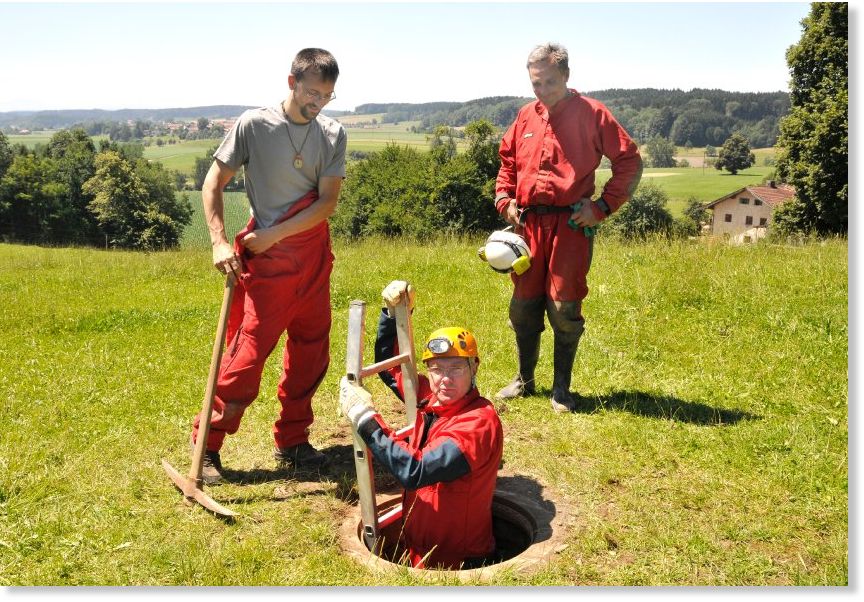
The geologists and land surveyors who appeared on Greithanner's property at the end of June were determined to get to the bottom of the mystery. Three members of a group called the "Working Group for Erdstall Research," wearing red protective suits and helmets, dragged the heavy concrete plate away from the entrance and disappeared into the depths.
Their leader, Dieter Ahlborn, began by crawling through a passageway only about 70 centimeters (2 foot 3 inches) high. His colleague Andreas Mittermüller had to return to the surface when the lack of oxygen in the tunnel gave him a headache. Ahlborn continued crawling into the space until his lamp revealed a decayed piece of wood.
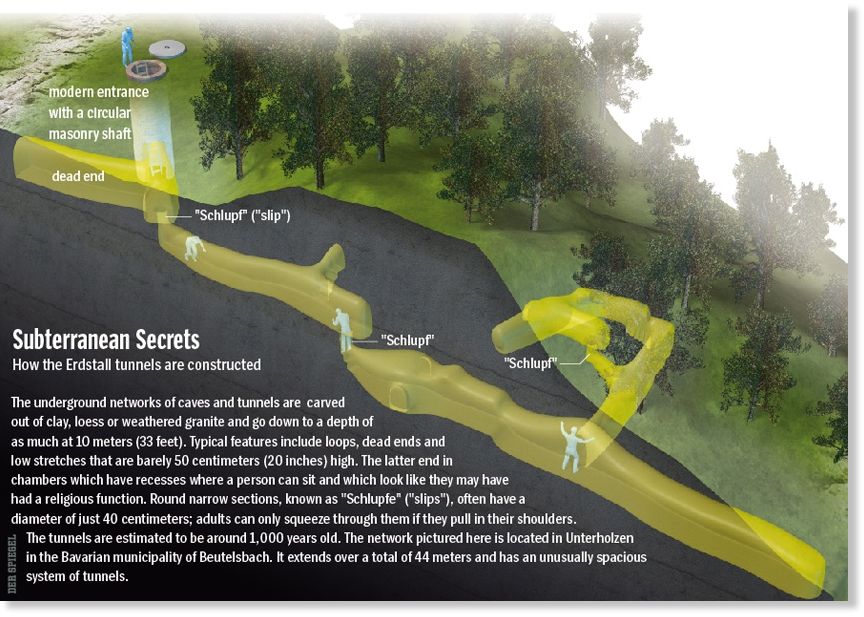
© Der Spiegel Bavaria's mysterious Erdstall tunnels
Meanwhile, in the meadow above, a group from the State Office of Historic Preservation in Munich had marked off the site with colored tape. Then they rolled a three-wheeled cart equipped with ground-penetrating radar across the grass. "The gallery has collapsed at the back," one member of the group explains. "We're figuring out its actual size."
The exploration of the site is a pioneering activity, marking the first time an archeological agency in Germany is showing an interest in an extremely unusual ancient phenomenon. Similar small underground labyrinths have been found across Europe, from Hungary to Spain, but no one knows why they were built.
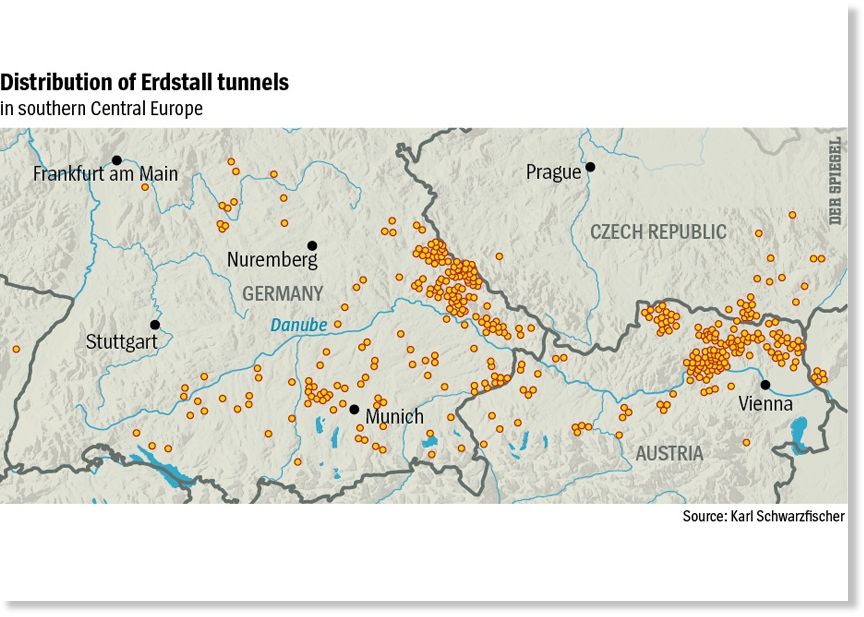
At least 700 of these chambers have been found in Bavaria alone, along with about 500 in Austria. In the local vernacular, they have fanciful names such as "Schrazelloch" ("goblin hole") or "Alraunenhöhle" ("mandrake cave"). They were supposedly built by elves, and legend has it that gnomes lived inside. According to some sagas, they were parts of long escape tunnels from castles.
In reality, the tunnels are often only 20 to 50 meters long. The larger passageways are big enough so that people can walk through them in a hunched position, but some tunnels are so small that explorers have to get down on all fours. The tiniest passageways, known as "Schlupfe" ("slips"), are barely 40 centimeters (16 inches) in diameter.
The ground beneath the southern German state of Bavaria is literally perforated with these underground mazes -- and no one knows why.
Many galleries are connected to the sites of former settlements. The tunnel entrances are sometimes located in the kitchens of old farmhouses, near churches and cemeteries or in the middle of a forest. The atmosphere inside is dark and oppressive, much as it would be inside an animal den.
'Completely Hushed Up'
For those curious to see what it's like inside the tunnels, innkeeper Vinzenz Wösner offers tours, or "guided crawls," in Münzkirchen, a town in northern Austria.
The tour begins in the taproom and proceeds down a stone stairway into the cider cellar, where there is a trap door that opens into a gaping hole. "We don't let people with heart conditions do the tour," Wösner says in his thick Austrian accent. He keeps a large sling on hand for emergencies, so that if anyone faints he can pull them out of the narrow tunnel.
© Karl Schwarzfischer
Distribution of Erdstall tunnels in southern Central Europe
Distribution of Erdstall tunnels in southern Central Europe
There is not a single written record of the construction of an Erdstall dating from the medieval period. "The tunnels were completely hushed up," says Ahlborn.
Archeologists have also been surprised to find that the tunnels are almost completely empty and appear to be swept clean, as if they were abodes for the spirits. One gallery contained an iron plowshare, while heavy millstones were found in three others. Virtually nothing else has turned up in the vaults.
Until recently, the secret caves were explored only by amateur archeologists. The pioneer of Erdstall exploration, Lambert Karner (1841 to 1909), was a priest. According to his records, he crawled through 400 vaults, lit only by flickering candlelight, with "strange winding passages" through which "one can often only force oneself like a worm."
The tunnels later became the realm of local historians armed with vivid imaginations. They speculated that the caves were used as "winter quarters by the Teutonic tribes" or as dungeons for the disabled. Some of today's more esoteric souls interpret them as "spaces of nonbeing."
© Ben Behnke/ Der Spiegel
There are more than 700 curious underground passageways in Bavaria, but their purpose remains a mystery. Here, SPIEGEL reporter Matthias Schulz (middle) enters an "Erdstall," as the tunnels are known, together with experts Dieter Ahlborn (right) and Andreas Mittermüller (left).
There are more than 700 curious underground passageways in Bavaria, but their purpose remains a mystery. Here, SPIEGEL reporter Matthias Schulz (middle) enters an "Erdstall," as the tunnels are known, together with experts Dieter Ahlborn (right) and Andreas Mittermüller (left).
At their annual meeting, the amateur explorers combine shoptalk with bold subterranean expeditions. To avoid suffocating, says one member of the group, they recently blew air into a tunnel with a "reversible vacuum cleaner."
An exhibition in the Bavarian city of Passau now makes the subject of these mysterious galleries more accessible to a broader public. One of the hands-on exhibits is a tunnel made of plywood. Posters refer to the actual tunnels as "Central Europe's last great mystery."
The show is generating urgently needed attention. Road and construction crews often stumble upon subterranean galleries, and not knowing what they are, promptly fill them up with dirt.
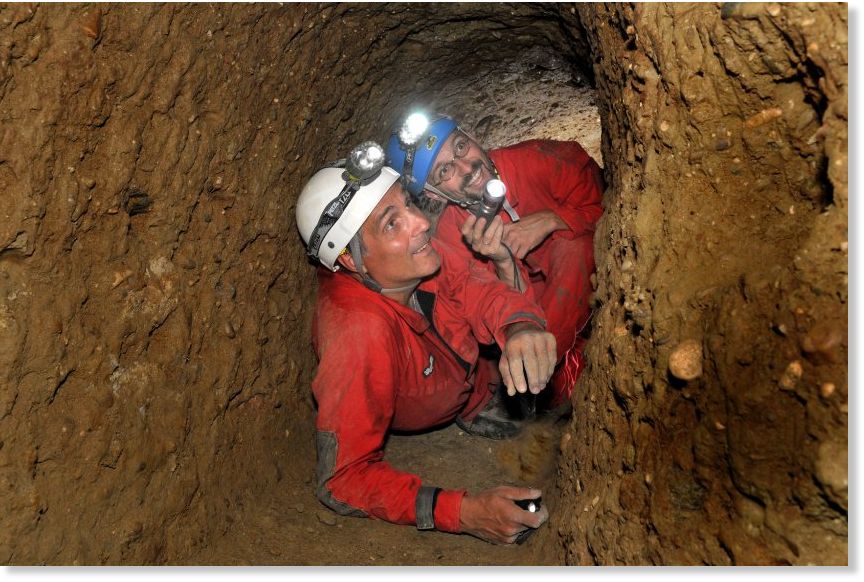
© Ben Behnke/ Der Spiegel
Ahlborn (left) and Mittermüller investigate an Erdstall in Doblberg
Ahlborn (left) and Mittermüller investigate an Erdstall in Doblberg
The story of Josef Wasmeier from Beutelsbach in Lower Bavaria shows how difficult it is to track them down. There was once a castle not far from his farmstead. It was torn down in the 18th century, and now there is a grove of locust trees on the site.
"According to the legend, there were escape tunnels emanating from the castle hill," says Wasmeier. He and a few friends decided to search for the tunnels. They dug and drilled, day in and day out. "In the end, the only one still digging was Rudi Eichschmied -- every evening, sometimes in the moonlight," says Wasmeier.
The man finally came across an underground cavity.
It led to a unique gallery with walls made of sand. Initially the tunnel went down vertically for 4 meters, and then it continued in a zigzag pattern. There was a narrow "Schlupf" section at the end of the labyrinth. It reminds the researchers of a vagina.
Wasmeier once took a group of female healers down into his cave. The women slid headlong through the tunnel, in complete darkness, as if passing through a birth canal.
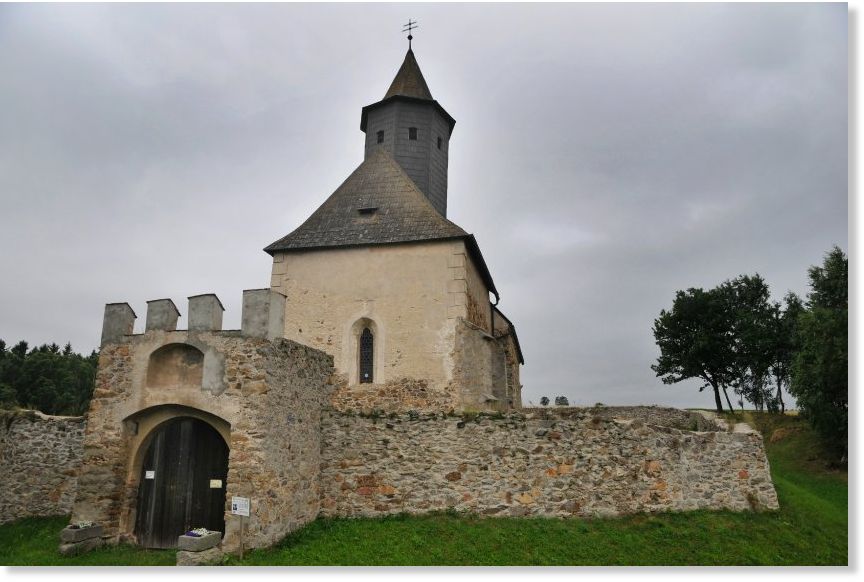
© Ben Behnke/ Der Spiegel
There is an Erdstall tunnel complex under this church in Kleinzwettel, Austria
There is an Erdstall tunnel complex under this church in Kleinzwettel, Austria
'Gateways to the Underworld'
But how old is the vault? The members of the task force were so eager to find an answer that they paid for pollen analyses out of their own pockets.
A few radiocarbon dating analyses have also been performed, and they indicate that the galleries date back to the 10th to the 13th century. Bits of charcoal recovered from the Erdstall tunnels in Höcherlmühle date back to the period between 950 and 1050 A.D.
Heinrich Kusch, a prehistorian from the Austrian city of Graz, believes that these results are incorrect. He suspects that some of the subterranean systems were built about 5,000 years ago, in the Neolithic period. For several years now, he has been probing Austria's Steiermark region with giant drills for "gateways to the underworld."
But Kusch's theory has lost some of its appeal. All of the radiocarbon dating analyses completed to date indicate that the tunnels were built in the Middle Ages, challenging the validity of the prevailing school of thought. It holds that the tunnels were built during the Migration Period (known as the "Völkerwanderung" in German) in the 5th and 6th centuries, when entire tribes left their homes and abandoned the cemeteries of their ancestors. The assumption was that the tunnels and galleries were created so that the dead could still be venerated.
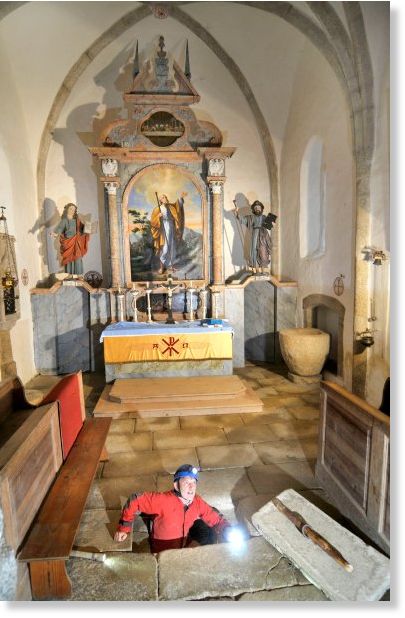
© Ben Behnke/ Der Spiegel
Explorer Josef Weichenberger emerges from the Erdstall into the church
Explorer Josef Weichenberger emerges from the Erdstall into the church
Around the year 1200, the underground labyrinths were filled in and the entrances blocked with rubble. The rubble contained ceramics clearly attributable to the Gothic period.
The confusion over the tunnels is hardly surprising. Some believe that they were used as dungeons for criminals, while others see them as places of healing, where the sick could cast off their afflictions. Still others speculate that they were used by druids.
As a result of the international cooperation of the Erdstall working group, new clues have come to light. The galleries are also concentrated in parts of Ireland and Scotland, and there are also clusters in central France.
This distribution bears intriguing parallels to the routes of the Irish-Scottish traveling monks who, coming from the Celtic north in the 6th century, traveled across the continent as missionaries. The tattooed monks made the passage to the continent from the islands, carrying long staffs and wearing coarse habits.
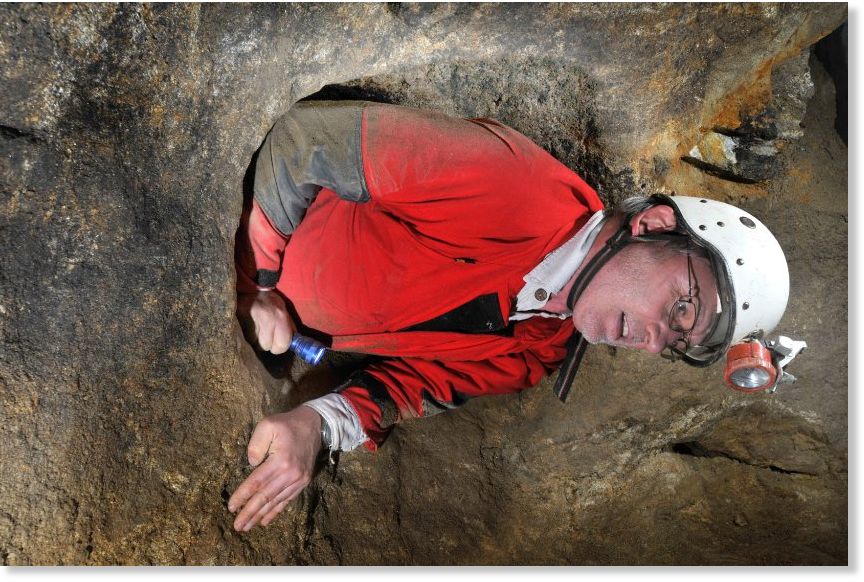
© Ben Behnke/ Der Spiegel Weichenberger in a tunnel complex in Reichersberg. Some of the passages are so narrow that one has to squeeze through them
Ahlborn speculates that these early Christian missionaries also brought along heathen ideas, the remnants of Druid scholarship or special Celtic concepts of the afterlife, which led to the construction of the subterranean galleries.
Perhaps the tunnels were also prisons for demons, evil dwarves and the undead. Some galleries contain traces of building stones and remnants of doors or locks. A sandstone relief was found in an Erdstall at Bösenreutin near the town of Lindau on Lake Constance. It depicts a goblin with a tail attached to its rump.
Were the galleries temples for the superstitious?
Hiding from Bandits
Not everyone finds these spiritual interpretations convincing. Josef Weichenberger can only shake his head when he hears them. He is talking himself into a rage as he speeds from the Bavarian city of Passau toward the Waldviertel region in Lower Austria. "The cult theories are completely erroneous."
Then he offers his interpretation: "The Erdstall galleries were simply hiding places."
Weichenberger's opinion carries some weight. An archivist by profession, he has been crawling through the labyrinths for the last 34 years. He also runs an alarm center from his office. When construction workers report the discovery of an Erdstall, he rushes to the site to document it with a compass and a measuring tape.
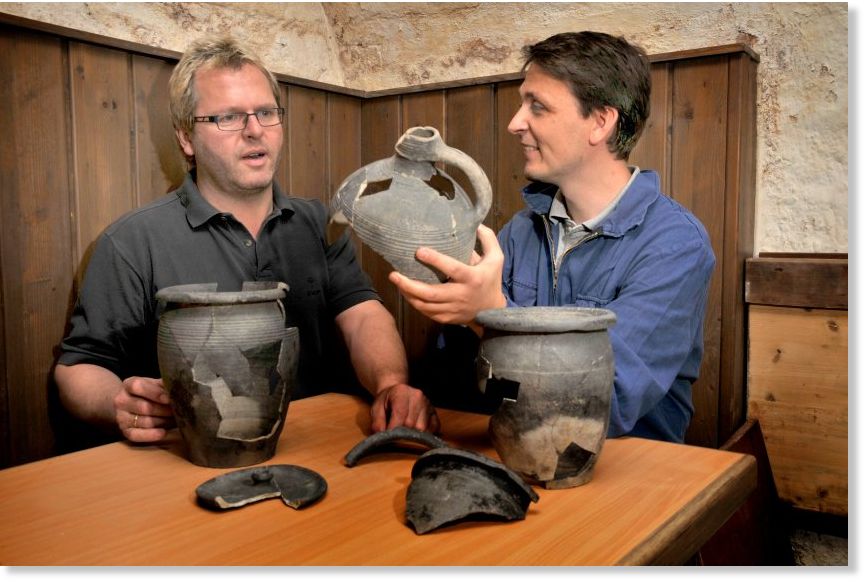
© Ben Behnke/ Der Spiegel Austrian
archaeologist Heinz Gruber (right) shows restored clay pots that were
found in tunnels. On the left is Vinzenz Vösner, who owns an Erdstall
located under his inn
According to Weichenberger, the galleries in his native Austria were built during the "medieval clearing period" in the 11th century. At the time, settlers from Bavaria traveled down the Danube to cultivate land in the east.
Armed with hatchets, they cut swaths into the wilderness. It was not an entirely safe undertaking. Magyars flooded into the area around 1042. Around 1700, the Hungarian rebels known as Kurucs, with the backing of the Ottoman Turks, ransacked the countryside.
Robbers also posed a threat in the region. They raided remote villages and used crowbars to get into the houses. Weichenberger believes that the farmers quickly fled underground "from this vermin," taking their valuables with them.
In Weichenberger's version of the mystery of the subterranean galleries, the terrified villagers would sit in their hiding places underground, their hearts pounding, while the intruders raged above ground, searching in vain for valuables.
He also offers written evidence. "An old account of a death tells the story of a woman who was so afraid of being discovered that she suffocated her screaming baby in an Erdstall."
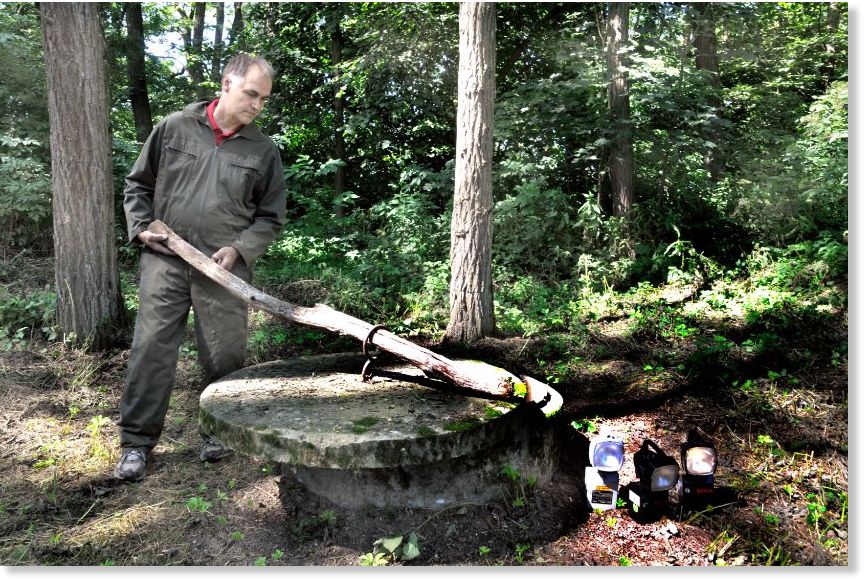
© Ben Behnke/ Der Spiegel Farmer Josef Wasmeier has an Erdstall tunnel complex on his property in Unterholzen
After four hours on the road, we approach the Kleinzwettl fortified church. The ruins once included a drawbridge and a circular rampart. As churches go, it must have been a veritable fortress.
There is also a system of passageways directly beneath the church. When he surveyed it last November, Weichenberger determined that it was 62 meters long. The entrance is under the granite cobblestones in the sanctuary.
A special permit is needed to enter the dim vault, because of the danger of collapse. At first, we make our way through a muddy, serpentine passageway.
The tunnel gradually becomes narrower. A water leak has transformed the rear section into a mud pit. Water drips from the ceiling. The thought of the heavy church columns resting on the ground above is terrifying.
"It's certainly a little uncomfortable here," Weichenberger admits, "but the people were desperate to stay alive."
To substantiate his theory, Weichenberger even hazarded a survival experiment. He and two colleagues were locked into an Erdstall for 48 hours. The oxygen monitors were soon beeping and the candles they had brought along started flickering oddly. The men dozed away, and whenever breathing became too difficult they crawled into other tunnels. The test was a success.
But what does it prove?
"Some galleries were indeed used as hiding places, but only much later," says Ahlborn, promptly dismissing his rival's theory. "They were also uses as toilets and refuse pits."
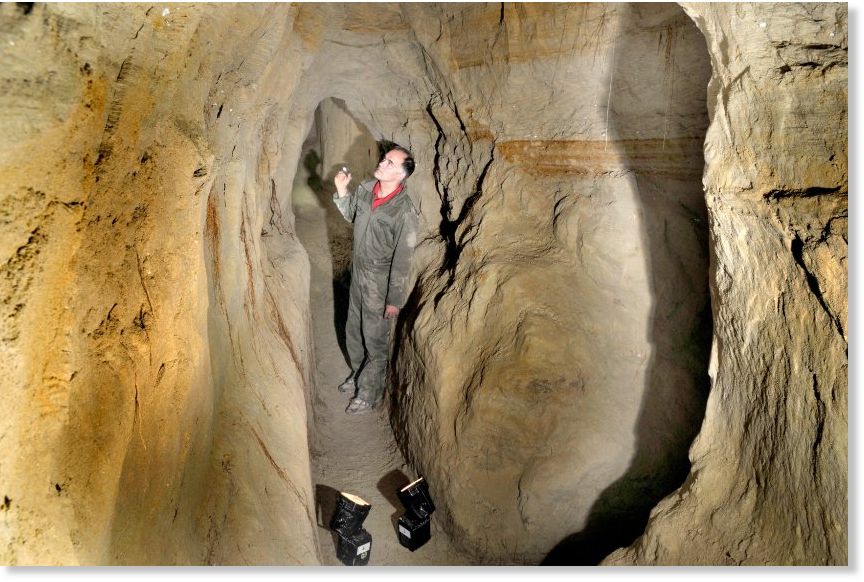
© Ben Behnke/ Der Spiegel Wasmeier enjoys spending time in the underground chambers
Besides, if the terrified villagers were tightly packed into the subterranean vaults during attacks, why did nothing fall out of anyone's pockets? There are no food remains or traces of torches.
For these reasons, most experts attribute a sacred and ritual function to the underground landmarks. Many find the idea of a "chamber of souls" particularly attractive.
According to this theory, the galleries were essentially waiting rooms in which the souls of the dead were to spend the period until the Second Coming of Christ -- the Day of Judgment, when Jesus Christ would judge "the living and the dead."
It wasn't until the 12th century that the theology of purgatory became established, which made it possible for souls to become purified. This meant that good people could ascend to heaven right away. The caves would have been useless at that time, which corresponds to the period when they were filled in.
But even this view doesn't explain why the sacred vaults were kept such a secret. And why are there no Erdstalls in Switzerland or in the Black Forest?
For now, the mystery must remain unsolved. "We could use the help of physicists with radiocarbon dating expertise, theologists and specialists in prehistoric mining," says Ahlborn. Not a single doctoral thesis has been written on the subject to date. The dark tunnels are still virtually unknown among academics.
This doesn't trouble farmer Josef Wasmeier. He loves his Erdstall, particularly because of its mysterious aura. Sometimes he crawls into his sandy private cave for half an hour in the evening and meditates. It's "completely quiet" inside, he says, dark and distant like a womb.
"And when I climb back up again, the stars seem so bright you feel you could almost touch them."
Source: Der Spiegel
Translated from the German by Christopher Sultan
Aachen World Championship
Andreas Helgstrand's mare Blue Hors Matine entertains in the Free Style Championships (2006)
These championships take place annually in Aachen - often while we're in the area.
These championships take place annually in Aachen - often while we're in the area.
Wednesday, April 15, 2015
Papa Richard Johnson spielt -- aber heute!

At first, he didn’t want to watch, but she insisted, saying “sit with me,” and so he did.
Over the years, as he became an adult, he kept watching. He left North Kingstown and traveled for 16 years, spending time in South Africa and Canada to name two places. He met his wife, started a family and about 11 years ago returned home to Rhode Island to live in the same house he grew up. That's when the tradition of the TV on at 7 p.m. with Pat Sajak, Vanna White and his parents and children truly became a family routine.
“When you just sit down every night and watch, after a while, I felt like ‘you know? I can do that. I could be on that,’” Johnson said.
Today, Johnson can cross being a contestant on Wheel of Fortune off his bucket list and he and his friends and family are eagerly awaiting the April 16 airing of his appearance, the results of which he is sworn to keep secret. He hasn’t even told his parents what happened.
“It was cool just to be able to stand there, to walk into the studio and see it in person for the first time,” Johnson said. “When I walked in and looked at the wheel, it was a lot smaller than I thought it would be.”
Sajak “is as nice in person as he seems to be on the show and so is Vanna,” Johnson said.
Now, Johnson wants to pay it forward. And to do so, he’s asking for his friends to come to his viewing party at the Knights of Columbus Hall that night and bring a canned good. Later, Johnson said he will deliver all the cans he’s collected to the North Kingstown Food Pantry.
“We’ll come together to watch it – it was fun and exciting and we can bless some other people,” Johnson said.
Locals will know Johnson as a member of the North Kingstown Community Chorus and M.C. for all the concerts there.
“I make my way around town,” he said.
He’s also asking for all the friends he made over the 25 years he’s traveled with a Christian theater company to bring a canned good to their local food pantries, “even if they just watch in their own living room.”
So how does one get from muttering in front of the TV to laying hands on the 2,700 pound wheel in front of the lights and cameras?
It all started with a notice he saw about a casting call at the Warwick Mall in October. It was his birthday weekend and he figured there’s no harm in trying.
It was a “cattle call,” he said, with names on pieces of paper in a bucket. Those lucky enough to get called have a chance to audition.
He didn’t get picked on the first day.
So he came back, put his name in the bucket, and sure enough, found himself on stage.
“You have to have a hook, talk about yourself, and if you have special talents, you get to show those. Then solve a puzzle,” he said.
What else can a singer do but sing, and so Johnson broke out into a rendition of a song he wrote himself.
It’s called Breakfast with Dad and it’s based on a true story about one of his friends and her dad as the generations go through life. It starts with a child’s young love for a dad, to his habit of ordering the same breakfast at Cracker Barrel, to a time after her dad has died and she sees a “great big sign,” and she knows it’s time for “one last breakfast with dad.”
People were clapping by the end and it’s likely a few were crying. He didn’t bring a CD but folks were clapping along. He spoke loud with a clear voice. Made sure he smiled and showed charisma. Finding the perfect Wheel of Fortune contestant is a science, Johnson said, and he said he tried to “put it all out there.”
Three months later, he gets an e-mail inviting him to another audition in January in Newport. He goes and next thing he knows, he's locked in a three-hour long process. He's in a large group of people who take turns solving puzzles, responding to questions, “all kinds of things” to see who might make the cut.
“They’re being specific about what they want. They want personality. They want energy. Smile. Drive.”
At the end, three-quarters of the potential contestants are told to leave. Just 25 were left and the entire process starts over.
“When I came home from that my dad says to me ‘how did you do?’”
“I did the best I can,” Johnson said to his father.”I did my absolute best. If they don’t take me, then OK, don’t take me, but I gave it everything I had.”
Two weeks later a letter arrived in the mail from Wheel of Fortune, telling him he’s a contestant and between now and the next 18 months he’d be notified of his taping date.
“I thought I had time,” he said, only to get an e-mail 10 days later telling him his tape date was Feb. 13.
He and his wife scrambled to rearrange their schedules and soon found themselves in sunny California, heading into the taping.
When he walked into Sony Pictures Studios, that was it – no more contact with the outside world. Even with his wife. Talking to other contestants, even asking someone where the bathroom is, could be considered cheating.
Contestants get appointed representatives who guide them through the process. They’re shown the wheel, the set, trained on how to use it.
And everyone at the show seemed excited and rooting for the contestants, Johnson said.
“They want you to win. They don’t want to watch you go away losing.”
Every contestant is promised at least $1,000 for appearing, and Johnson said that’s the extent of what he can reveal.
And it’s understandable that Johnson wants to keep the results a surprise.
It’s a chance for him to look to his 16-year-old daughter and 18-year-old son and say, “come sit with me.”
The viewing party will be held at the Knights of Columbus Hall at 1265 Tower Hill Road, North Kingstown and will be from 6:15 to 8 p.m.
Johnson has a CD of original music entitled "Moments in Time" and is available at his Web site, wrichardjohnson.com The CDs will be for sale for $12 at the viewing party and $2 from each sale will go to the food pantry.
Burgau Partnerschaft -- About our Partnership
HIER HERE MAREN and JANA K SCHREIBEN UEBER UNS!
In der riesigen Schule gab es selbstverständlich einige Herausforderungen, sich zurechtzufinden.
Und dann sind da natürlich noch die mit kompliziertem Zahlenschloss gesicherten Locker für die
Taschen, mit denen wir uns erstmal anfreunden mussten. Ziemlich schnell haben wir gemerkt,
wie anders der Unterricht und generell das gesamte Schulleben in Amerika ist.
Mittlerweile finden wir uns recht gut zurecht und freuen uns auf die nächsten zwei Wochen!!!
Die ersten Ausflüge nach Newport und Boston waren schon sehr interessant und anstrengend,
wir sind noch nie so viel gelaufen...
Am meisten freuen wir uns aber auf New York!!! Big Apple, bald sind wir da!


Und dann sind da natürlich noch die mit kompliziertem Zahlenschloss gesicherten Locker für die
Taschen, mit denen wir uns erstmal anfreunden mussten. Ziemlich schnell haben wir gemerkt,
wie anders der Unterricht und generell das gesamte Schulleben in Amerika ist.
Mittlerweile finden wir uns recht gut zurecht und freuen uns auf die nächsten zwei Wochen!!!
Die ersten Ausflüge nach Newport und Boston waren schon sehr interessant und anstrengend,
wir sind noch nie so viel gelaufen...
Am meisten freuen wir uns aber auf New York!!! Big Apple, bald sind wir da!
Maren Olefs und Jana Kröll

Termine
Berufsberatung
Ein Mitarbeiter der Dürener Arbeitsagentur bietet eine regelmäßige Berufs- und Studienfachberatung für SchülerInnen der Oberstufean.
Ort: Raum 010
Anmeldung: im Sekretariat
Ein Mitarbeiter der Dürener Arbeitsagentur bietet eine regelmäßige Berufs- und Studienfachberatung für SchülerInnen der Oberstufean.
Ort: Raum 010
Anmeldung: im Sekretariat


Subscribe to:
Posts (Atom)