Showing posts with label Economy. Show all posts

Saturday, September 20, 2014

Why Germans pay cash for almost everything

Written by Matt Phillips
September 17, 2014

As banks, technology giants and would-be disruptors such as Square scrummage over the payment system of the future, German consumers seem perfectly happy with the payment system of the past. Germany remains one of the most cash-intensive advanced economies on earth.

On average, wallets in Germany hold nearly twice as much cash—about $123 worth—as those in Australia, the US, France and Holland, according to a recent Federal Reserve report on how consumers paid for things in seven countries. Roughly 80% of all transactions in Germany are conducted in cash. (In the US, it’s less than 50%.) And cash is the dominant form of payment there even for large transactions.
No one knows precisely why Germans have such a strong preference for cash, though survey data offer some hints. German respondents suggested that using cash makes it easier to keep track of their money and spending [pdf].

Other responses suggest Germans like the anonymity of cash, in keeping with their general enthusiasm for tightly protecting privacy.

But, of course, their attitudes toward currency must owe something to Germany’s tumultuous monetary history. During the Weimar-era hyperinflation that peaked in 1923, prices rose roughly a trillion-fold, as Germany attempted to pay its onerous war reparations with devalued marks.

German-cash-in-circulation-during-the-Weimar-hyperinflation-of-1923-German-cash-in-circulation_chartbuilder

The sheer lunacy of the sums involved make this everyone’s favorite hyperinflation.
At the end of it, a loaf of bread cost 428 billion marks, a kilo of butter would run you roughly 6 trillion. Employers would halt work in the middle of morning to pay out bales of banknotes to workers—who sometimes collected them in laundry baskets—and the workday would be suspended for an hour or so as employees were given time to run around and purchase as much as they could before the money became worthless. (They would barter it later.) And, of course, people were using the worthless banknotes for all sorts of silly things, such as wallpaper, furnace fuel and kites.
Weimar wallpaper, 1923.Deutsches Bundesarchiv
But this wasn’t the last time Germany’s currency was rendered worthless in the 20th century. After World War II, the reichsmark was again in disarray. Hitler had largely financed the war by printing money, keeping inflation at bay through a uniquely fascist policy of strict price controls and violent threats. (“Inflation is a lack of discipline,” Hitler once said. “I’ll see to it that prices remain stable. That’s what my storm troopers are for.”)
During the postwar occupation, the Allies kept wage and price controls and rationing in effect. But more and more economic activity moved to the black market. Packs of Camels and Chesterfields, nylon stockings and Parker pens—which US servicemen stationed in Germany could easily buy at their bases—became de facto currencies.
A man lights his pipe with a useless Reichsmark, on June 20, 1948, the day the Deutsche Mark was introduced. AP Photo
The currency reform of June 20, 1948, in which Germans were forced to convert their cash into the newly introduced deutsche marks at a rate of more than 10 reichsmarks to the D-mark, was painful too, vaporizing more than 90% of an individual’s savings (paywall).

But the new currency help pull hoarded goods back into shops and tamped down on the enervating effects of the black market. It was widely viewed as a tough, but necessary step that put Germany’s post-war economic resurgence in motion.

As such, the deutsche mark became a point of pride, first for West Germany, and in 1990 for those who lived in the former Communist east as well. (They were able to exchange their worthless ostmarks for deutsche marks at a generous rate of one-for-one.) It was with some consternation that Germany changed over to the euro in 2002.
 
So what role does this history play in the preference for cash?

One explanation is that, as researchers have found, memories of hyperinflation have quite a bit of staying power. People in countries that suffered banking crises quite sensibly often prefer to save in cash—though typically in foreign currencies such as US dollars—rather than put money in the bank. (Federal Reserve Bank of New York economists found that demand for US dollars rises for at least a generation in countries after they suffer a searing experience with high inflation.) And countries such as Bulgaria and Romania, which have recent histories of currency instability and financial crises, also are quite heavy users of cash.

But the real point isn’t that Germans love cash. It’s that—for the same historical reasons—they loathe debt. (Armchair anthropologists have also long noted that German word for debt—Schulden—comes from the word for guilt, Schuld.)

Levels of consumer debt in Germany are remarkably low. German aversion to mortgage debt is part of the reason why the country has some of the lowest homeownership rates in the developed world. Just 33% of Germans said they had a credit card back in 2011. And most of those hardly ever get used. In 2013, only 18% of payments in Germany were made via cards, compared to 50% in France and 59% in the UK.

The national preference for cash, then, seems to be the flip side of aversion to debt, which, in turn, can be interpreted as a sign of deep-seated doubt about the future. (German businesspeople are also notorious for their pessimism about the future.) And fear of the future, of course, is rooted in the past.

In other words, the German tendency to settle up in cash undeniably reflects the fact that for much of the last century, Germany has been either on the brink of, in the midst of, or struggling to recover from, disaster. And traumas like that are bound to leave, if you’ll excuse the pun, a mark.

Read This Next: Most Germans don’t buy their homes, they rent. Here’s why

Tuesday, June 3, 2014

Is only speaking English enough

 to compete in the jobs market?

English may be a world language, but is it really enough to compete in the global job race?
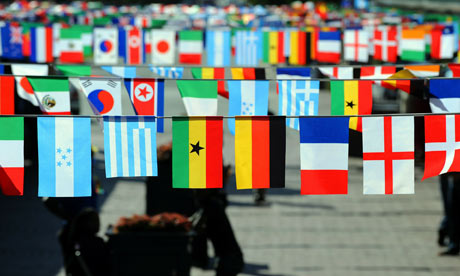
Flags of countries
Language skills boost career prospects. Photograph: Patrick Hertzog/AFP/Getty Images
 
English is the world language; the dominant lingua franca in commerce and media; the language which cruises at the apex of globalisation, technology and pop music, and is arguably at its most dominant position in its history.

But is this a blessing or a curse for the people who speak it as a native language, rather than a second language? And is there any point of learning another language?

Graduates in the UK are facing stiff competition in this seemingly never-ending economic slump. Carl Gilleard, former chief executive of the Association of Graduate Recruiters (AGR), says: "Businesses require talent to compete at a global level, and the fact that the UK is lagging behind its competitors in developing graduates who fit the bill is a real cause of concern."

According to Eurostat, 54% of Europeans can converse in at least one foreign language. In comparison, just 39% of Brits claimed the same. In fact, only a 1% lower score for Ireland saves us from being labelled the most monolingual country in Europe. Aside from the slight PR boost from Nick Clegg's Dutch and Boris Johnson's French, if language is the "dress of thought", then our wardrobes are bare.

Having contracted a serious case of wanderlust on my gap year, I moved to the French-Canadian metropolis of Montréal. For me, living there while studying Chinese and economics helped push my proficiency in French far beyond my flailing GCSE level. It also helped me unshackle myself from the sluggish UK graduate jobs market by opening up opportunities in alternative countries and growth markets.

The Confederation of British Industry's Education and Skills Survey 2012 concluded that almost three quarters of businesses value foreign language skills among employees, and nearly 70% are not satisfied with young peoples' linguistic skills. 

German tops the list of languages rated as most useful, followed by French, Spanish, Mandarin and Polish.

A separate survey of 1,000 UK graduates revealed that 14% lost out on a job in the digital sector because they did not speak another language.
...
Speaking one language gets you onto the racetrack, but two will knock down half the hurdles. Communicating in a foreign tongue can be the most exhilarating experience. And it will probably help you get a job too.

Loksan Harley works for Kreab Gavin Anderson, an international communications consultancy.

Warum lernt man Deutsch? Hier spricht eine Schülerin!

HIER IST FRAU LAUREN KRÜGER!

In zwei-ein-halb-Minuten, sprach sie einfach los heute morgen, als die Schüler ins Klassenzimmer reinkamen! Ist sie nicht ein SUPERSTAR?

Viel Glück, Lauren!


Und jetzt auch bei YOUTUBE?  Cool!


Sunday, April 13, 2014

Why U.S. Retailers Are Still Vulnerable to Card Fraud

Bloomberg Business Week Technology Data Security

A chip-based EMV smart card
Photograph by Kristoffer Tripplaar/Sipa via AP Photo
A chip-based EMV smart card

After last year’s massive security breaches at Target (TGT) and Neiman Marcus, data security pros urged U.S. retailers to upgrade their credit and debit card technology to reduce fraud. Companies have been slow to embrace the more secure payment systems that have been widely used in Europe and Asia for years, mostly because of the expense and a lack of synchronization among retailers, credit card providers, and banks.

Many companies are behind schedule in updating their systems to comply with a chip-based smart card standard known as EMV (for Europay-MasterCard (MA)-Visa (V), the companies that first backed the technology). Credit card networks have set an October 2015 deadline for most U.S. merchants to upgrade their payment systems.

EMV is considered more secure because it’s harder to copy account numbers and security codes from chips than from the magnetic strips on most cards used in the U.S.  EMV cards create a unique code for each transaction, making them more difficult to hack or counterfeit than striped cards.


Merchant Warehouse, which processes credit and debit card transactions for 80,000 U.S. merchants, projects that only about 60 percent of its clients’ locations will be ready to accept chip-based cards by the deadline. Richard Crone, chief executive officer of payments advisory firm Crone Consulting, says more than half of U.S. merchants will miss the cutoff.


One reason for the delay is the upgrade’s high cost—$500 to $1,000 per payment terminal, according to researcher Javelin Strategy & Research, a division of Greenwich Associates. Retailers are also concerned that the switch will slow checkout times and that it remains unclear how the EMV software will work with debit cards. “It is not a question of just turning it on,” says Margaret Chabris, a spokeswoman for 7-Eleven (3382:JP). “EMV specifications are still being finalized.”

....
For terminals to provide added security, customers must have chip-enabled cards. “Part of the reason we haven’t pushed faster is there’re just no cards out there for acceptance,” Cook says. Today, with about 1 billion cards in use in the U.S., just 20 million chip cards have been issued, according to Smart Card Alliance. Only 20 percent to 30 percent of U.S. card holders will have the new cards by the deadline, says Nick Holland, an analyst at Javelin.

The new cards can cost up to $2 each, compared with pennies for the magnetic-stripe models. “We’ve got 10 million cards in inventory out in the field,” says Mark Putman, a senior vice president for First Data (KKR), which offers prepaid card services. “At $2, we are probably looking at a $20 million investment, which I am going to defer for as long as possible.”

Retailers are willing to do their part to improve security, the National Retail Federation says, but banks and card companies also have a responsibility to update their systems. That includes making and issuing chip-enabled cards.

The price for not complying could be high. Credit card companies have said most retailers and banks will be liable for some fraudulent in-store transactions if they don’t have the new system. Even so, “merchants aren’t crazy about this migration to EMV, and many of them are fighting it tooth and nail,” says Julie Conroy, an analyst at Aite Group.

Tuesday, December 3, 2013

GERMAN APPRENTICESHIP PROGRAM in the USA

NOTE:  I miss the 1990's, when EWAG employed 3 students from NKHS as paid apprentices, in such fields as Management, Mechantronics, and Engineering.  Included were various paid semester courses at different colleges, universities and trade schools, depending on need, which ultimately led to a diploma, without tuition, in fact, while being paid an increasing salary as the semesters went on.  What a deal! 

  NYTIMES VIDEO:

http://nyti.ms/1c3SNln    

 Here's the related article:

GREER, S.C. — For Joerg Klisch, hiring the first 60 workers to build heavy engines at his company’s new factory in South Carolina was easy. Finding the next 60 was not so simple.

“It seemed like we had sucked up everybody who knew about diesel engines,” said Mr. Klisch, vice president for North American operations of Tognum America. “It wasn’t working as we had planned.” 

So Mr. Klisch did what he would have done back home in Germany: He set out to train them himself. Working with five local high schools and a career center in Aiken County, S.C. — and a curriculum nearly identical to the one at the company’s headquarters in Friedrichshafen — Tognum now has nine juniors and seniors enrolled in its apprenticeship program. 

Inspired by a partnership between schools and industry that is seen as a key to Germany’s advanced industrial capability and relatively low unemployment rate, projects like the one at Tognum are practically unheard-of in the United States. 

But experts in government and academia, along with those inside companies like BMW, which has its only American factory in South Carolina, say apprenticeships are a desperately needed option for younger workers who want decent-paying jobs, or increasingly, any job at all. And without more programs like the one at Tognum, they maintain, the nascent recovery in American manufacturing will run out of steam for lack of qualified workers. 

“South Carolina offers a fantastic model for what we can do nationally,” said Ben Olinsky, co-author of a forthcoming report by the Center for American Progress, a liberal Washington research organization, recommending a vast expansion in apprenticeships. 

Despite South Carolina’s progress and the public support for apprenticeships from President Obama, who cited the German model in his last State of the Union address, these positions are becoming harder to find in other states. Since 2008, the number of apprentices has fallen by nearly 40 percent, according to the Center for American Progress study. 

“As a nation, over the course of the last couple of decades, we have regrettably and mistakenly devalued apprenticeships and training,” said Thomas E. Perez, the secretary of labor. “We need to change that, and you will hear the president talk a lot about it in the weeks and months ahead.”
In November, the White House announced a new $100 million grant program aimed at advancing technical training in high schools. But veteran apprenticeship advocates say the Obama administration has been slow to act. 

“The results have not matched the rhetoric in terms of direct funding for apprenticeships so far,” said Robert Lerman, a professor of economics at American University in Washington. “I’m hoping for a new push.” 

In Germany, apprentices divide their time between classroom training in a public vocational school and practical training at a company or small firm. Some 330 types of apprenticeships are accredited by the government in Berlin, including such jobs as hairdresser, roofer and automobile electronics specialist. About 60 percent of German high school students go through some kind of apprenticeship program, which leads to a formal certificate in the chosen skill and often a permanent job at the company where the young person trained. 

If there is a downside to the German system, it is that it can be inflexible, because a person trained in a specific skill may find it difficult to switch vocations if demand shifts. 

In South Carolina, apprenticeships are mainly funded by employers, but the state introduced a four-year, annual tax credit of $1,000 per position in 2007 that proved to be a boon for small- to medium-size companies. The Center for American Progress report recommends a similar credit nationwide that would rise to $2,000 for apprentices under age 25. 

The emphasis on job training has also been a major calling card overseas for South Carolina officials, who lured BMW here two decades ago and more recently persuaded France’s Michelin and Germany’s Continental Tire to expand in the state. 

“The European influence is huge,” said Brad Neese, director of Apprenticeship Carolina, which links the state’s technical college system with private companies to help create specialized programs. “They are our strongest partners.” 

 European companies are major employers in the state, with more than 28,000 workers for German companies alone. The influx has helped stanch much of the bleeding caused by the decades-long erosion of jobs in the textile industry, once the economic bulwark of the Palmetto state. 

Of course, there are other reasons foreign companies have moved here. For starters, wages are lower than the national average. Even more important for many manufacturers, unions have made few inroads in South Carolina. 

Still, the close cooperation between employers and the state educational system is unusual, and despite initial skepticism on both sides, apprenticeship opportunities are rapidly expanding both for high-school age students and for older workers. 

Apprenticeship Carolina started in 2007 with 777 students at 90 companies. It now has 4,500 students at more than 600 companies in the state, with the typical apprentice in his or her late 20s. Mr. Neese’s goal is to have 2,000 companies by 2020. 

To help develop his program, Mr. Neese has traveled to Germany, Austria and Switzerland, where apprenticeships are thriving, youth unemployment is relatively low and blue-collar jobs are still prized. That contrasts with the United States, where the economic fortunes of younger people with just a high school diploma have plummeted, and the unemployment rate among workers age 16 to 19 stands at more than 20 percent. 

“This generation has taken a huge hit from the economic crisis,” said Alexander Gelber, an economist at the University of California at Berkeley and a former senior Treasury official. “Apprenticeships offer people the possibility of building skills when they often don’t have many other options.”
So why have they not caught on in the United States like in Germany, which has 1.8 million apprentices with less than one-third the population? 

Besides a longstanding stigma attached to vocational education, opposition from entrenched interests on both the left and the right has hobbled past efforts to promote apprenticeships, including under President Clinton in the 1990s. 

Joerg Klisch discovered this firsthand when he started seeking support for the program in 2011.
School officials were wary of allowing a private company to dictate the curriculum. Meanwhile, among employers, “there seems to be a perception that apprenticeship means unions,” Mr. Klisch said. “It doesn’t, but we have to overcome this hurdle.” 

Here in Greer, where more than 7,000 employees produce over 300,000 S.U.V.’s and other luxury cars a year in a sprawling, ultramodern BMW factory, Richard Morris, vice president for assembly and logistics, identifies one of the company’s biggest problems: a serious shortage of medium-skilled workers who specialize in mechatronics, or repairing robots and metal presses when they break down and operating the computers that dot the paint shop, body shop and assembly shop. Not only do these jobs pay better than typical assembly-line positions, they also open up avenues for advancement.  Werner Eikenbusch, manager of work force development for BMW in the Americas, is himself the product of an apprenticeship program in Germany who later went back to school and earned a master’s degree in engineering. He helped create the BMW Scholars program in 2011, he said, “to build the skills from the ground up.” 

The BMW Scholars are older than Tognum’s apprentices — mostly in their 20s and 30s — and they study full-time at local technical colleges for two years while also working in the BMW factory for 20 hours a week. 

“It is a struggle, but if you know how to manage the time, it is not hard,” said Benjamin Peoples, a 27-year-old BMW Scholar who dropped out of Clemson University a few years ago because he could no longer afford it. “I wanted to work with my hands and with machines, but I didn’t have experience with robots.” 

Mr. Eikenbusch has been pitching the program to European parts suppliers in the area, as well as to executives at Boeing, which began building sections of the new 787 Dreamliner in Charleston in 2011. He hopes they will follow BMW’s lead. 

“We need to find a way to establish two-year training programs on a broader scale,” he said. “Everybody who I hire is someone who is not available for our suppliers to hire.”

Tuesday, February 19, 2013

Spiegel: Promoting an Economic NATO

The World from Berlin: 'It's Worth Promoting ECONOMIC NATO' - SPIEGEL ONLINE »
By Daryl Lindsey

 Greener pastures from US-EU trade? A container ship enters the North Sea from the Elbe River in Germany.

The European Union and United States say they will soon begin negotiations to create the world's largest free-trade zone. German editorialists argue a deal is necessary if the West wants to help shape global politics and address the challenge of a rising China.

US President Barack Obama and German Chancellor Angela Merkel both believe this figure could be increased significantly, adding some much needed economic stimulus in America and Europe.
"An EU-US free-trade agreement would create a new drive for the economy, investments and jobs -- on both sides of the Atlantic," German Economics Minister Philipp Rösler told the German daily Handelsblatt.

In Brussels, European Commission President Jose Manuel Barroso has described the potential deal as "ground-breaking ... a game-changer" -- and it is one that wouldn't cost a cent.

Together, the US and EU want to boost their economies, jobs and present a united front against the growing economic strength of emerging superpower China.

There are many hurdles confronting this "economic NATO," particularly when it comes to food and agriculture -- with European concerns over chlorine-rinsed chicken, hormone-treated beef and genetically modified crops, and American concerns over strict European regulations. But Europe and the United States have agreed to enter into negotiations aimed at eliminating barriers on the flow of goods and services and creating the world's largest free-trade zone.

Talks are expected to begin on the margins of the next G-8 summit in Britain on June 18, German newspapers are reporting on Thursday. Initially, Washington had expressed a lack of interest over a possible deal, but Germany's Merkel has gently nudged two successive administrations since 2007 and it is believed that a personal telephone call prior to Obama's State of the Union address helped remove remaining concerns. Conservative British Prime Minister David Cameron has also pushed for a deal.

The trade agreement aims to go far beyond just trade and services, and negotiations will also strive for common regulations and standards on issues like product safety and intellectual property. A widely cited example are differing automobile safety standards that require a company like Audi to produce different versions of its cars for the American market.

On Thursday, editorialists at leading German newspapers praise the effort, with one financial daily even describing a "United States of the West."

  • Center-left Süddeutsche Zeitung writes:
"The project is extremely ambitious, with some Atlanticists already speaking of an 'economic NATO'. That term isn't totally out of place either. The NATO military alliance was once established to protect against the threat of the Soviet Union. The idea of a new economic alliance also has found so many supporters because the old industrialized nations fear that they are falling behind the emerging economic power of China. The fact that negotiations are even taking place is a success for German Chancellor Merkel, who has been pushing the project for years despite an initial lack of interest in Washington. Obama's economics team also held off for a long time because his advisors felt the initiative would be too complex."

"The fact is, an economic NATO would be a major venture. The EU and the US are already tightly interwoven economically. … Despite this, 1.5 percent annual economic growth could be created if the remaining barriers were removed. The only problem is that eliminating these barriers would trigger protests of myriad interest groups and also require considerable political capital. It could also test European solidarity. In London and Berlin, the political classes tend to be oriented towards the free market, whereas protectionism often lurks in Paris."

"Resistance is already forming. In the future will we (Europeans) be forced to eat chlorine-rinsed American chicken? Will we have to sow the seeds of genetically-modified corn on our fields and accept America's lax data privacy provisions? Or, from the American perspective: Will we have to tolerate the Europeans' obsession with regulations?"

"Regardless what the outcome of the talks is, the fact that they are even taking place is extremely advantageous for the Europeans. The EU is now getting a future-oriented project that will allow it to look away from its own problems as well. A free-trade agreement would further open the Continent and could also foster trust between the Americans and Europeans and set standards for the rest of the world. It's worth using all of our energy to promote an economic NATO."

  • Center-right Frankfurter Allgemeine Zeitung writes:
"Finally, one wants to call out, the US and EU are willing to turn an idea that has been bandied about in the political realm for some time now into a real project -- and negotiations are expected to begin soon for a 'Transatlantic Trade and Investment Partnership'. So President Obama isn't just answering the call of Asia -- he's also making the expansion of American-European economic ties a pet issue. Expectations for the mutual advantages of a free-trade agreement -- economically, politically and strategically -- are so great that one must ask why this wasn't already tackled sooner? But the rise of emerging economies and the challenges that presents wasn't a dominant issue until recently. Today, however, a response is needed, and every potential driving force for prosperity and the strengthening of the Atlantic community needs to be used."

  • Conservative Die Welt writes:
"It appears that the differences on both sides of the Atlantic are now seen as surmountable. And that's very good news, because a free-trade agreement between the two economic zones would be the cheapest stimulus package one could conceive of. The European Commission expects that the reduction of trade barriers and the harmonization of standards and regulations would lead to annual GDP growth of 0.5 percent. Other estimates are even higher."
"But a common market would also send a powerful political message: Namely that the West wants to pull more tightly together to face the challenges coming from emerging powers in other parts of the world. Given America's current weakness in leadership, it is also necessary. Otherwise, Obama's speech had a clearly isolationist character. …. Only when the country's economic foundations are healthy again can (America) assume a global leadership role (Obama suggested)."

"This means that the trans-Atlantic free-trade zone at the same time has both economic and political significance. It is aimed at helping Europe and the United States recover economically. But it also makes clear that only an en ever-closer West can succeed in decisively helping to determine global policy. Given these considerations of overriding importance, the free-trade zone cannot be allowed to fail over niggling details."