Daylight savings: 8 German words that will change the way you see time
People all over the world win back an hour of their lives thanks to the
practice of daylight savings. From weddings to pickles, here are some
interesting German words that are - surprisingly - dedicated
to time.
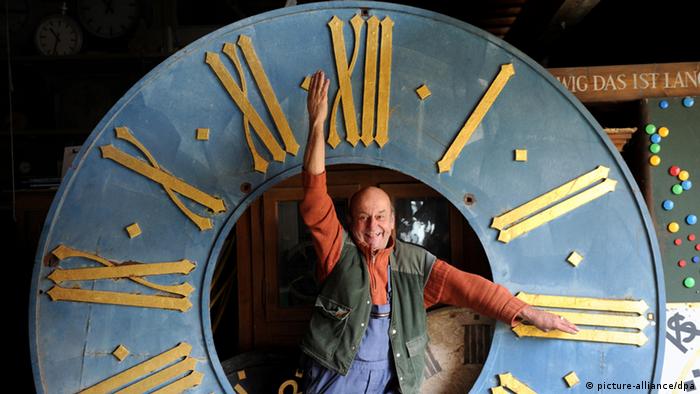
Zeitumstellung
This is what is happening either on October 24/25 or October
31/November 1, depending where in the world you live: Zeitumstellung, or
time change. Even if it feels luxurious to sleep for one more hour,
we're just getting back what was due as we sacrificed an hour in March.
Zeitumstellung at least gives a feeling of power - even if we are all
bound by time, we at least act like we can change it.
Many other German expressions integrate "Zeit," the word for time.
Zeitzschrift
A "Zeitschrift" - literally, time writing, is simply a magazine. Whether
it includes political discourse or scantily clad women (now with
nipples covered), theoretically a magazine should keep up with the
times.
Zeitgeist
While Zeitgeist can also be used in English, its direct translation -
time spirit - conjures up images of Charles Dickens' Ghosts of
Christmas Past and Present. Referring to the philosophical idea that
each era is characterized by particular ways of thinking, the concept of
Zeitgeist dates back to 18th-century philosophers and is often
associated with Johann Gottfried Herder.
Mahlzeit
Like time itself, food is elementary to the human existence. A
"Mahlzeit" simply means "meal time," and can refer to breakfast, lunch
or dinner. But it's also used to wish someone else the maximum amount of
pleasure while eating. Next time you see a friend chomping down on a
sandwich, you can say, "Mahlzeit!"
Hochzeit
It's often referred to as the happiest day of your life. In German,
it's also a "high time" - a "Hochzeit." Who isn't high on adrenaline and
emotion on that day of all days, on which your credit card debt reaches
an all-time high? And for some impatient mother-in-laws, it certainly
may be "high time" for that son to finally get hitched.
Sauregurkenzeit
It's "pickle time!" I'll have a BLT and some chips with that pickle,
please... Actually the term "Sauregurkenzeit" originally, in the 18th
century, referred to periods when little food was available. Now, it's
used during the summer when everyone's on vacation, politics comes to a
standstill, the streets are empty, and things get quiet. Pickle anyone?
Zeitgenosse
While "Genosse" means "comrade" and has a communist after-taste, a
"Zeitgenosse" is anyone who lives at the same time you do: a
contemporary. Just think: You are a "Zeitgenosse" of Barack Obama, Heidi
Klum and Cristiano Ronaldo. You're co-worker may not cheer, though, if
you tell him he's your "time comrade."
Zeitgefühl
German often has a single word for a concept English needs a phrase
to express. "Zeitgefühl" is your sense of time - something that suffers
when you're concentrating on an important project, staring into the eyes
of your sweetheart, or changing the clocks back for daylight savings.
Your Zeitgefühl may say it's 8:00 am, but it's really only 7:00. So go
back to sleep already!
While doing research for an article recently, I came across
so many things that I had no idea were German, or that I never knew had
their roots in German traditions. It isn’t hard to imagine that America
and Germany shares a lot of similar customs and inventions. After all,
roughly 17% of Americans are of German descent. The side effect of my
research diversion is this list!
Although the origins about this delicious, plate swamping treat vary
(I mean, we can’t even agree about who or where it was first served in
the Lone Star State) most sources say that it is attributed to German
and Austrian immigrants in Texas, who brought over the recipe for Wiener
Schnitzel. Of course, Americans took it up a notch and really fried the
heck out of that sucker and smothered it in gravy. It is believed that
it started being referred to as Chicken Fried Steak, and not Wiener
Schnitzel, during the war with Germany.
14
Ring Binder
The famous ring binder that we all come into contact with at least
once a week (or daily if in school) is a German invention – and a
relatively recent one, at that. Friedrich Soennecken invented it in
Bonn, Germany, in 1886. The same year he also patented the hole punch
(he must have seen Thomas Edison snooping around). The great innovation
of adding a hole to the cover was also introduced by a German: Louis
Leitz. Interestingly, there is an ISO standard for the distance between
the two rings on a double-ring binder, but no official standard for
three ring binders.
13
Nutcracker
(Story and Figuring)
The carving of nutcrackers began as a small, cottage industry in the
wooded regions of rural Germany. They were, and are, known for their
intricate detail and decoration.
Also, before the word nutcracker became synonymous with the Russian
ballet by Tchaikovsky (and also synonymous with the ever hilarious short
videos on America’s Funniest Videos), the Nutcracker was the hero of an
early 19th century story by Berlin’s E.T.A. Hoffman. The story was
later adapted for the famous ballet.
12
Gingerbread Houses
The Gingerbread house was first noted in the Grimm’s Fairy tale,
Hansel and Gretel, and followed in a little known German opera by the
same title. After the show was first produced only days before
Christmas, it became a holiday tradition in German Opera houses to build
miniature replicas of the gingerbread house from the story. The
tradition then spread to bakeries and, eventually, to homes.
11
Advent Calendars
The origins of this Christmas tradition come from the German
Lutherans, as early as the beginning of the 19th century. The calendar
started off simple, a written way to count down the days until
Christmas. Eventually, lighting 24 candles became popular. And, very
early in the 20th century, Gerhard Lang was credited with printing the
first Advent calendar. Several years later, he decided to add little
doors that would open to reveal the date or a scripture. It wasn’t until
after WWII that the calendars began to be filled with candies and
treats for the days before Christmas.
10
Christmas Tree
The tradition of decorating the Tannenbaum (hello, German word) dates
back to the 16th century. Although it is documented that trees were
erected in present day Estonia and Latvia in the 15th century, it was
the Germans who really started the whole decorating tradition. They
spruced up the tree with wax candles, fruits and trinkets and the
tradition remained confined to the upper Rheinland region of Germany for
some time. The idea eventually began to spread throughout the Christian
world, when royal families from neighboring countries got wind of it.
Hallmark, you can thank Germany for the bazillions of ornaments you sell
every year.
9
Easter Bunny
The Easter Bunny, at least as we know it today, first appeared in
16th century writings in Germany. In the 1700s, Pennsylvania Dutch
settlers brought the tradition of the Easter Bunny with them to the new
world. Their children believed that if they were good, the Easter bunny
would come and lay eggs and treats into nests the children made out of
upturned hats and bonnets.
8
Easter Eggs Hunts
While evidence on this isn’t as firm as some of the others, it is
believed that the tradition of hiding Easter eggs was first started in
Southern Germany. While the legend of the Easter bunny laying eggs in
the grass had been around for sometime, the Germans decided to go all
out and actually have children hunt for the eggs in hard to reach and
see places. Leave it to the Germans to step it up a notch or two!
7
Gummi Bears
I (and probably most American readers) always thought of Gummi Bears
as an American product. The sweet treats were invented in the 1920′s by Hans Riegel Sr (of Bonn) when he started the Ha-ri-bo company. Not only do they
produce Gummi Bears, and all other chewy candy under the Haribo name,
but the company also makes all Trolli brands of gummy candy, like the
popular gummi worms.
6
Prefabricated Houses
Ha, take that one, you “American white trash” stereotypers! The pre
fab home – oh come on, let’s just call them like they are – the trailer
home was invented by Warner Sell of Berlin. After WWII, there was a need
for places to house the U.S. forces occupying the area. Sell’s company
manufactured over 5000 prefabricated houses, and the soldier boys lived
it up in high style!
5
Here Comes the Bride
First known as the “Treulich geführt”, the song that is forever
linked to women in white gowns, was composed in 1850 by Richard Wagner
for his opera, Lohengrin. Although the song is now traditionally played
as the bride makes her way down the aisle, it was sung (yes, it even has
original words to go along) in the Opera after the ceremony by the
members of the bridal party. The video clip above is a good version of
this song from the opera. Oh – and by the way, the OTHER wedding song
(the recessional) is also by a German: Felix Mendelssohn – it is called
the Wedding March and it is from A Midsummer Night’s Dream
4
Everything Disney Does
From cashing in on Grimm’s Fairy Tales, Cinderella, Rapunzel,
Sleeping Beauty, Snow White to name a few, to building a close replica
of the Neuschwanstein Castle in Bavaria, Disney movies and theme parks
have relied heavily on German influence. Entertainment would be pretty
dull if it wasn’t for Disney stealing from the Germans and Hollywood
stealing from the Japanese (think J-Horror)!
3
American Picnic Items
Just about all the ingredients to make a perfect ‘All-American’
picnic come from German origins. There is the hot dog, or a Frankfurter:
a pork sausage that finds its origins in 13th century Germany. Then,
you can’t forget the condiments. Ketchup, which was developed by Heinz,
and Mayonnaise, developed by Hellman, both German immigrants. Of course
some of those items are based off earlier recipes (Ancient Rome:
ketchup; France: mayonnaise) but the favorites eaten today are
definitely German. Then, of course, there is the Potato Salad. Although
there are many different versions to this dish, one of the most popular
variations is the tradition German potato salad.
2
Light Bulb
Poor Heinrich Göbel. He is credited with developing the incandescent
light bulb over 25 years before Thomas Edison had his bright idea. There
was just one little thing Göbel forgot to do….apply for a patent.
(Although, I will have to admit, that he was born and grew up in Germany
but was in the US by the time he developed his idea). At least Tesla
wasn’t the only one cheated by Edison.
1(Time to get personal...rsb)
The Hair Perm
German hairdresser Charles Nessler invented a very early version of
the perm. He used a mixture of cow urine and water to achieve those
bouncy, poodle like waves. Smells good ladies. Before coming up with
just the right mix of harsh and damaging chemicals, he ran test trials
on his wife. Two of which burnt off most of her hair and resulted in
scalp burns. I think that might be grounds for divorce. Thanks for
giving me a dog’s hairstyle in the 4th grade, Germany!
So, out of these 15, who has a favorite? Other items to add? (MP3 Player, for instance...)
Till -- Du hast schon wieder etwas ganz interessant für uns gefunden. Danke. --rsb