by Chantal Panozzo on February 1, 2016
"Are you interested in permanent jobs instead?" she asked.
"I could consider a permanent job if it was part-time," I said.
She looked at me like I was speaking a foreign language and went right back to her pitch: long commute, full-time, no benefits. No way, I thought. Who would want to do that? And then it hit me: Either I had become a completely privileged jerk or my own country was not as amazing as I had once thought it to be. This wasn't an unusually bad offer: It was just American Reality.
Now that I'm back, I'm angry that my own country isn't providing more for its people.
Before I moved to Switzerland for almost a decade, American Reality was all I knew. I was living in a two-bedroom apartment making $30,000 a year in a job where I worked almost seven days a week with no overtime pay and received 10 days of paid time off a year.
In other words, for the hours worked, I was making minimum wage, if that. The glamour of this job was supposed to make up for the hours, but in reality, working every weekend is a ticket to burnout — not success.
My husband and I were so accustomed to American Reality that when he was offered an opportunity to work in Switzerland, we both thought about travel and adventure — not about improving our quality of life. It hadn't occurred to us that we could improve our quality of life simply by moving.
But without realizing it, or even asking for it, a better life quality came to us. And this is why, now that I'm back, I'm angry that my own country isn't providing more for its people. I will never regret living abroad. It taught me to understand another culture. And it taught me to see my own. But it also taught me something else — to lose touch with the American version of reality.
Here are seven ways living abroad made it hard to return to American life.
1) I had work-life balance
The Swiss work hard, but they have a strong work-life balance. According to data from the Organisation for Economic Co-operation and Development, the average Swiss worker earned the equivalent of $91,574 a year in 2013, while the average American worker earned only $55,708. But the real story is that the average American had to work 219 hours more per year for this lesser salary.Which brings us to lunch. In Switzerland, you don't arrive to a meeting late, but you also don't leave for your lunch break a second past noon. If it's summer, jumping into the lake to swim with the swans is an acceptable way to spend your lunch hour. If you eat a sandwich at your desk, people will scold you. I learned this the hard way.
"Ugh," said Tom, a Swiss art director I shared an office with at a Zurich ad agency. "It smells like someone ate their lunch in here." He threw open the windows and fanned the air.
"They did. I ate a sandwich here," I said.
Tom looked at me like I was crazy.
"No. Tomorrow you're having a proper lunch. With me," he said.
The next day, exactly at noon, we rode the funicular to a restaurant where we dined al fresco above Zurich. After lunch, we strolled down the hill. I felt guilty for being gone for an hour and a half. But no one had missed us at the office.
Lunchtime is sacred time in Switzerland. When I was on maternity leave, my husband came home for lunch to help me care for our daughter. This strengthened our marriage. Many families still reunite during weekdays over the lunch hour.
Weekends in Switzerland encourage leisure time, too. On Sundays, you can't even shop — most stores are closed. You are semi-required to hike in the Alps with your family. It's just what you do.

The author and her daughter in Urnaesch, Switzerland, watching the cows come home. (Brian Opyd)
2) I had time and money
The Swiss have a culture of professional part-time work, and as a result, part-time jobs include every benefit of a full-time job, including vacation time and payment into two Swiss pension systems. Salaries for part-time work are set as a percentage of a professional full-time salary because unlike in the United States, part-time jobs are not viewed as necessarily unskilled jobs with their attendant lower pay.
During my Swiss career, I was employed by various companies from 25 percent to 100 percent. When I worked 60 percent, for example, I worked three days a week. A job that is 50 percent could mean the employee works five mornings a week or, as I once did, two and a half days a week. The freedom to choose the amount of work that was right for me at varying points of my life was wonderful and kept me engaged and happy.
When I took only 10 days for a trip to Spain, my colleagues chastised me for taking so little time offOften, jobs in Switzerland are advertised with the percentage of work that is expected. Other times, you can negotiate what percentage you would like to work or request to go from working five days a week to four days a week, for example. There is normally little risk involved in asking.
One married couple I knew each worked 80 percent, which meant they each spent one day a week at home with their child, limiting the child's time in day care to three days a week while continuing full professional lives for both of them. According to a recent article in the New York Times, "Why U.S. Women Are Leaving Jobs Behind," 81 percent of women in Switzerland are in the workforce, versus 69 percent in the US. I believe attitudes toward professional part-time work — for both men and women — have a lot to do with this.
3) I had the support of an amazing unemployment system
About three years into my Swiss life, I lost my job. And I discovered that in Switzerland, being on unemployment meant you received 70 to 80 percent of your prior salary for 18 months. The Swiss government also paid for me to take German classes, and when I wasn't looking for jobs, I could afford to write a book.
In the United States, on the other hand, unemployment benefits generally pay workers between 40 and 50 percent of their previous salary, and these benefits only last for six months on average. However, thanks to the American Recovery and Reinvestment Act in 2009, some unemployed people now receive up to 99 weeks of benefits.
4) I witnessed what happens when countries impose wealth-based taxes
Compared with taxes in the United States, Swiss taxes are easy on the average worker. For example, a worker earning the average wage of $91,574 would pay only about 5 percent of that in Swiss federal income tax. Instead of taxing salaries at high percentages — a practice that puts most of the tax burden on the middle class, where most income comes from wages and not from capital gains — Switzerland immediately taxes dividends at a maximum of 35 percent and also has a wealth-based tax.
While the American tax system is supposed to be progressive — so the more you earn, the more taxes you pay — up to 39.6 percent tax for the highest income brackets, the superrich escape paying these kind of taxes because they aren't making most of their money in wages.
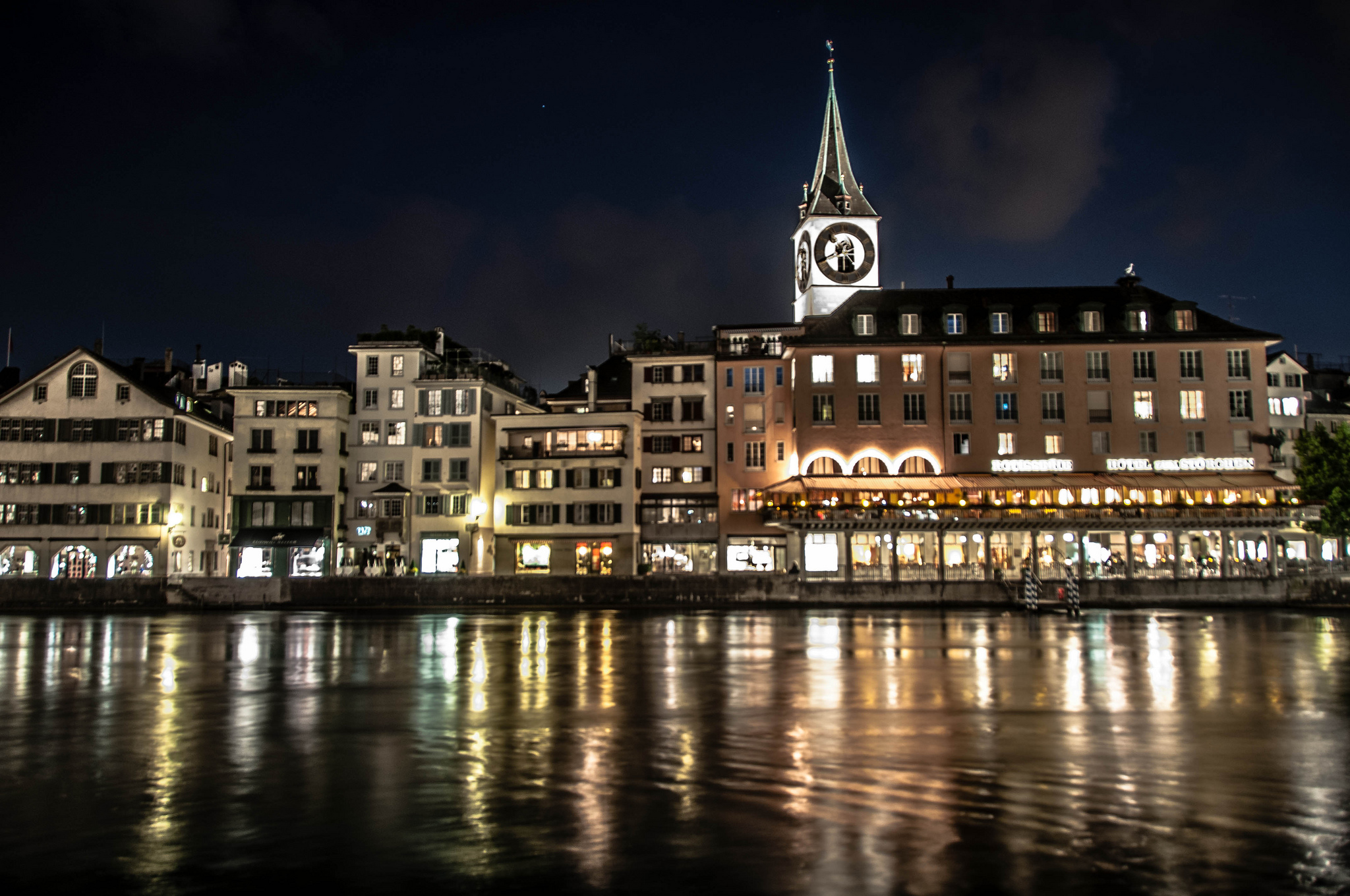
Zurich at night. Beautiful! (Kamil Porembiński)
For example, in 2010, Mitt Romney, whose total income was $21.6 million, paid only $3 million in taxes, or a tax rate of about 14 percent, which is amazing when you consider this is the same tax rate American families earning wages from about $16,750 to $68,000 paid in 2010.
The Swiss taxation method leaves money in the pocket of the average worker — and allows them to save accordingly. The average adult in Switzerland has a net worth worth of $513,000 according to the 2013 Credit Suisse Wealth Report. Average net worth among adults in the US is half that.
While I witnessed the benefits of the Swiss tax system for the average person, I did not benefit from them due to my American citizenship. Instead, I paid both Swiss tax and American tax while living in Switzerland. Unfortunately, the US is one of the only nations in the world where tax is citizen-based instead of resident-based. (China, in a new push to enforce tax law for citizens working abroad, is one of the others, along with Eritrea.)
5) I had lots of paid vacation time; was never made to feel guilty about taking it
At my former American job, I received 10 days of paid vacation per year, and each of those days came with a sizable portion of guilt if actually used. But in Switzerland, my husband's company gave employees six weeks of vacation a year. Most of the Swiss companies I worked for gave four — the legal minimum is four. Moreover, everything shut down between Christmas and New Year's, giving most employees like me another guaranteed week off.
People in Europe took vacation seriously. Once, when I only took 10 days for a trip to Spain, my colleagues chastised me for taking so little time off. I learned to take vacation chunks in two-week intervals. Well rested, I noticed that I felt more productive and creative when I returned to work. Recent American research confirms what I was feeling: Relaxing can make you more productive. So why don't Americans embrace vacation time?
6) I never had to own a car
I'm currently cringing at the idea of being required to buy a car. A Honda dealer here in Chicago recently quoted me $18,000 for a 2012 Accord, and that seems like a lot of money — especially when you still need to pay for insurance, gasoline, and repairs. The price is even more daunting for someone who isn't used to being required to pay for such a thing.
The freedom to choose the amount of work that was right for me kept me engaged and happyNot owning a car is financially freeing — and it saves the environment, too. In Switzerland, 21 percent of households do not own a car, versus 9.2 percent in the US.
The Swiss train connects to the bus that connects to the cable car to get you on the slopes in the middle of nowhere at the scheduled second. From Zurich, I could also take a high-speed train to Paris in three and a half hours. Now I can barely get from the western suburbs to the north side of Chicago in that amount of time — let alone have the option to do it carless. This means I'm turning down jobs instead of taking them. This isn't good for the American economy or for me.
And let's be clear: Living in a city suburb is no excuse for having bad transit options. I lived exactly the same distance from Zurich that I now live from Chicago (15 miles) but shared none of the public transport frustrations.
7) I had excellent health care when I gave birth — and then enjoyed a fully paid 14-week maternity leave
When I gave birth in Switzerland, I was encouraged to stay five days in the hospital. So I did. The $3,000 bill for the birth and hospital stay was paid in full by my Swiss insurance. As was the required midwife, who came to my apartment for five days after I came home from the hospital to check on both my health and my baby's.
Had I been in the US for my delivery, the cost would have been much higher — and the quality of care arguably lower. The average price for a vaginal birth in the US is $30,000 and includes an average of less than a two-day hospital stay.
Swiss law also mandates a 14-week maternity leave at a minimum of 80 percent pay. I was lucky enough to receive 100 percent pay.
Compare that with the US, where new mothers aren't guaranteed any paid time off after giving birth. In Switzerland, it's also common to choose how much work to return to after having a child. Since my Swiss job at the time had been full time, I chose to return at 60 percent.
Other American friends in Switzerland who gave birth also chose to return to their careers part time: My engineering manager friend chose 70 percent, and my lawyer friend chose 80 percent. We had great careers, we had balance, and we also had a Swiss government that paid a monthly child stipend whether we needed it or not. For Americans like me, Swiss Reality was privilege.
Finally, finally, after almost a decade abroad, my husband and I decided we needed to go home to see what home felt like -- or to see if the US even felt like home anymore. So we put our Swiss residence permits on hold for two years and went back to Chicago.
While I enjoy being close to family again, returning to the US made me realize who I've become:
- Someone who can't believe companies aren't required to pay into a pension fund beyond Social Security.
- Someone who is offended that most women in America don't have the maternity benefits she had.
- someone who is mad that she must own a car for lack of efficient public transportation.
- Someone who, because of all of this, is still debating where she ultimately wants to call home.
Chantal Panozzo is the author of Swiss Life: 30 Things I Wish I'd Known.


