1. Make Use of Your German Dictionary
You’re always going to have more questions than answers, and a dictionary helps you make progress in this area and allows more spontaneity in your learning.If you don't have your own, here are a few suggestions:
Langenscheidt language learning aids are high quality across the board.
If you want a challenge, the German standard dictionary “Duden” is for you. It’s universally respected and offers the definitive guide to past and current conventions relating to Rechtschreibung (orthography).
The Internet has many free websites which can help you on the road to fluency, including dict.cc (general accuracy, specificity and breadth of synonyms).
Google Translate can also be a useful tool, but refrain from relying on it too heavily. Google is frequently fallible and grammatically suspect, so you’ll need to check for errors along the way.
2. Use your German Textbook
You'll get a better idea of what remains to learn and what gaps still exist in your understanding of grammar and basic conversation.3. Listen to German Music
Whether you love rock, reggae, rap, folk or fusion, there are German language artists waiting to fill up your music library and steal your heart.Google around for artists in your preferred genre, get on YouTube and Spotify, see what you like and go from there.
Google radio stations in German cities for your preferred music genres and use their online streaming services.
Get artist recommendations from German music magazines like Spex. Many of them have music available on US iTunes and Amazon, or you can get adventurous and go through the process of downloading music internationally from MediaMarkt.de. [Remember – support the artists!]
3. Learn German Music Videos [on FluentU]
If you want to simplify the research and look-up process so that you can focus on learning, try out FluentU with its interactive captions – click on any word to see a definition, image, and examples. You can even see the word used in other videos. [I believe you need to subscribe for the amazing caption service. --rsb]FluentU takes real-world videos like music videos, movie trailers, news, and inspiring talks, and turns them into German learning lessons. [Maybe you've noticed that I've recently posted quite a few of the items I've found on Deutsch-heute. --rsb]
One of FluentU’s features is
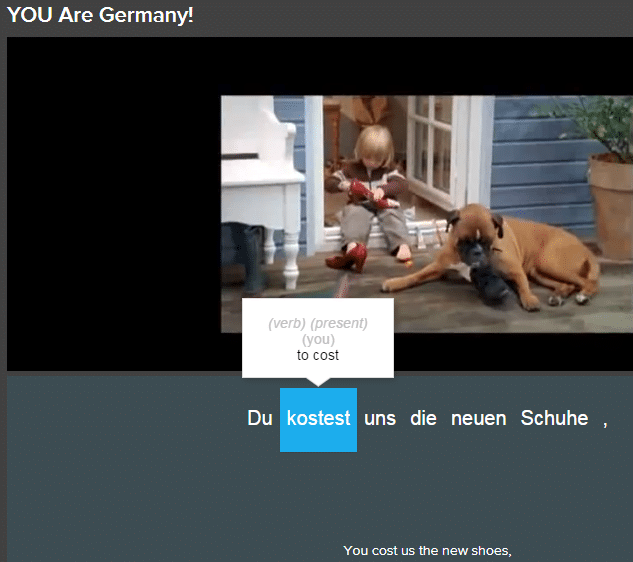
This demonstrates FluentU’s interactive captions in action.
5. Read German Children’s Books
You may like a reminder that I run a German library service. You can check all of the books you see on the shelves out from our classroom! --rsb They are charming and fun – plus you’ll gain cultural insights by learning the stories which Germans experience as kids. Some, like the Grimms Märchen (Grimm’s fairy tales) you may be familiar with in their English versions.Others are German translations of English stories, like the classic “Die kleine Raupe Nimmersatt“ (“The Very Hungry Caterpillar”).
6. Read German Translations of English books
Get your hand on one of the “Harry Potter” books for instance. I'm afraid many of my own favorite titles have walked away in recent years . . .[My version of the first Potter film can only be played on a universal DVD player.] --rsb
7. Get a German Sprachpartner (language partner)
Use your GAPP exchanger! --rsbOtherwise, you could track down a native speaker who’ll meet you for regular conversation sessions, surprising you with sentences you would’ve never extrapolated out of lifeless textbook pages.
Alternatively you could ask a leading German learning Twitter feed for a retweet to help you find potential partners. The language center of the Humboldt-Universität zu Berlin even has an online tandem databank. There are options out there no matter your availability.
8. Find a Stammtisch (regular meeting of German speakers)
URI holds a Kaffeeklatsch every week. --rsb Bored with talking to just one German speaker? Now it’s time for you to find an entire group of them!Go meet them and learn their stories – many of these people have lived fascinating lives and will be happy to tell you all about it.
9. Follow German Twitter Feeds
Use spare minutes to get the latest updates on all things German. (Remember, you can also change your tritter language configuration to German!) For humor, try@NeinQuarterly
@mainwasser
@Aus_der_UBahn
@GrumpyMerkel
Learn through newsfeeds:
@SPIEGEL_alles
@dw_deutsch
@LearnXDGerman
Learn through phrases and single words:
@thegermanfor
10. Listen to German Podcasts
Search iTunes for Deutsche Welle and Goethe-Institut podcasts.One I enjoy is Slow German
It’s a fabulous way to accelerate learning for beginners and intermediates. The episodes are hosted by Annik, a journalist who lives in the city of Munich in southern Germany. For the absolute beginner, there are podcasts conducted in English which provide a gentle introduction to key German words.
There’s nothing like a good detective story! In Radio D
Paula and Philipp are “Radio D” reporters traveling across Germany to investigate several mysterious cases.
You'll find excitement and fun combined when you tune into German Pod 101
With attention-grabbing podcast titles such as “How Far Will Klingon Get You in Germany?” and “Have You Ever Seen a Blind Fish in Germany?” the German language learner is guaranteed to be hooked from the start. There are lessons designed for every level of ability, from the absolute beginner to the advanced speaker.
If you have 30 minutes to spare, take a coffee break with Thomas and Mark in Coffee Break German
Mark has a knack for asking the questions to which all students really want to know the answers. Explanations by Thomas are highly satisfying!
Prepare your conversational phrases and get ready to travel with host Stefen of Learn German for Free
which is a series for the beginner, with cataloged episodes covering basic greetings, numbers, ordering in restaurants, travelling on public transport, and so much more!
Programs like Deutsche Welle’s youth culture show “Pulse” and Goethe-Institut’s “Popcast” will also expand your German music repertoire.
Language learning isn't something anyone else can do for you. As in mastering anything, your own time investment will pay off, if you just let it! Please share her what works for you! --rsb